Thursday, 19 April 2012

Ad Multos Annos, Sancte Pater

People talk about remembering where they were when Kennedy was shot, or when the World Trade Center came down in September 2001.  I remember exactly where I was on 19 April 2005 when Cardinal Ratzinger became Pope Benedict XVI. 

My family and I were living in Hong Kong at the time, and I had fallen asleep in front of the television, watching CNN's wall-to-wall coverage of what was happening in Rome.  At around 2am Hong Kong time, I was woken up by the loud cheering that greeted Cardinal Estevez as he emerged to make his great announcement :
Anuntio vobis gaudium magnum;  habemus Papam: Ementissimum ac Reverendissimum Dominum, Dominum Iosephum Sanctae Romanae Ecclesiae Cardinalem Ratzinger qui sibi nomen imposuit Benedictum XVI.
Cardinal Ratzinger had been much talked about as a likely candidate, but I had first become properly aware of him just over a decade before, when I was still an undergraduate.  One of the Anglican clergy at Pusey House at the time, now a Catholic, was keen on extolling his virtues, and this made a lasting impression on me.


Dear Brothers and Sisters: After the great Pope John Paul II, the Lord Cardinals have elected me, a simple and humble worker in the vineyard of the Lord. I am consoled by the fact that the Lord knows how to act, even... with inadequate instruments and above all I entrust myself to your prayers. In the joy of the Risen Lord, trusting in His permanent help, as we go forward the Lord will help us, and His Mother, Mary Most Holy, is on our side. Thank you. 
Did any of us know in 2005 just what a massive difference Pope Benedict XVI would make to us personally?  Of course not.  The Holy Father's vision for Unity has brought the members of the Marylebone Ordinariate Group, and well over a thousand others in England alone, into the full communion of the Catholic Church.  Thank you, Pope Benedict, for making this possible. 

The Provost of the London Oratory put it like this :
Another of the Holy Father’s outstanding achievements is his inspiring work for Christian Unity in setting-up the Ordinariates for former Anglicans. What a brilliant way of cutting through the plethora of mealy-mouthed verbiage and foggy thinking that has characterized so much ecumenical activity in recent decades, verbiage and fogginess which may indeed have had the very best of intentions, but which nevertheless achieved so little in real terms.

Let us also pray with all our heart and mind and strength that our vitally important ecumenical journey with our Greek and Russian Orthodox brethren will continue apace, that our charitable and respectful dialogue with them will bear much fruit, so that the universal Church might once again breathe with two whole lungs, and so that soon there may be but one flock and one shepherd. Domine, ut sit!
To add to the achievement of greater Unity brought about by Anglicanorum Coetibus, it looks like there could be a great reconciliation with the SSPX.   We have mentioned before on this blog that there are parallels, even if far from exact, between the situations of these two groups that are being / have been / will be brought (back) into full visible communion.  Those still outside full visible communion might be interested in reading this letter. 

In this great week when we have celebrated Pope Benedict's 85th birthday, and now the 7th anniversary of his election as our Pope, we give thanks for his mission among us, for the inspiration he provides and for his faith and devotion.  Most of all, we give thanks for his achievements in working for unity. 

In the words of an earlier Prince of the Church, who showed great support for Anglicans joining the Church, "God Bless Our Pope".  Ad multos annos, Sancte Pater. 

Wednesday, 18 April 2012

Beyond the End of Our Noses

A few days ago, someone left a comment on our blogpost The Extraordinary Form in Hong Kong, asking what the contents of that post had to do with the Personal Ordinariate of Our Lady of Walsingham.  A response was provided, stating that, as explained in the opening paragraphs of the post, the Ordinariate was part of the Catholic Church, and that it was a good thing that Ordinariate members were interested in what was going on in the Catholic Church.  It would be ridiculous for us not to be.


The person who left the comment didn't leave any clues as to their identity, so we cannot know if it was someone quite genuinely asking a question without any preconceptions or prejudice, or if the comment was an uncharitable attempt at a snide remark. Given that doubt, it should be made clear that the rest of this post refers to a general phenomenon, and is in no way an assault on (nor a guess at) the views of Anonymous of a few days ago.

I must confess to having been rather irritated by the question raised in the comment: I know, I should know better than that.  What irritated me is that it reminded me of a habit amongst some of delighting in fantasising that the Ordinariate is somehow pointless.  Those prey to this phenomenon criticise the Ordinariate as not being Anglican enough ("What's the point of it?") and yet simultaneously and no less ill-informedly criticise the Ordinariate as not being Catholic enough ("Why don't they just become 'proper' Catholics?").   Anonymous of a few days ago brought all this to mind because his or her remark seemed to imply that Ordinariate members should only be interested in the Ordinariate.

When they leave polemic aside and reflect calmly, I wonder what these people believe that those like me thought we would be signing up to when we joined the Ordinariate.  I wonder what they think our motives were.  They cannot seriously imagine that we wanted to create a little ghetto for disgruntled ex-Anglicans to hang about in, a ghetto in which we could ignore the rest of the Church.  They must surely know that we were answering a call to Unity in the Catholic Faith, in the Catholic Church, in communion with the Successor of St Peter.  No longer do we sojourn in a halfway house.  They cannot be under the misapprehension that we were called upon to renounce anything of our Anglican past, they must know that indeed the contrary was asked of us, that we should bring our Anglican Patrimony with us so that this might become part of the wider treasures of the Catholic Church. 

Ordinariate members are fully part of the Catholic Church, and we are full of joy to be so.  We are not Ordinariate members first and somehow members of the Catholic Church second.  We are delighted to have come into the full communion of the Catholic Church: joining the Ordinariate was a wonderful means of achieving this, it was not itself the goal. 

We do indeed look beyond the end of our noses, and realise with great happiness that we are part of the Church, part of an "organisation" that is present around the world and has over a billion members.  We are not interested in obsessing only about our little constituent part of the Catholic Church. 

Ordinariate members do not (and should not) spend their time focusing solely on their own immediate environment, ignoring the wider Catholic Church around them. The shortest of trawls of Ordinariate-related blogs makes this perfectly clear. Fr Ed Tomlinson talks regularly of the joy of unity that the group of Anglicans he led out of St Barnabas Tunbridge Wells and into the Catholic Church now shares with their now fellow Catholics in Pembury, and of what has been achieved for his group by both Monsignor Newton and by the Archbishop of Southwark and his Area Bishop John Hine. Fr Edwin Barnes frequently highlights joint events with diocesan parishes, indeed one of his recent posts talked of how he had attended two Chrism Masses this year, the Ordinariate Chrism Mass and also the Portsmouth Diocesan Chrism Mass.

As Anglo-Catholics, we for many years managed to cling on to the belief that the Church of England was part of the one Universal Church, separated from the wider Church only by misfortune and accident of history.  This was the vision that was shared for generations, but it was also a vision and ecclesiology that crumbled around us, a phenomenon that caused Dr Eric Mascall and many others great anguish.  Now that we are undoubtedly fully part of the Catholic Church, why would anyone think that we would not rejoice in being in that wider communion, why would anyone think that we would not be interested in the Catholic Church as a whole?

Two follow-on comments :
  • Criticisms of this nature are often accompanied by melodramatic sweeping comments such as ".....and I know lots of Catholics who are very worried by the Ordinariate."  Well, perhaps such people do, but from personal experience, I can only say that I have encountered nothing other than joy and welcome from my fellow Catholics.  Members of the Marylebone Ordinariate Group were especially touched at the support shown to the Ordinariate's First Anniversary Evensong and Benediction by members of the St James's parish congregation.
  • There are some who rather mystically decree that the Ordinariate is not about Unity.  Their logic escapes me entirely.  It really does.  Unity is about people coming together, not about finding new and exciting ways in which to split Christianity.  This marvellous initiative from Pope Benedict, who is truly showing himself to be the Pope of Christian Unity, is a real gift. 
In one of our earliest posts on this blog, The Universal Church, we referred to how when we were Anglicans we thought we knew all about the concept of believing in unam sanctam catholicam et apostolicam ecclesiam, we even sang those words every week, but now that we were truly part of the Catholic Church, we had realised that we had a lot to learn.   What a joy it is to learn about being part of the Catholic Church, and to come across its treasures across the world.

Tuesday, 10 April 2012

The Extraordinary Form in Hong Kong

In today's post, we leave the reports of activities in London W1 behind us and focus instead on a report from a friend of the Marylebone Ordinariate Group (another former member of the congregation of St Mary's Bourne St), who lives in Hong Kong and who this weekend attended the Easter Day Solemn Pontifical High Mass celebrated in the Extraordinary Form by the Bishop of Hong Kong, newly elevated to being a Cardinal. 

Our correspondent has previously reported in from Hong Kong (in a blogpost containing some very fine vintage 1930s footage of Catholic processions there) and from the National Shrine of St Francis in San Francisco.  This was, however, his first glimpse of the Extraordinary Form. 

It does some good to show that we in the Ordinariate are not obsessed with our canonical entity, our little corner of the Catholic world, our Anglican Patrimony.   We are very much part of the wider Catholic Church, and we have an awareness of what is going on around the world in the Catholic Church and of the riches of the various forms of liturgy and music that can be found in the Catholic Church.  We signed up because we wanted to be part of the one Universal Church: and now we are.

*********


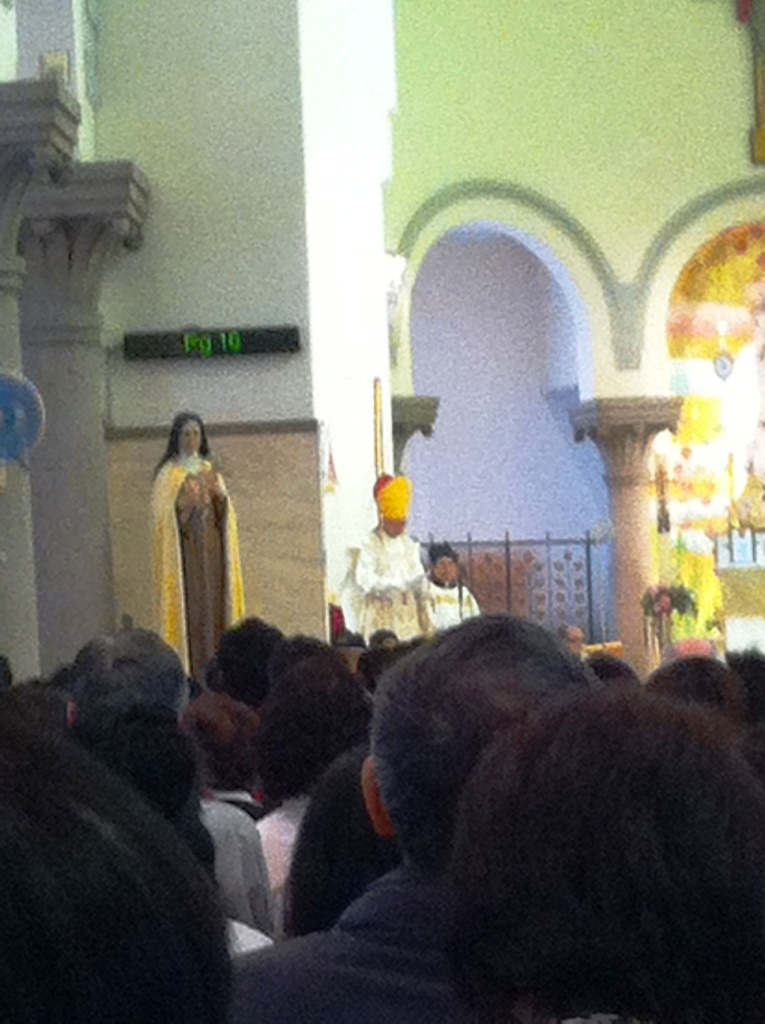
Although usually more at home on Hong Kong island, your correspondent made a special trip over to Kowloon on Easter Day.  Just one road south of Boundary Street (the original limit of British control until the lease of the New Territories was granted in 1898) is St Teresa's Church on Prince Edward Road.  This was the venue for a Solemn Pontifical High Mass in the Extraordinary Form of the Roman Rite celebrated by His Eminence John Cardinal Tong, the Bishop of Hong Kong.  This Easter Day event was organised in thanksgiving upon the tenth anniversary of the foundation of the Tridentine Liturgy Community of Hong Kong. 


The Mass was advertised as starting at 3pm.  When I arrived at 2.40pm, the church was already very nearly full.  As this was my first Extraordinary Form Mass, and since my GCSE Latin is almost as rusty as my singing, I very much appreciated both the glossy souvenir booklet containing the text of the entire service (in Latin, English and Chinese) and the opportunity to practise some of the hymns along with the choirs before the service began.  For those unfamiliar with the Mass of the Ages, page numbers from the Mass booklet were helpfully displayed on an electronic board to the left of the sanctuary (and you thought that such things could only be used for bouncing balls and choruses....).


The Cardinal processed in, as I understand is correct, twice.  First of all in choir dress, before his formal vesting, and then again properly attired to offer the Most Holy Sacrifice of the Mass.


The entire Mass was, of course, in Latin, save that the Gospel was repeated in Cantonese and then in English.  The Homily was delivered first in Cantonese and then in English, although my Cantonese is not up to my being able to be sure that it was exactly the same homily being delivered twice. 


While many in the congregation were members of the Tridentine Liturgy Community, there also seemed to be a large number who were not familiar with the Extraordinary Form at all, but were nonetheless enthusiastic participants.  Events such as this, especially when supported by Cardinal Tong (exactly as similar events were supported by his predecessor Cardinal Zen), will doubtless encourage more people to encounter the traditional liturgy.


The best part of two hours after we began, Cardinal Tong processed out.  It was a thrilling experience to witness this form of the liturgy generating such enthusiasm and interest.

Since writing this report, I am pleased to note that the New Liturgical Movement website has published some excellent photos of the same Mass.  It was a great occasion. 

**********

To conclude, and to prove that the Extraordinary Form is growing in popularity in Hong Kong, here is the last segment of a youtube recording of Cardinal Zen celebrating at a similar, though smaller, event a couple of years ago.

Sunday, 8 April 2012

Alleluia!

At the Easter Vigil last night in St James's, in common with the rest of the Church, we completed the Triduum and began the great rejoicing of Easter.


The Vigil on Holy Saturday evening has, in my experience, often been the least well attended of the Triduum liturgies.  Perhaps this is down to fatigue, perhaps it is down to the lateness of the service or to the fact that it is on a Saturday night.  Although St James's was not quite as packed as it had been on Good Friday, where there were certainly 500+ in church, we managed an extremely respectable turnout indeed, with perhaps 300-400 there.  Not bad for a cold Saturday evening, in an eerily deserted "Bank Holiday Weekend" Central London.  How pleasing to note that people still came to church despite Giles Fraser's fascinating earlier assertion on Radio 4 that people should not enter a church building on Holy Saturday. 

There was limited lighting in church, but then at 9pm exactly, all the lights went out, and across the gloom, one could just make out the procession leaving the sacristy and heading to the back of church.  The new fire was lit inside (an advantage of having a tall building and plentiful space behind the back rows of seating).  The effect of the light on the fire on the gothic arches of St James's was beautiful. 

Fr Irwin, who had sung the Ecce Lignum Crucis so well on Good Friday, chanted Lumen Christi as the newly lit Paschal Candle was borne up the centre aisle.  He went on to sing the haunting, enchanting and joyful Exsultet, in the much-talked about new bee-friendly translation of course.

As the series of readings continued, the choir made their presence felt with some stunning chant singing.  In the dim light of the candles, flickering around that stunning building, the beauty of the chant of the Canticle of the Red Sea, the Cantemus Domino, was overwhelming, as was the Palestrina setting of Sicut Cervus


After the Easter Alleluias and the Gospel, we moved onto a tour de force of a homily by Monsignor Jamieson.  He talked of the challenge of maintaining and nurturing faith, holding on to the incredible importance of the events we marked last night in this negative and doubting world.  The Devil was negative, the Devil was against things, whereas we as Catholics defined our stance in positive terms, most notably that, as Fr Colven had said on Good Friday, Jesus had died for all, and that death had no more dominion over him and need hold no fear for us.  

Easter was a positive message, he said, and we as positive Catholics should hold on to its place in our lives.  Not only at moments of great joy when we remember to give thanks, nor only at moments of great trial when we want to ask for help, but all the time.  Unlike antitheists, who are against those who believe in God, and unlike Protestants, who define themselves by negative comparison against Catholics, we must be positive, and bear Easter in our hearts. 

Around ten adults were then confirmed (a few were also baptised) in a very moving few moments.  With the exception of what happened at Candlemas, which had a familiar Ordinariate-influenced feeling to it, this was the first time that some of us had witnessed the phenomenon of numerous individuals joining the Church.  Come to think of it, for me at least, it was the first time that I had witnessed (as far as I remember), people being baptised and confirmed at the Easter Vigil, surely the most appropriate time for it to happen. 

After communion, the opportunity to sing our first great Easter hymn of the year "Jesus Christ is Risen Today!  Alleluia!".  This put us in mind of the singing of the Reginae Caeli to that tune, something that we hope to have the opportunity to do soon, for that is very much Anglican Patrimony. 

After mass was over, and the Vierne finale from Symphonie no 6 concluded, our little Ordinariate group repaired to the home of one of our members (along with a friend from the Oxford Ordinariate Group, one of at least two from that group who was present with us in church last night) to celebrate the Resurrection with a glass of something.  We return to St James's in a few hours, when we continue our celebrations with the Mozart Mass in C K337, and with the Byrd Haec Dies.


Surrexit Christus!  Alleluia!

Saturday, 7 April 2012

Good Friday

The Sacred Triduum continued yesterday at St James's with the most moving Good Friday liturgy that many of us had experienced.  It was, of course, very familiar, but the depth of the ceremonies was tremendous, not least to those of us experiencing Good Friday for the first time as Catholics.


Taking account of the speed in which St James's filled up on Thursday evening, I arrived almost half an hour before the liturgy began, to find that the front half of church was pretty much already full, with the back half filling up gradually.   More impressive than that was the total silence, even with all those people present, a silence that was fully maintained.

Yesterday was mostly sunny and light, as this picture taken on my way to St James's shows.  However, inside the church, there were no lights on at all, and this effect, coupled with several well-timed passing clouds lessening what sunlight was coming in, made for the perfect sombre setting.  On account of the lighting, there are no photos of the inside to share today.


The liturgy began in utter silence at 3pm, with all four of the parish clergy following the servers in and prostrating themselves before the altar, as around 500 people knelt down in the body of the church.  It was very powerful. 

Before the Passion, we all sat in silence as the choir sang this motet by Anerio.  The way the music appears to die, but then pushes on after the first "usque at mortem" is a homily in itself.


Following the beautiful singing of the Passion by three choir members (including the Byrd setting for the choral parts, which was new to me), Fr Colven gave a homily that addressed two main points.  First, in John's Gospel, where no textual detail is merely padding, that Pilate's order that INRI be written in Greek, Hebrew and Latin was a sign that what happened on Good Friday was part of something that was for everyone and would change existence for everyone, there was a universality to it.  Second, that what changed is that, as the Catechism says, death is not to be feared, and this is for all who put their trust in Christ.

The Solemn Prayers had a particular resonance and logic to new Catholics, the prayers for separated brethren in particular.

Perhaps the most striking part of the liturgy was the Procession of the Cross (with Fr Irwin singing the Ecce Lignum Crucis rather well) and the Veneration.  The Veneration must have taken around half an hour, purely on account of the number of people present. 

During the Veneration, the choir sang several motets and hymns.  The question raised on the famous New Liturgical Movement website a couple of weeks ago was answered at Spanish Place with the beautiful setting by Victoria.


Among the hymns, the popular but moving When I Survey was included.  This verse in particular never fails to pull heartstrings.

Forbid it, Lord, that I should boast,
Save in the death of Christ my God!
All the vain things that charm me most,
I sacrifice them to His blood.


As we returned to our seats following Veneration, we were each handed a card with a prayer of Blessed John Henry Newman :


....shine through me and be so in me that every soul I come in contact with may feel Thy Presence in my soul; let them look up, and see no longer me - but only Jesus.


This text tied in perfectly with the Holy Father's Chrism Mass homily, which has been so widely covered elsewhere, but which talked about sacrifice of self and dedication.

We wait for tonight's vigil and the resurrection with the rest of the Church.

Friday, 6 April 2012

More on Maundy Thursday

Last night's post, The Dutch Who Don't Touch, included some photos of the St James's Spanish Place liturgy for Maundy Thursday, one of which is reproduced below.  However, to counter its slightly flippant tone, here is an eyewitness report of last night at St James's, provided by another member of the Marylebone group.  Before going into the report, we'd just like to note that yesterday, our blog passed the milestone of having received 13,000 hits - what an appropriate day for that to have occurred. 

At the end of the report, there is the organ piece that preceded the Mass, the extraordinary Le Banquet Céleste by Olivier Messaien, which meditates on the text of John 6:56 "He that eateth my flesh, and drinketh my blood, dwelleth in me, and I in Him."


Maundy Thursday is one of the very few religious occasions in England widely reported by the media. Alas, it is inevitably reported not as a religious but as a regal occasion, being the day on which the Queen distributes the Maundy money. Time was when the royal connexion emphasised rather than obfuscated the religious significance of the start of the triduum. The monarch would not only distribute alms but also kneel to wash the feet of the poor. In 1689 William III refused such close contact with his subjects (as we mentioned last night, a case of “the Dutch don’t touch” perhaps) and ended the tradition, which his Protestant successors have shown no inclination to reinstate.

Certainly the Catholics of Marylebone were in no doubt about the religious importance of the day as they crowded into St James's Spanish Place for the evening mass to commemorate Our Lord’s Last Supper with his Apostles.

The choir sang Palestrina’s setting of the Introit, Nos autem gloriari oportet in cruce Domini nostrae Iesu Christi (Let our glory be in the cross of our Lord Jesus Christ) and as the priests of the parish entered the sanctuary it was suddenly illuminated by sunlight bursting through the stained glass windows as if in anticipation of Fr Colven’s reminder in his homily that today we were gathered, in spirit, in the Upper Room where Jesus commanded us to love one another, where He gave us the Holy Eucharist and where He instituted the priesthood.

It was on the priesthood that Fr Colven asked us to concentrate. When Our Lord knelt to wash the feet of his disciples, God knelt before all he had made and all Christian ministry was thus defined in terms of service. Karl Rahner had written, “You are only what you should be as a priest if you bring your whole life into your vocation. You are only a priest such as a priest must be, if you drain all the strength of your life in carrying out the duties of your office in faith, hope and love. Your life-work is to establish an ever closer intimacy between yourself and your office. Your vocation is your life and your life your vocation. …………..The candle on the candlestick in the house of the Church that you are to be must burn by the oil of your own heart, must burn all your life away. Only then will it burn, as it must. One can only discharge this office by paying one's life for it”.

Those of us in the Ordinariate have particular reason to give thanks for the gift of priesthood. On Monday we had gathered with the priests of the Ordinariate for the Chrism Mass. These were priests who had shown great courage and faithfulness in their response to Pope Benedict’s call to unity and in their ministry to the laity who had responded to that same call. Today we gathered with the priests of St James, all of whom had made that same brave journey at earlier times and who have been most generous in welcoming the Marylebone Ordinariate Group. We do indeed give thanks for these men and for, in St John Vianney’s words, their “love of the heart of Jesus”, as we begin our first Triduum as Catholics.

Thursday, 5 April 2012

The Dutch Who Don't Touch

The poor old Dutch must be tired of being mentioned so often in blogs touching on Catholicism and Anglo-Catholicism.  All this talk of the Dutch Touch : few enough people know about it in England, it must surely be perplexing for any native of the Netherlands that so much space is given to this topic.

Well, today, we can make amends.  We can talk about the Dutch who don't touch. 

Why today?  Today, Maundy Thursday, the Holy Father washed the feet of 12 priests during the liturgy at the Basilica of St John Lateran, reflecting the Gospel passage where Our Lord washes the feet of his disciples.  For many centuries, this was also the custom of the English monarch.  It remained so until the overthrow of the Catholic King James II (King James VII of Scotland).  The Dutch usurper, the staunchly protestant Prince William of Orange, had no wish to continue such practices.

A few photos then of this evening at Spanish Place.  The main body of church was impressively full, although there was space left in the side aisles.  The liturgy was well executed and the choir were on good form. 

The photos of the Altar of Repose have worked particularly well, so much so that we will include one of them first. 


The Altar of Repose is situated in the beautiful Spanish Place Lady Chapel, which has featured on this blog before.  Before we put up the other photos of this evening, here is a hymn ideal for today that is in fact dear to the members of the Marylebone group, since it was sung at the Ordination Mass of the three Ordinariate monsignori in January 2011. 


O Bread of Heaven, beneath this veil
Thou dost my very God conceal:
My Jesus, dearest treasure, hail!
I love Thee and, adoring, kneel;
Each loving soul by Thee is fed
With Thine own Self in form of Bread.

O food of life, Thou Who dost give
The pledge of immortality;
I live, no 'tis not I that live;
God gives me life, God lives in me:
He feeds my soul, He guides my ways,
And every grief with joy repays.

O Bond of love that dost unite
The servant to his living Lord;
Could I dare live and not requite
Such love - then death were meet reward:
I cannot live unless to prove
Some love for such unmeasured love.

Beloved Lord, in Heaven above
There, Jesus, Thou awaitest me,
To gaze on Thee with endless love;
Yes, thus I hope, thus shall it be:
For how can He deny me Heaven,
Who here on earth Himself hath given?

A most blessed Triduum to you all, and a joyful Easter when it comes.


Unexpected Anglican Patrimony

A tremendous amount of time has been spent discussing Anglican Patrimony and what it might mean.   This blog has participated in that debate, for example in this blogpost and in a follow up to it here. 

One particular feature of the Ordinariate Chrism Mass celebrated earlier this week reminded members of the Marylebone Ordinariate Group of something in their Anglican past that you might think would be very hard to fit into the category of Anglican Patrimony. 

The deacons, James Bradley and Daniel Lloyd, who are both to be ordained priest at St Patrick's, Soho later this month, wore what looked like apparelled amices.  There is no reason why readers should know what these are, so if you don't know, it probably reflects better on you than it does on people like me who do.  Originally a decorated edge to the top of the amice, in some parts of Europe they evolved into separate collars, even as they fell out of use in Rome.  Here are Deacons Bradley and Lloyd last Monday, seen in one of the very fine Mazar photos of the day.


Apparelled amices became a feature of Sarum celebrations, and you can see traces of that around many of the grander buildings found in Anglicanism.  For example, these two archive photos from Westminster Abbey show how apparelled amices have survived there, as a vestige of a very old English use.


They survived outside Sarum though, including in places such as Milan and indeed in Spain, this latter connection making their use at St James's Spanish Place very suitable (St James's having originally been, in penal times, the Spanish Embassy chapel).

Talk of a Spanish connection, Anglican Patrimony and apparelled amices leads us back to St Mary's Bourne St, where the so called "Spanish set" of vestments, used usually on Marian feast days, includes apparelled amices.  Here are a couple of photos of them being worn in procession c.1992.  The eagle-eyed amongst you will spot that one of the clergy captured here in his Anglican days is Fr Nicholas Kavanagh, now one of the priests at St James's Spanish Place.  It's a small, small world.


Tuesday, 3 April 2012

Ordinariate Chrism Mass 2012

The Apostolic Nuncio celebrated the Ordinariate's first ever Chrism Mass yesterday, a great event that was held at St James's Spanish Place.  People certainly came in large numbers, not only the 60+ Ordinariate priests who had travelled from across the country, but also many lay members of the Ordinariate, other Catholics encouraged by Fr Colven's announcement at Mass on Palm Sunday morning of what was to happen the following day, and no doubt a number of people who happened to be passing by and came across something rather bigger than they expected to see happening in church.  The photo below shows the reception held afterwards in the St James's Social Centre, with the Nuncio and Msgr Newton in cheerful conversation.


The St James's choir was on its usual excellent form, and a number of servers from the regular St James's team kindly gave up their time to help the Ordinariate celebrate this great occasion.  Thanks are due to them and to the Rector for all that they do to help the Ordinariate, in line with the Holy Father's wishes.

Monsignor Newton pointed out in his homily that since his authority as Ordinary of the Personal Ordinariate of Our Lady of Walsingham is vicarious on behalf of the Roman Pontiff, it was wonderful and entirely appropriate that the Apostolic Nuncio, His Excellency Archbishop Mennini, had come to celebrate the Ordinariate's first Chrism Mass.  In this year when we mark the 30th anniversary of the establishment of full diplomatic relations between the Holy See and the Court of St James, there was an added feeling of this just being exactly right. 

Archbishop Mennini's presence and obvious delight at being able to participate were a clear sign, if any were necessary, that the Ordinariate is a project that the Holy Father very actively supports.  Fr Ed Tomlinson, in his blogpost last night, wrote of the Archbishop's very warm words at the end of Mass.

Something that seems to have struck a lot of people present is the total sense of Unity of the event.  In theory, this ought not to be anything new, but for former Anglo-Catholics, it most certainly is.  Chrism Masses are a unifying event for a particular church with its Ordinary, but since the early 1990s Anglo-Catholics never really had that.  They faced the choice of attending diocesan celebrations alongside people of whose orders they were not entirely sure, or there was the option of a Forward in Faith / PEV Chrism Mass.  Those latter occasions were certainly joyful, encouraging and full of enthusiasm when they began, and I remember clearly attending such an event in Reading c.1995 (the first time I had the chance to sing the hymn below, yes any excuse to include Frank Patterson.....), but even then there was a knowledge at the back of everyone's mind that the ecclesiology of a separate arrangement, out of communion with those with whom we were technically in communion, was not obviously catholic.  As priests have left to join the Ordinariate, and as this trend continues, one wonders how long these PEV events will survive, particularly after the likely changes in legislation affecting the Church of England.  While people are on friendly terms, having the local Anglican diocesan bishop present and involved in a PEV Chrism Mass may be a sign of hospitality and indeed even of communion, but if the future is less rosey than that, a diocesan bishop insisting on joining in might be rather political.


One member of the Marylebone Ordinariate Group summed it up like this :

..... I overheard a priest say exactly what I had said to myself at Mass, it was the first time I had been at a Chrism Mass where I felt myself fully in union with Bishop, priests and people, and that was the most joyful and moving experience of the day.


Fr Ed Tomlinson, in the blogpost mentioned above, put it this way :

It was a happy day. But above all it was a day that underlined a thrilling truth. In previous years I would always feel a pang of sorrow during the Chrism Mass because Anglo-Catholics felt unable to attend the main diocesan event and held a separate service. It was a visible sign of the disunity with which we had to live. But today there was no sorrow only joy. For this was the main event- there was only unity. A unity that exists between all Catholics the world over. It is good to be home.


As Monsignor Newton said in his homily, we have gone forward in faith together, into an environment where we are part of that Unity to which we are all called.  In this respect, it was pleasing to see so many familiar faces amongst the clergy and people, with whom we are once again united. 

It is also worth commenting on the enthusiastic singing from the congregation, both in the hymns and in the responses.  This is one aspect of Anglican Patrimony that is immediate and audible, and which sounds wonderful in a stunning building such as St James's.  It was also striking (as you can see in this photo) that the unkind rumours spread by some of the modern day deniers about all the Ordinariate clergy being pensioners is manifestly untrue. 

We have posted a set of photos on our Flickr site, a few of which are reproduced below.  The Ordinariate has also produced a very good set of photos on their Flickr site. 

All said, a very joyous occasion, and one that brought home that we are truly part of the Church, all in the same communion.


Just to conclude, Msgr Newton quite righly pointed out that there are many in the Catholic Church whom we thank regularly, justly so.  However, we also owe a sincere debt of thanks to those very brave men (and in many cases their families) who gave up not only the Church of England as a spiritual home, but also took a far greater risk in material terms by leaving behind housing, employment and future pension accrual.  We thank Fr Colven and the clergy at St James's regularly here on this blog, but we are also very pleased to take this opportunity to thank Fr Christopher Pearson publicly, Fr Pearson being the nearest that the Marylebone Ordinariate Group has to its own priest.

Monday, 2 April 2012

All Glory, Laud and Honour

Tomorrow's blogpost will contain photos and a report on today's Ordinariate Chrism Mass, which took place at St James's this morning.  However, today's blogpost reports on what went on yesterday, when at Spanish Place as elsewhere, the Holy Week journey into Jerusalem began with Palm Sunday.  This photo shows the procession setting off on its way.


The particular nature of the Palm Sunday and Holy Week services make them very prone to bring memories of previous years and comparisons to previous celebrations of the same day.  Memories of outdoor processions from St Barnabas Pimlico to St Mary's Bourne St were certainly not that far from our minds as we gathered before Mass in the place where the procession was to begin.  Last year, all three of the first members of the Marylebone group were heavily involved in the marking of Palm Sunday at Bourne St, one of us as churchwarden, one of us as an acolyte and one of us as subdeacon (and hence chanting the Chronista part in the Passion).  This year, we were simply in the congregation, but felt very much at home and as if we had been a part of this for years. 

Here are some photos of yesterday at St James's, followed by a photo of last year's Bourne St procession, for old time's sake. 


This first photo shows a little seen view of St James's.  It is taken from Manchester Mews, and affords an excellent chance to see the outside of the beautiful apse of this stunning building.


Still having a very Anglican habit of turning up too early, we were amongst the first to arrive.  However, even at that point all had been readied.


Father Colven presides, with Fr Irwin and Fr Kavanagh dressed ready for the later concelebration, and Monsignor Jamieson in choir dress.


The procession sets off on the short journey round the corner and into the main door of St James's.


A rare shot of the renowned St James's choir.  They do a stunning job, as many readers will recall from the Solemn Evensong and Benediction held to mark the Ordinariate's first anniversary. 


The congregation makes it way along George St and towards the door of the church.


Two shots of the sanctuary after mass, the tranquility before the 12 noon Mass only preserved by the throng leaving after the 1030 Mass keeping the incoming crowds back.


The 2011 Palm Sunday procession held by our former Anglican parish, St Mary's Bourne St.  Two members of the Marylebone Ordinariate Group are visible in this photo. 

A photo I did not take, but which in some ways wish I had, would have been of the Canon being said.  There, at the altar, were three former Anglican clergyman, now priests in the Catholic Church, who had made the very same journey we had into the Church, and who now shared with us the fact of being in communion with the Successor of St Peter and with over a billion others.    It was a powerful moment for ex-Anglicans experiencing their first Palm Sunday, their first journey into Jerusalem, in the Catholic Church.  For some rather good words of encouragement for others who might be considering the same journey, click on this link to read a pastoral letter from Monsignor Steenson, the Ordinary of the Personal Ordinariate of the Chair of St Peter, the Ordinariate for former Anglicans in North America.

The choir pictured and praised above were on very good form, not least in the beauty of the Sanctus, Benedictus and Agnus Dei of Palestrina's Missa Aeterna Christi Munera.  Hymns are always an important part of ceremonies that involve processions, and we did indeed sing All Glory, Laud and Honour yesterday as we walked to church, just as we had a year before at Bourne Street.  After Mass this year, we had the opportunity to sing one of the most powerful yet gentle hymns in the book, My Song is Love Unknown.   The John Ireland tune is tremendously affecting, and full of the most beautiful harmonic moments, not least the B flat resolving onto the A in the tenor part of the penultimate line.


Having avoided a link to a video of the well known hymn setting of All Glory, Laud and Honour, it seems only right to include those well known words in what will probably be to most people a less familiar form.  With thanks to the Let Nothing You Dismay blog, here is a youtube video of how the procession is done in Rome.