Showing posts with label Monsignor Keith Newton. Show all posts

Saturday, 13 October 2012

Mystici Corporis Christi - Part I

Almost three years have now passed since the apostolic constitution, Anglicanorum Coetibus, was given by Pope Benedict XVI providing for the creation of personal ordinariates for Anglicans wishing to enter into full communion with the Catholic Church. That same apostolic constitution requires under Article XI that the Ordinary must go to Rome every five years for an ad limina visit to report on his ordinariate’s status. Since the Ordinariate of Our Lady of Walsingham has now been in existence for about a third of that time, it seems an appropriate time to consider what the Ordinary might relay to the Holy See if he were called now to account for the past year and a half.


First, however, it is necessary to return to that original document which, along with its Complementary Norms issued by William Cardinal Levada, forms the basis of the ecclesiastical authority and form of the ordinariates, but also entrusts them with their mission and vocation. This return to those founding documents will then provide us with the means to consider both what the objectives of the ordinariates must be, as formed in the mind of the Successor of S. Peter, but also to assess whether the ordinariates, particularly that established here in the Dowry of our Blessed Mother, have achieved anything of what they were created to accomplish, and whether they are well-placed to bring to fulfilment the prayers of Our Lady to win our country back for God. The aims of the ordinariates as expressed in Anglicanorum Coetibus can be refined into three distinct yet complementary objectives, and it is upon these that our assessment of the Ordinariate will be based.

The Lord’s mandate to the Successor of S. Peter to preside over and safeguard the universal communion of all the Churches

Since the Second Vatican Council much emphasis has been placed upon ecumenism, and yet since the publication of Lumen gentium, some elements within the Church have in certain ways lost a true sense of what ecumenism actually entails, and indeed what the Council Fathers understood by it. Across the world events involving other religions and communities have taken place which have sought to not only open up the Church to an understanding and dialogue with those traditions, but also to proclaim as equals the Catholic Faith and interpretations of the religion of Jesus Christ.  Furthermore, and particularly relevant to the Anglican Communion, there had been a not insignificant move away from position held for many centuries culminating with the conclusion reached in Apostolicae Curae that Anglican orders are ‘absolutely null and utterly void’. Despite there never having been an official retraction or amendment to that position, an attitude has arisen in sections of both the Catholic Church and the Anglican Communion that their respective clergy were speaking the same words each Sunday morning, wearing the same vestments, and were performing equally valid and wholesome acts: all this as if they were each utterly interchangeable.


Clearly, this is not the truth that comes from God as received by the Church whose teachings are as His own. Lumen gentium itself made clear that ‘the sole Church of Christ which in the Creed we profess to be one, holy, catholic and apostolic, which our Saviour, after His Resurrection, commissioned Peter to shepherd, and him and the other apostles to extend and direct with authority, which He erected for all ages as 'the pillar and mainstay of the truth,' as a society in the present world…subsists in the Catholic Church, which is governed by the successor of Peter and by the bishops in communion with him’.

The Creed is the identity of the Church expressed Sunday by Sunday during the Mass and declared by each individual wishing to assume that identity as their own in baptism. What is evident in the current pontificate is a clear longing for a recovery of this identity faithful to Christ’s own teaching which Anglicanorum Coetibus proclaims as ‘visibly manifested in the bonds of the profession of the faith in its entirety…united with its head, the Roman Pontiff’. The Holy Father has not only sought to recover traditional identity by drawing in Anglicans who hold firm to that which they received from S. Augustine and grew through faithful adherence to those teachings. The universal liberation of the Extraordinary Form of the Roman Rite as something that ‘earlier generations held as sacred, remains sacred and great for us too’ in Summorum Pontificum reminds the Church of her holy tradition which has professed our blessed Faith in all generations. It is this calling to mind of the Truth that makes us free which the apostolic constitution seeks to achieve first and foremost. The pastoral concern of the Vicar of Christ for the sheep entrusted to him cannot accept the ever more aggressive advances of the dictatorship of relativism, whether inside communities of faith or otherwise.

The apostolic constitution itself responds to those who, as illustrated earlier, appear to hold confused positions on orders apart from the Church. Article VI outlines provisions for those who ministered as Anglican deacons, priests, or bishops to be ordained as priests. The document does not make any comment on whether they are, or even might in certain cases arguably be, deacons, priests, or bishops in the sense meant in the Catholic Church. Whilst it is entirely right, as the constitution quotes from Lumen gentium, that ‘many elements of sanctification and of truth are found outside [the Church’s] visible confines’, Anglicanorum Coetibus requires even the tiniest element of doubt to be removed, and ordination to Holy Order to take place.  Why would anyone wish to argue that even an iota of doubt should be allowed to remain?

What is strongly stated immediately following that quotation is that the gifts of sanctification and truth properly belong to the Church, and as such ‘they are forces impelling towards Catholic unity’. Many commentators on the Church’s position on ecumenism and the position of other baptised communities fail repeatedly to grasp the implications and force of this statement. To include it in his apostolic constitution founding the Ordinariate is a clear statement from the Holy Father that we are to be strong and firm in the Faith, and not to shy away from boldly proclaiming it.

Since the publication of Anglicanorum Coetibus, and particularly in the first days after its release, there has been widespread shock and criticism from leaders in the Anglican Communion, and indeed within the Church in England. Many expressed their distaste for the proactive approach taken by the Pope, and equated it with landing tanks in front of Lambeth Palace. Yet this is the mission of the Pope as Successor of St. Peter, the Rock on which Christ Himself wished to build His Church. Pope Benedict, in his own words, ‘could not fail to make available the means necessary to bring this holy desire to realisation’.

Has the Ordinariate of Our Lady of Walsingham succeeded in its efforts to realise the will of Pope Benedict in this regard? Clearly the result of the first objective is of success. Over a thousand souls have been received into the Church through the Ordinariate, and the stream of men and women, young and old, of diverse backgrounds continues week by week. In many ways this success renders the remainder of this post redundant, as the most precious and immediately important concern of the Church is to bring as many as possible to partake in the sureness of salvation won on Calvary’s tree, guaranteed in the faithful reception of the sacraments as acts of love and devotion for the Lord.

Yet in reality the number of Anglicans who have felt the call of the Holy Spirit and obeyed the command of Christ to be one could have been higher. Explanations for this are certainly complicated and multifaceted, and they can also be confusing.  Some of those Anglo-Catholics who are still in the Church of England, claiming  to be remaining loyal to the church of their baptism, have themselves petitioned repeatedly and insistently for fuller communion with the Pope, and continue to pray for him in the Roman Canon each day, and affix images of him to sacristy walls, exactly as though they were in that fuller communion from which they, in fact, prefer to separate themselves. 

The Ordinariate is called in Anglicanorum Coetibus to proclaim afresh the Faith of the Church so that England may indeed be free. The brave decision of the Ordinary to lead the Forty Days For Life prayer vigil this Autumn is one powerful example of how the Ordinariate can achieve this objective in the fight against one of the greatest evils of our generation. The commitment of the laity and clergy of the Ordinariate to the fight against the redefinition of marriage has been exemplary, and the devotion of priests in the worthy celebration of the Mass has become an ordinary part of the Ordinariate’s daily cycle.

This is not to say that there remain no issues. There are some who have the mistaken impression that the Catholic priesthood in which Ordinariate clergy serve is identical to the Anglican priesthood in which they served so recently.  To take this view is to see their Catholic priestly ordination as merely a confirming in their pre-existing orders for the wider Church, signalling a failing in sacramental theology and also in understanding of the Catholic insight into holy orders. Similarly the sacrament of Confirmation which, along with Holy Orders and Baptism, cannot be repeated, with simulating such being sacrilege. It is absolutely wrong for clergy to preach or teach such divergences from the Faith, or to instruct candidates that they are merely continuing exactly what they have always enjoyed, with nothing whatsoever having changed. Whilst such deviations from the teaching of the Church are rare, they can be found, and for as long as they continue, the Ordinariate will have an extra challenge placed before it as it seeks to fulfill its fullest potential as a sign and symbol of Christ to the English people. Certainly we must preach to our separated brethren by kindly words, and we must at all times take great care to avoid arrogant pride: but in that spirit of friendship and humility, we must not hide or deny the integrity which we attained when we decided that it was indeed better to be together with the Sucessor of St Peter.


In the Vatican Council’s decree Unitatis redintegratio, the Fathers noted the numerous communities of the baptised which present themselves to men as the true inheriters of Jesus Christ, but also that whilst it is true that division amongst the baptised wounds the Church and causes scandal, those separated communities fall short of what those in the Ordinariate now achieve. It is essential, therefore, that the Ordinariate does not falter in its preaching of the Church being ‘the all-embracing means of salvation’, which all men must embrace so that they can be sure of being able to benefit fully from the means of salvation within her.

Continues.

Monday, 17 September 2012

Walsingham Way

Members of the Marylebone Ordinariate Group forsook W1 for Norfolk on Saturday to join the Ordinariate Pilgrimage to Walsingham. We were each returning to England’s Nazareth for the first time as Catholics to join Mgr Keith Newton and several hundred fellow Ordinariate members for mass at the National Shrine.


For those of us accustomed to the rarified (and nowadays, dare one suggest, rather etiolated) character of Anglo Catholic parishes in London one of the most heartening features of the Ordinariate is the wonderful mix of people who make up its priesthood and laity. As we set off after mass to progress from the Slipper Chapel to the village it was striking that this group of pilgrims was very far from the stereotype of a self-selecting and insular group that one Anglican bishop of our acquaintance likes to refer to as “the Anglo-Catholic travelling circus”. This was quite simply a group of people, men and women, from all parts of the country and from all walks of life, gathered together in England's Nazareth to give thanks for many blessings received, and to celebrate that its petition for union with Holy Mother Church had been answered.


One unexpected consequence of the numbers joining the pilgrimage was that we were diverted from the road on to what had once been the Wells and Fakenham Railway, until it fell victim to Dr Beeching’s axe in 1964, a particular shock for those who had very properly and very bravely chosen to walk unshod and who now forsook the caressing tarmac for unforgiving stones and thistles. We followed the cross, lifted high and glinting in the bright sunlight, and a statue of Our Lady of Walsingham carried by four bearers, if not exactly o’er hill and dale then certainly through countryside a little more rugged than that of Regent’s Park.

Flushed as we were by the unaccustomed exercise, onlookers would not have noticed our blushes when, encountering first our Orthodox brethren outside the Chapel of Saint Seraphim, and then some minutes later the Administrator of the Anglican Shrine, we had on each occasion reached the second verse in the Lourdes Hymn:

We pray for God's glory, May his kingdom come!
We pray for His vicar, Our Father, and Rome.


Those blushes dissolved into beams of delight at the greater symbolism of arriving in the little village that is such an important part both of our Catholic history and our Anglican Patrimony, carrying Our Lady onwards into the grounds of the Anglican Shrine where we could offer up more petitions for the unity of Catholic Christendom.

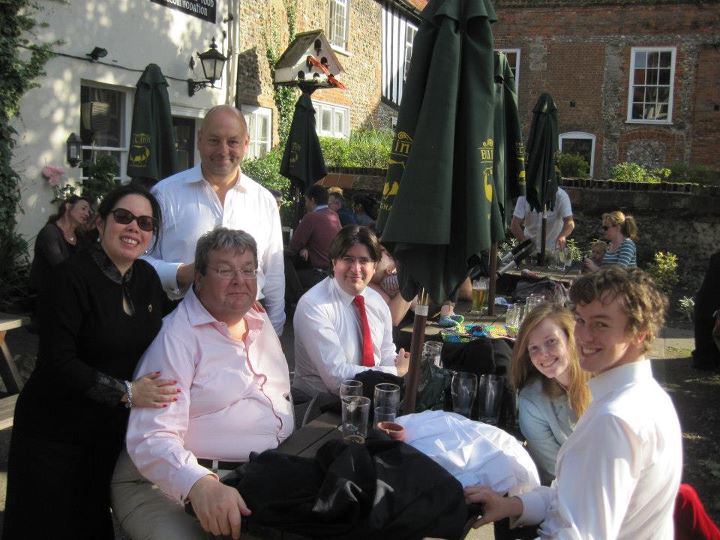
Then, as pilgrims thirsting after righteousness and mindful of our Anglican Patrimony we settled into The Bull to relive the events of the day over a pint. Some things never change.


Thursday, 2 August 2012

Monsignor Newton on The Future of Ecumenism

A video recording of Mgr Newton's address given at the Church of St Mary Magdalen in Brighton has been in circulation for some time, but it is only now that the quiet days of August allow the members of the Marylebone group to view it and to provide a few personal thoughts on it.


It can come as no surprise that we find ourselves wholeheartedly in agreement with what Mgr Newton says (and no, we are not saying that simply because he is our Ordinary).

To prove that, do please note that we have often referred (for example here and here) on this blog to our sadness that the warnings given by many, including by Cardinal Kaspar in 2006 (to the Church of England's House of Bishops) and in 2008 (to the Lambeth Conference) have not been taken into account.  His 2006 speech called for the Church of England not to erect new impediments to unity.  Cardinal Kaspar's 2008 text included the following as part of his longer address :
We would see the Anglican Communion as moving a considerable distance closer to the side of the Protestant churches of the 16th century, and to a position they adopted only during the second half of the 20th century.
The 1966 Common Declaration signed by Pope Paul VI and Archbishop Michael Ramsey called for a dialogue that would “lead to that unity in truth, for which Christ prayed”, and spoke of “a restoration of complete communion of faith and sacramental life”. It now seems that full visible communion as the aim of our dialogue has receded further, and that our dialogue will have less ultimate goals and therefore will be altered in its character. While such a dialogue could still lead to good results, it would not be sustained by the dynamism which arises from the realistic possibility of the unity Christ asks of us, or the shared partaking of the one Lord’s table, for which we so earnestly long.
The advice of those such as Cardinal Kaspar has been ignored even although senior clergy from the Orthodox Church have addressed leading Anglicans on the same point (certain kinds of Anglicans like to turn a deaf ear to Rome, fondly but vainly imagining that Constantinople or Moscow will say something rather more to their liking).  At a 2010 address to the Nicaea Club at Lambeth Palace, Metropolitan Hilarion, of the Russian Orthodox Church, after recalling the warm history of co-operation between Anglicanism and the Orthodox, and having taken several none-too-subtle swipes at the über-liberal practices of certain parts of the Anglican Communion, went on to comment that the Church of England's approach on certain issues was not conducive to Christian Unity.
We have studied the preparatory documents for the decision on female episcopate and were struck by the conviction expressed in them that even if the female episcopate were introduced, ecumenical contacts with the Roman Catholic and the Orthodox Churches would not come to an end. What made the authors of these documents so certain?
The effect of what is now happening is that the underlying raison d'être for the no doubt friendly and sincere ecumenical dialogue that carries on is fundamentally different from that envisaged by the 1966 Common Declaration.  No longer does even the most Panglossian optimist think that any kind of corporate unity is likely in the lifetime of anyone living today.  The unquestionably warm friendships and contacts at the parish and personal level continue, but the true Unity for which Christ prayed is further away than it was.  The conclusions of ARCIC I and the zenith of hope for reunion that was attained when Blessed John Paul II knelt in prayer beside Archbishop Robert Runcie in Canterbury Cathedral seem so very far distant now.

Well, that's all old ground, you might say.  Cardinal Kaspar and Monsignor Newton have said it all rather better than you, and indeed you have written of this in the past.  All true.  We'll leave it there.
 
However, what we would want to do is to pick up on something else that Monsignor Newton mentioned.  He talked of an address given by the Archbishop of Canterbury to a symposium at the Gregorian University in Rome in 2009, marking the centenary of the birth of Cardinal Willebrands, the first president of the Pontifical Council for the Promotion of Christian Unity.

Dr Williams talked of the many things upon which Catholics and Anglicans agree being first order issues (by which he meant important points), and of those upon which we did not agree being second order issues (by which he meant less significant matters that ought not to get in the way of the bigger points).  He also talked of how the way that the Anglican Communion handles differences might be a potential model for Catholic-Anglican discussions, but we shall make no comment upon that, sticking rather to his differentiation in significance of topics.

When reading of Dr Williams's talk at the time, my reaction to the first order and second order analysis was  that I wanted to apply it rather differently.  If these points really are second order (in an Anglican understanding thereof), why then (of relevance to Anglicans) does General Synod not only spend seemingly all of its time discussing them, but also (of relevance to Catholics too) place such a high value on them that they are allowed to wound shared understandings of first order issues?

Whatever we might think of any of these "second order issues", do any of them really trump the following:
Ut omnes unum sint, sicut tu Pater in me, et ego in te, ut et ipsi in nobis unum sint, ut credat mundus, quia tu me misisti.

That they all may be one; as thou, Father, art in me, and I in thee, that they also may be one in us; that the world may believe that thou hast sent me.
In this context, Anglicanorum coetibus can indeed be seen very clearly as a practical ecumenical gesture, as Monsignor Newton rightly said.  To Anglo-Catholics who didn't wish their response to the Gospel call to Unity to be subject to second order issues, it was indeed the perfect ecumenical gesture.


Let us conclude with two musical settings of the words of Psalm 132 (or Psalm 133, depending on which counting system you follow....).  The first version is very definitely Anglican Patrimony, it is Anglican chant sung by the choir of King's College, Cambridge.  The second is a setting that has featured previously on this blog, written by Fernando de las Infantas in 1570 to commemorate the founding the Holy League, the alliance of Catholic Nations that in 1571, under Don John of Austria, would emerge victorious from the Battle of Lepanto, as Fr Hunwicke evoked so clearly for us at St Mary's Bourne St in 2010.
Ecce quam bonum et quam iucundum, habitare fratres in unum.  Sicut unguentum in capite, quod descendit in barbam, barbam Aaron.  Quod descendit in oram vestimenti eius, sicut ros Hermon, qui descendit in montem Sion.  Quoniam illic mandavit Dominus benedictionem, et vitam usque in saeculum.

Behold how good and joyful a thing it is, brethren, to dwell together in unity.  It is like the precious ointment upon the head, that ran down unto the beard, even unto Aaron's beard.  And went down to the skirts of his clothing, like as the dew of Hermon, which fell upon the hill of Sion.  For there the Lord promised his blessing and life for evermore.


Tuesday, 31 July 2012

O Lux et Decus Hispaniae

A joyful week of celebration at St James’s, Spanish Place.  Wednesday was the Feast of Title, and the Right Reverend Dom Cuthbert Brogan, Abbot of Farnborough, celebrated and preached at Solemn Mass. 


The Spanish Ambassador was also present, marking the historic connexion between the people of Spain and St James.  Like so many of the older parishes in the Westminster diocese (parish records date back to 1732), St James's Spanish Place can trace its origins to penal times and to the benefactions of a nearby Catholic embassy, and a fascinating explanation of the parish's history can be found on the parish website.

Having previously been based in Ely Place, the Spanish Embassy was once in Hertford House (now the Wallace Collection) and in 1791 a chapel was built in Spanish Place (close to the site of the present church, and of sufficient renown to have been mentioned by Thackeray in Vanity Fair as the church attended by the Marchioness of Steyne) to serve the needs of Catholics serving there.


Although the Embassy moved elsewhere long ago and the London Vicariate assumed control of the chapel in 1827, and although the chapel was replaced by the present building in the 19th century, there are many reminders of Spanish heritage in the church, including Alfonso XIII's personal standard, which hangs above the door from the sacristy into church, and the twin crowns situated above two prime positions in choir set aside for visits from the King and Queen of Spain.  It is, however, mere coincidence that the colours of the Spanish flag are reflected in the colours of the Marylebone Cricket Club.

At that mass last week, the Marylebone Ordinariate Group was also joined for the first time by its newest member, Rupert Brennan Brown.  Known to most of the group from his time at St Mary’s Bourne Street (and the third member of the group to be married there), Rupert was received into the Church some years ago but has now joined the Ordinariate, taking advantage of the provision that enables former Anglicans who were received into the Church prior to Anglicanorum Coetibus to become members of the Ordinariate.

A great occasion, happy for the parish of course and for those of us privileged to be hosted by it, but also happy very specifically for us in the Marylebone Ordinariate Group, because now we found ourselves reunited with one from whom we had been separated.  A certain extract from Blessed John Henry Newman's Apologia pro Vita Sua came to mind.
And I earnestly pray for this whole company, with a hope against hope, that all of us, who once were so united, and so happy in our union, may even now be brought at length, by the Power of the Divine Will, into One Fold and under One Shepherd.
We were also delighted to note that among the clergy in the sanctuary, Fr Christopher Pearson was one of the concelebrants. 

For us, the highlight among a venerable feast of music was Victoria's O Lux et Decus Hispaniae.
O lux et decus Hispaniae Sanctissime Jacobe, qui inter Apostolos primatum tenens, primus eorum martyrio laureatus.  Alleluia.

O light and grace of Spain, most holy James, he who held primacy among the Apostles, was the first of them to take the laurels of martyrdom. Alleluia.
This powerful piece, previously unknown to us, sat beautifully alongside other much more familiar music.  The setting of the ordinary of the mass was Mozart's Coronation Mass, and as well as a Jubilate Deo from Giovanni Gabrieli, we were delighted to hear the Finale from Vierne's Organ Symphony No. 1, which had also been played after the Ordinariate's Anniversary Solemn Evensong and Benediction at St James's earlier this year.  Those of you interested in hearing what music in St James's sounds like, as well as merely seeing plenty of photos of this stunning building, can find a video on our post entitled A Perfect Setting.


A few photos of the great day follow below.  Those of you interested in the Spanish connection will note that the picture of the Abbot preaching (so reminiscent of the excellent photos of Monsignor Newton preaching in that same place some months ago) shows the aforementioned personal standard of King Alfonso XIII of Spain in the background. 


Friday, 11 May 2012

Reforming Perceptions

On Tuesday, London’s tourists were flocking to the Mall to watch the Queen make her way to the Palace of Westminster for the State Opening of Parliament.  This is, of course, a familiar sight to those of us who live or work in the city; a sight as banal as the language of the speech our unfortunate monarch is required to deliver on behalf of her ministers.

Yet but a short distance away, in the even older ceremonial thoroughfare of Pall Mall, a more remarkable site was to be seen, that of fifty or so Catholic priests making their way not to the more familiar ecclesiastical territory of the Athenaeum or the Travellers, but to that less godly institution, the Reform Club.


The occasion was a meeting hosted by the Friends of the Ordinariate at which Mgr Keith Newton and Mgr Andrew Burnham discussed the role of the Ordinariate in the Catholic life of Great Britain and how that work might be supported by the priests and parishes of the Church.  The meeting itself was private but the goodwill demonstrated towards the Ordinariate was both heartfelt and heartening.

When we were received into the Church it was at first a little disappointing, if entirely understandable, to find a widespread lack of awareness of the Ordinariate among Catholics, of what it is about and why Pope Benedict brought it into being.  We are very familiar with the question “but why did you not just become a Catholic” and are well experienced in the art of explaining that we are indeed full members of the Catholic Church, rejoicing in a unity we so long denied ourselves.

In the Marylebone Ordinariate Group, we have been particularly fortunate not only in the support we have received from the clergy in the parish that our group attends, but also in having the opportunity at occasional Ordinariate services to demonstrate some of those rich traditions we bring with us as part of our Anglican patrimony.  We know that when we have the opportunity to explain, and better still to show, the role of the Ordinariate, understanding and support invariably follows quickly from those hitherto perplexed.  The initiative of the Friends in arranging the meeting, and there will be more to follow in other parts of the country, is greatly to be welcomed.  Quite rightly, the obligation is on us to explain ourselves, and this we are more than happy to do.

Fr Alexander Lucie-Smith has already reported very positively on the meeting in the Catholic Herald, including reference to a service of evensong he attended in Chichester, a name that is to feature in an upcoming blogpost here.  

How appropriate it was that the meeting should end with the singing of the Regina Caeli, surely the first time it had ever been heard in the Reform Club.  As the words echoed from the Library, through the Gallery and the Saloon and into every corner of Charles Barry’s magnificent building, they enveloped the portrait of Daniel O’Connell, the bust of Henry Brougham and many another who had fought for Catholic Emancipation and who, in their triumph, paved the way for the passing of the great Reform Act itself.  O’Connell’s Catholic Association had profound and lasting consequences for the British constitution, far beyond those imagined by its founders.  Perhaps in their choice of the Reform Club the Friends of the Ordinariate were wiser than they knew.


Monday, 23 April 2012

Sacerdotes Domini

Another truly groundbreaking few days for the Ordinariate of Our Lady of Walsingham.  This weekend, for the first time in the Ordinariate, we witnessed the ordination to the Sacred Priesthood of former Anglicans who had never been Anglican priests.  This was a sign of progress, a sign of continuity and a sign of hope for the future.   Below you will see a picture of most of the Marylebone Ordinariate Group with the newly minted Fr James Bradley, then below you will see one of our number receiving one of Fr Daniel Lloyd's first blessings.


In April 2010, in our Anglican days, a small group of us from St Mary's Bourne St travelled up to Oxford to attend a conference on the subject of Anglicanorum Coetibus held in Pusey House.  In one of the breaks between the fascinating talks that day, we joked with The Revd Canon Dr Robin Ward, Principal of St Stephen’s House, as we pointed to two of his students, James Bradley and Daniel Lloyd, and together wondered, perhaps in fact only half in jest, if we were looking upon the last two catholic ordinands in the Church of England. 

I doubt that any of us there that day would have believed that only two years later, almost to the day, we would, as Catholics ourselves, be gathered in the magnificently restored St Patrick’s Soho Square to witness the ordination of those two young men into the Catholic priesthood at a service in which Dr Ward read from the Letter to the Hebrews of how Our Lord “learned obedience through what he suffered; and being made perfect he became the source of eternal salvation to all who obey him, being designated by God a high priest according to the order of Melchizedek.”  Here is a photo of Dr Ward during the reading of that lesson, standing in the pulpit where, as he pointed out himself on his Facebook page, the great Archbishop Fulton Sheen, Servant of God, had once stood to preach.


As the two deacons lay prostrate before the altar and we invoked the prayers of Our Lady of Walsingham, the Holy Angels, the Saints and Blessed John Henry Newman, we did so with the confidence of those who had been guided by such prayers, and by the grace of God, into full union with Holy Mother Church.  At the moment Bishop Alan Hopes (himself a former Anglican) consecrated Fr Bradley and Fr Lloyd to the dignity of priesthood we gave heartfelt thanks that we had been brought to witness the ordination of the first two men not previously to have served in the Anglican priesthood to offer their service to God as priests in his Church in the Ordinariate of Our Lady of Walsingham.

In his homily, our Ordinary, Monsignor Keith Newton, quoted from ‘Aaron’ by George Herbert, the divine of our very own Anglican Patrimony.

Holiness on the head,
Light and perfection on the breast,
Harmonious bells below, raising the dead
To led them unto life and rest.
Thus are true Aarons dressed.

Profaneness in my head,
Defects and darkness in my breast,
A noise of passions ringing me for dead
Unto a place where is no rest.
Poor priest thus am I dressed.
Only another head
I have, another heart and breast,
another music, making live not dead,
without whom I could have no rest:
In him I am well dressed.
Christ is my only head,
My alone only heart and breast,
My only music, striking me even dead;
That to the old man I may rest,
And be in him new dressed.
So holy in my head,
Perfect and light in my dear breast,
My doctrine tuned by Christ, (who is not dead,
But lives in me while I do rest)
Come people; Aaron's dressed.
We have included a large number of photos of Saturday's Ordination Mass in an album on our group's Facebook site (which you can reach through the link on the right-hand toolbar of this blog - do sign up to "like" our group page if you haven't already done so).  A small selection of our favourite photos is set out below.  For those readers with a connection to St Mary's Bourne St and St Barnabas Pimlico, you might recognise below the Very Reverend John Salter in one of the pictures, another former Anglican, and since 2002 a Melkite priest in full communion with Rome.


After each ordination to the Sacred Priesthood, there is always a First Mass.  Members of the Marylebone Ordinariate Group managed to attend Fr Bradley's FIrst Mass in Balham, and Fr Lloyd's First Mass in Oxford.

As feeble and ignorant Central Londoners, we do not know much of what lies beyond Zone 1, and we referred to this on our blogpost about our previous visit to the parish of Holy Ghost, Balham.  Therefore, there were, we regret to confess, those of us who were unaware that true beauty might be found in Balham.  It may famously be the Gateway to the South, but it is not widely known as the Stairway to Heaven.  Some of us trod our way rather warily from W1 to SW12, the marbled magnificence of St Patrick’s Soho Square fresh in our minds.  What a wonderful surprise lay in store for us, for there in Nightingale Square at the Church of the Holy Ghost we found a haven of beauty that should be a compulsory stop on the itinerary of every church architect and parish priest in the land wishing to discover what can be achieved with taste and simplicity.

One would have described it as tranquil but we arrived just as the congregation from an earlier mass was leaving, and the area was awash with small and excited children.  We are not so small but were just as excited as we were about to witness the First Mass of Fr James Bradley, whose ordination we had witnessed on Saturday.

There are few occasions more joyful in church than the First Mass of a priest.  In his homily Fr Stephen Langridge was to remind us of Blessed Theresa of Calcutta's injunction to priests to “celebrate each Mass as if it were your first Mass and your last Mass” and when we witness the Most Holy Sacrifice of the Mass being offered at the hands of a newly-ordained priest it is as if we too share in it for the first time.

After the rich liturgical diet of the Sacred Triduum at St James’s, Spanish Place, and yesterday’s ordination one could be forgiven for becoming a touch jaded, especially upon hearing of rumours of guitars in church (ever an uncomfortable reminder of the worst excesses of some of the more popular misinterpretations of the Second Vatican Council).  Yet again would Balham prove the folly of blind prejudice. The songbirds themselves were surely listening in awed silence as the sound of Padilla's Missa Ego Flos Campi and Guerrero's Regina Caeli floated, accompanied by authentic Spanish instruments in their correct context.


On leaving the church, one parishioner was overheard saying to another "What is this Ordinariate then?".  Her friend replied "Oh, it's what they call the Church of England nowadays."  This reminded us of the challenge continually ahead of us, that of spreading the word about what the Ordinariate is and what it does.  Efforts such as mentioned here must continue to be made (we know that there are plans afoot to do exactly this).  Yet, perhaps that casual remark between friends was closer to the truth than we had at first recognised - where else now was that vision of the Church of England to which we in our Anglo-Catholic days had adhered?

We returned to Marylebone humbled, joyful and full of thanksgiving for the start of the ministry of Fr Bradley.

We will report on the happy occasion of Fr Daniel Lloyd's First Mass in the next few days.  Thanks be to God for giving us these two new priests. 

Sacerdotes Domini incensum et panes offerunt Deo et ideo sancti erunt Deo et non polluent nomen eius. 

The priests of the Lord offered bread and incense to God and therefore they shall be holy to their God and shall not defile his name.  

Tuesday, 3 April 2012

Ordinariate Chrism Mass 2012

The Apostolic Nuncio celebrated the Ordinariate's first ever Chrism Mass yesterday, a great event that was held at St James's Spanish Place.  People certainly came in large numbers, not only the 60+ Ordinariate priests who had travelled from across the country, but also many lay members of the Ordinariate, other Catholics encouraged by Fr Colven's announcement at Mass on Palm Sunday morning of what was to happen the following day, and no doubt a number of people who happened to be passing by and came across something rather bigger than they expected to see happening in church.  The photo below shows the reception held afterwards in the St James's Social Centre, with the Nuncio and Msgr Newton in cheerful conversation.


The St James's choir was on its usual excellent form, and a number of servers from the regular St James's team kindly gave up their time to help the Ordinariate celebrate this great occasion.  Thanks are due to them and to the Rector for all that they do to help the Ordinariate, in line with the Holy Father's wishes.

Monsignor Newton pointed out in his homily that since his authority as Ordinary of the Personal Ordinariate of Our Lady of Walsingham is vicarious on behalf of the Roman Pontiff, it was wonderful and entirely appropriate that the Apostolic Nuncio, His Excellency Archbishop Mennini, had come to celebrate the Ordinariate's first Chrism Mass.  In this year when we mark the 30th anniversary of the establishment of full diplomatic relations between the Holy See and the Court of St James, there was an added feeling of this just being exactly right. 

Archbishop Mennini's presence and obvious delight at being able to participate were a clear sign, if any were necessary, that the Ordinariate is a project that the Holy Father very actively supports.  Fr Ed Tomlinson, in his blogpost last night, wrote of the Archbishop's very warm words at the end of Mass.

Something that seems to have struck a lot of people present is the total sense of Unity of the event.  In theory, this ought not to be anything new, but for former Anglo-Catholics, it most certainly is.  Chrism Masses are a unifying event for a particular church with its Ordinary, but since the early 1990s Anglo-Catholics never really had that.  They faced the choice of attending diocesan celebrations alongside people of whose orders they were not entirely sure, or there was the option of a Forward in Faith / PEV Chrism Mass.  Those latter occasions were certainly joyful, encouraging and full of enthusiasm when they began, and I remember clearly attending such an event in Reading c.1995 (the first time I had the chance to sing the hymn below, yes any excuse to include Frank Patterson.....), but even then there was a knowledge at the back of everyone's mind that the ecclesiology of a separate arrangement, out of communion with those with whom we were technically in communion, was not obviously catholic.  As priests have left to join the Ordinariate, and as this trend continues, one wonders how long these PEV events will survive, particularly after the likely changes in legislation affecting the Church of England.  While people are on friendly terms, having the local Anglican diocesan bishop present and involved in a PEV Chrism Mass may be a sign of hospitality and indeed even of communion, but if the future is less rosey than that, a diocesan bishop insisting on joining in might be rather political.


One member of the Marylebone Ordinariate Group summed it up like this :

..... I overheard a priest say exactly what I had said to myself at Mass, it was the first time I had been at a Chrism Mass where I felt myself fully in union with Bishop, priests and people, and that was the most joyful and moving experience of the day.


Fr Ed Tomlinson, in the blogpost mentioned above, put it this way :

It was a happy day. But above all it was a day that underlined a thrilling truth. In previous years I would always feel a pang of sorrow during the Chrism Mass because Anglo-Catholics felt unable to attend the main diocesan event and held a separate service. It was a visible sign of the disunity with which we had to live. But today there was no sorrow only joy. For this was the main event- there was only unity. A unity that exists between all Catholics the world over. It is good to be home.


As Monsignor Newton said in his homily, we have gone forward in faith together, into an environment where we are part of that Unity to which we are all called.  In this respect, it was pleasing to see so many familiar faces amongst the clergy and people, with whom we are once again united. 

It is also worth commenting on the enthusiastic singing from the congregation, both in the hymns and in the responses.  This is one aspect of Anglican Patrimony that is immediate and audible, and which sounds wonderful in a stunning building such as St James's.  It was also striking (as you can see in this photo) that the unkind rumours spread by some of the modern day deniers about all the Ordinariate clergy being pensioners is manifestly untrue. 

We have posted a set of photos on our Flickr site, a few of which are reproduced below.  The Ordinariate has also produced a very good set of photos on their Flickr site. 

All said, a very joyous occasion, and one that brought home that we are truly part of the Church, all in the same communion.


Just to conclude, Msgr Newton quite righly pointed out that there are many in the Catholic Church whom we thank regularly, justly so.  However, we also owe a sincere debt of thanks to those very brave men (and in many cases their families) who gave up not only the Church of England as a spiritual home, but also took a far greater risk in material terms by leaving behind housing, employment and future pension accrual.  We thank Fr Colven and the clergy at St James's regularly here on this blog, but we are also very pleased to take this opportunity to thank Fr Christopher Pearson publicly, Fr Pearson being the nearest that the Marylebone Ordinariate Group has to its own priest.