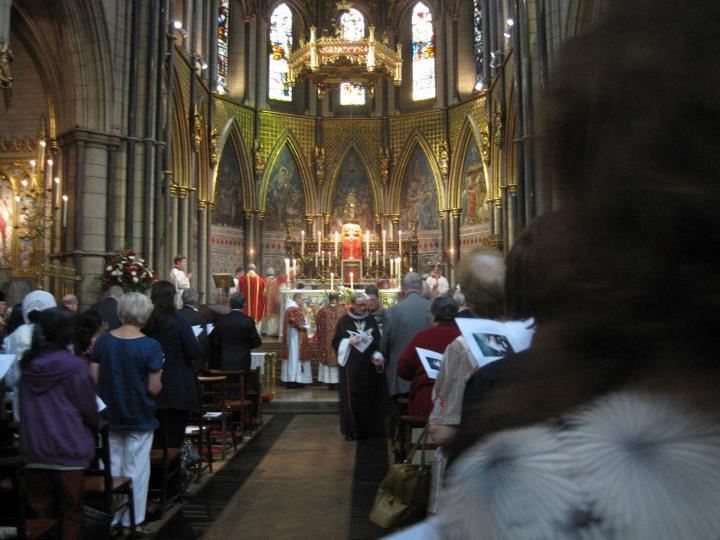
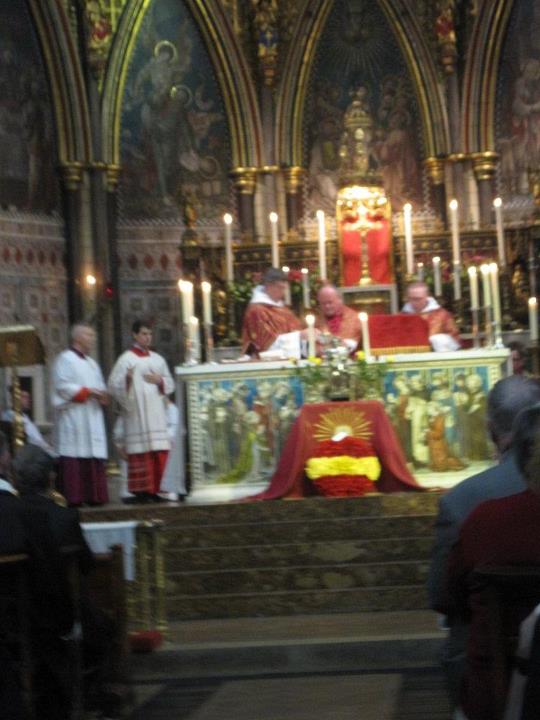
A joyful week of celebration at St James’s, Spanish Place. Wednesday was the Feast of Title, and the Right Reverend Dom Cuthbert Brogan, Abbot of Farnborough, celebrated and preached at Solemn Mass.
The Spanish Ambassador was also present, marking the historic connexion between the people of Spain and St James. Like so many of the older parishes in the Westminster diocese (parish records date back to 1732), St James's Spanish Place can trace its origins to penal times and to the benefactions of a nearby Catholic embassy, and a fascinating explanation of the parish's history can be found on the parish website.
Having previously been based in Ely Place, the Spanish Embassy was once in Hertford House (now the Wallace Collection) and in 1791 a chapel was built in Spanish Place (close to the site of the present church, and of sufficient renown to have been mentioned by Thackeray in Vanity Fair as the church attended by the Marchioness of Steyne) to serve the needs of Catholics serving there.
Although the Embassy moved elsewhere long ago and the London Vicariate assumed control of the chapel in 1827, and although the chapel was replaced by the present building in the 19th century, there are many reminders of Spanish heritage in the church, including Alfonso XIII's personal standard, which hangs above the door from the sacristy into church, and the twin crowns situated above two prime positions in choir set aside for visits from the King and Queen of Spain. It is, however, mere coincidence that the colours of the Spanish flag are reflected in the colours of the Marylebone Cricket Club.
A great occasion, happy for the parish of course and for those of us privileged to be hosted by it, but also happy very specifically for us in the Marylebone Ordinariate Group, because now we found ourselves reunited with one from whom we had been separated. A certain extract from Blessed John Henry Newman's Apologia pro Vita Sua came to mind.
And I earnestly pray for this whole company, with a hope against hope, that all of us, who once were so united, and so happy in our union, may even now be brought at length, by the Power of the Divine Will, into One Fold and under One Shepherd.
We were also delighted to note that among the clergy in the sanctuary, Fr Christopher Pearson was one of the concelebrants.
For us, the highlight among a venerable feast of music was Victoria's O Lux et Decus Hispaniae.
O lux et decus Hispaniae Sanctissime Jacobe, qui inter Apostolos primatum tenens, primus eorum martyrio laureatus. Alleluia.
O light and grace of Spain, most holy James, he who held primacy among the Apostles, was the first of them to take the laurels of martyrdom. Alleluia.
This powerful piece, previously unknown to us, sat beautifully alongside other much more familiar music. The setting of the ordinary of the mass was Mozart's Coronation Mass, and as well as a Jubilate Deo from Giovanni Gabrieli, we were delighted to hear the Finale from Vierne's Organ Symphony No. 1, which had also been played after the Ordinariate's Anniversary Solemn Evensong and Benediction at St James's earlier this year. Those of you interested in hearing what music in St James's sounds like, as well as merely seeing plenty of photos of this stunning building, can find a video on our post entitled A Perfect Setting.
A few photos of the great day follow below. Those of you interested in the Spanish connection will note that the picture of the Abbot preaching (so reminiscent of the excellent photos of Monsignor Newton preaching in that same place some months ago) shows the aforementioned personal standard of King Alfonso XIII of Spain in the background.
Friday's Solemnity was mentioned in advance on this blog. It was such a wonderful day that we are going to have to mention it again. It was a day of piercing clarity, yet also of mystery as to why we had not seen the clear truth before.
Some of us attended the 11am Extraordinary Form mass at St James's, others the 6pm Solemn Mass (Ordinary Form). I could make neither, and ended up at the 12.30pm mass at St Mary Moorfields. This small, beautiful and historic church is in the City of London, and has a packed schedule of masses.
The 12.30 was part of a lunchtime set of masses. There had been a 12 noon, and there was to be a 1.05pm. The mass I attended was pretty well attended, with the church being around half full, perhaps a touch more, and as far as I could tell by the traffic flow of people leaving as I arrived, and arriving as I left, the other masses were quite busy too. There were other masses during the day, not least of which was an evening Solemn Pontifical High Mass in the Extraordinary Form, being celebrated by Bishop Alan Hopes.
The history of the church is worth knowing, a reminder of the tough times that Catholics in this country have endured, and how their fidelity to the Catholic Faith and to the Church has survived some very severe tests. This from the parish website :
The roots of the parish of St Mary Moorfields go back to several chapels that sprang up in the area in the seventeenth and eighteenth centuries.
Catholic worship in those days was illegal.
The chapels were known locally as ‘Penny Hotels’, as people had to pay a penny to a man behind a grill in the door before they were allowed in.
These were hard times for Catholics. In 1736, for example, the Gordon Rioters attacked the chapel in Ropemakers Alley, ripping out its altar, fittings and crucifixes. Following the Catholic Relief Act of 1791, Catholics were permitted to worship in public. And in 1820 the first church of St Mary Moorfields opened in Finsbury Circus. As the permanent seat of the Vicar Apostolic, it served as Cardinal Wiseman's pro-cathedral from 1850 to 1869.
The church was pulled down in 1899 and replaced by the present church in Eldon Street, which was opened on 25th March 1903. The architect was George Sherrin, who also designed the dome of the London Oratory as well as several Underground stations.
We were reminded of how much it has cost some Catholics to remain true to their faith on the recent feasts of St John Fisher and St Thomas More on 22 June. In his introduction and homily that day, Fr Colven reminded us of the horrors of the protestant reformation, and of some of the important details of the lives of these two great saints. While each of these men were known for different things, both were undoubtedly men of integrity and virtue, whose faith came before all else, before comfortable employment, social respectability and the trappings of office.
One of the moments that was particularly striking during that mass was the reading from II Maccabees, where Eleazar's friends try to persuade him to pretend to eat the sacrificial meat while actually eating 'clean' meat that they will provide. When he refuses "Those who a little before had acted toward him with goodwill now changed to ill will, because the words he had uttered were in their opinion sheer madness."
Originally the altar of St Michael, whose statue still remains on the wall above, this altar now honours fourteen of the English Martyrs canonised in 1970. The painting that forms the reredos is the work of Geoffrey Webb. To the left is a statue of St John Fisher whose memory will always be cherished in the University of Cambridge; on the right is a statue of his friend St Thomas More honoured and loved as perhaps the finest flower of Christian humanism produced by the Renaissance. Both were martyred near the Tower of London in the summer of 1535 .
Those of you with an interest in the fascinating history of St James's Spanish Place, surely among the most colourful and intriguing of parish histories, might wish to make yourselves free on Thursday 12th July, in order to attend a talk to be given by Fr Nicholas Schofield, a trained historian archivist, who will be describing the building of the current St James's, including the historical and social context. Tickets are selling well, and cost £20 each.
Back to the Solemnity of St Peter and St Paul at St Mary Moorfields. The parish priest, Fr Peter Newby, a former Catholic chaplain to the University of Oxford, preached a short homily that contained an essential, and very obvious truth. On hearing the Gospel reading for the day, which of course relates Peter's Confession and contains the famous Tu es Petrus, as we discussed in this recent blogpost, one is reminded that serving Christ can only be done in its fullness within the Church, and by that we mean within the Catholic Church, the Church that Christ himself founded on the rock of Peter. The Christ who founded this Church, the Christ whom we seek to serve, is the true Christ, the Christ who is the Son of God, the Christ of the Gospels, not the Christ of our imaginations, of our selfish preferences, of our wishlists. Christ truly was on earth: Peter then, and his Successor now, defend and teach His Truth.
How right this is. For many years, as Anglo-Catholics, each of us in the Marylebone Group felt that we practised and followed the Catholic Faith, and although we prayed for the Pope, although we prayed for Unity, and although we celebrated the 29th June, we failed sufficiently to recognise the importance of being part of that One Church. In some ways, I suppose, we felt that we knew better. We could keep ourselves outside until other people sorted out the arrangements for some kind of corporate reunion. For all the excitement that arises whenever people criticise the Church for regarding X or Y as sinful, surely wilfully keeping yourself outside the Church (when you believe it to be the Church) is far worse, even more so if by doing so you encourage others in the same.
Well, we now know that such arrogance was wrong. The Holy Father offered us the chance to join the fold, and we have done so with joy. We have taken that step, we have played our part in bringing back together the gathered flock into one fold, under one shepherd. We were blind, but now we see.
As ever, Fr Colven's parish notes for this week provide some inspiring reading. We will leave the conclusion to him, after having allowed a little of last Friday night's 6pm Solemn Mass to find its way into this blogpost. It is the custom at St James's that a hymn is sung after mass (there is no need for extra-liturgical hymns to intrude in mass itself, because we are lucky enough to have a choir that sings the appointed plainchant). After the blessing on Friday, Fr Colven announced the last hymn, which was, of course, Full in the Panting Heart of Rome (what other reaction could there possibly be to the Solemnity?), as "The moment you've all been waiting for."
How right he was, not just about the enthusiasm of the congregation to sing this great hymn, but also about how long we had waited to be in the Church, to be Catholics, to be in communion with the Successor of St Peter.
The Rector writes :
As many of you will know, I was not born a Roman Catholic and my reception took place only in middle age. When I am asked to explain this decision, my answer consists of the two words SAINTPETER. The Gospel passage which we heard at Fridays’ joint celebration of the apostles Peter and Paul (Matthew 16:13-19) underlines the Petrine nature of the Church. Jesus judges that the moment has been reached when he can ask those he has chosen about their understanding of his true identity. He begins obliquely, asking who others are saying that he is. They come up with a variety of answers. “John the Baptist” – “Elijah” – “Jeremiah”: but then the question is made specific: “But you, who do you say that I am?” Peter assumes the role of spokesman – he articulates the faith of the others: “You are the Christ, the Son of the living God”. A turning point has been reached. For the first time, there it is out in the open – Jesus is recognised as the One he truly is.
Jesus’ response to Peter’s act of faith is the play on words with which we are so familiar. Peter means “rock” and he is to be the rock on which Christ’s Church will be built. The rock-man, rock hard. The keys of the kingdom are placed firmly in this one apostle's hands. Rightly the Catholic Church has always made much of these texts – for we believe they are not incidental – they are spoken by the Word of Truth, the one Peter recognises as God’s own Son: “It is not flesh and blood that revealed this to you, but my Father in heaven”.
Peter’s central role is part of God’s will for the salvation of his people. This is why Catholics have a special respect and loyalty for the successors of Saint Peter, the popes. Just as Peter acted as the centre of unity among the first group of disciples, so the pope down through the centuries has been the linchpin, holding together the communion of the Church as it spread into differing continents and cultures. The power of the keys, the authority to teach, to decide what is authentic, and what is not, in the transmission of belief and ethics, goes to the very heart of Christian witness in succeeding ages. It is a role which becomes increasingly crucial in a world of growing complexity.
Just as it fell to St Peter to make the first definitive statement about salvation through the person of Christ, so it is the responsibility of his successors, currently Pope Benedict XVI, to articulate a message of salvation for our own times. His, of course, cannot be a lone voice – each of the Baptised shares the responsibility to speak up and speak out, but the Pope, as it were, focuses the message and ensures that it is given expression: "It is not flesh and blood which has revealed this to you, but my Father in heaven”.
As a convert, perhaps I am allowed to say that many Catholic are not aware of the treasure that they have in St Peter and his successors – the gift is too often taken for granted! Those of us who have come late to the harvest do realise that “amidst the changes and chances of this fleeting world one firm anchor” does “holdfast”. In communion with Peter we have the guarantee that all things necessary for salvation are there within our grasp – that the truth will be proclaimed until the end of time: that evil will always be named for what it is and rebuked: and that the tenderness of Christ will continue to be ministered sacramentally and pastorally. What more can we ask than that?
In much of the internet traffic we have spotted encouraging people to attend the Ordinariate's "first birthday party", taking the form of Solemn Evensong, Procession of the Blessed Sacrament and Benediction at St James's, Spanish Place this Sunday (15th January) at 5pm, we have noted a good number of comments about how lovely St James's is. You would hardly expect us to disagree: it is indeed a spectacular and most lovely place in which to attend mass.
However, as those in the Ordinariate are by definition new Catholics, it is perfectly understandable that the "landmark" Catholic parish buildings in London are not as widely known to us as perhap the "shrine churches" of London Anglo-Catholicism are. We are all still learning our way around (even those of us who attended mass at Catholic churches on more than a few occasions before joining the Ordinariate). With that in mind, it seems a good idea to post a youtube video that shows the singing of the Veni Creator Spiritus at St James's on New Year's Day 2011.
This footage shows very clearly the stunning sanctuary, and gives some idea of what awaits those of you who are planning to be with us in Central London on Sunday to share in this great occasion.
You can find out much more about the history and architecture of St James's on the parish website, where there are also some rather good photos. Fr Ed Tomlinson has also posted a good picture here, clearly taken from a similar position in church to the video included above.
You will also find a couple of "exclusive to this blog" (well, taken by my shaky hand) photos in this blogpost on Remembrance Sunday, and in this blogpost on the subject of the parish procession on the Assumption. High up on the right hand side of this blog's sidebar, there is a photo of St James's taken as we celebrated St James's day 2011 with the Papal Nuncio, Archbishop Mennini, as Celebrant and Homilist. Finally, for those who haven't seen the pictures already, a Christmas blogpost showed a couple of photos that I took of the external crib at St James's.
There are many reasons why we hope that Sunday's celebration will be a momentous event, and why we hope that many people will be there to give thanks for the Holy Father's initiative in allowing the creation of the Personal Ordinariate of Our Lady of Walsingham. We also hope that there will be so many reasons encouraging you all to attend that none will be able to resist : the opportunity to celebrate and to give thanks; the opportunity to be among other Ordinariate friends; the opportunity to be among other Catholics and among Anglicans who wish the Ordinariate well; the opportunity to enjoy the fine Anglican Patrimony of Evensong; the opportunity to hear our Ordinary, Monsignor Newton, speak to us on this great day, and to see him give Benediction; the opportunity to hear a fine choir sing some fine music and.......... (hence the blogpost) the opportunity to do all the above in such a fine and inspirational building.