Showing posts with label Solemn Evensong and Benediction. Show all posts

Tuesday, 28 August 2012

Eternal Definitions, Reasonable Changes?

For most of our group, the first anniversary of being received into the full communion of the Catholic Church approaches.  Fr Colven included some very kind words on this subject in this week's parish notes at St James's, and went on to offer a little publicity for an event we hope you will all either attend or include in your prayers.
Sunday 2nd September will mark the first anniversary of the reception into full communion of the local group of the Ordinariate of Our Lady of Walsingham. We will pray for them especially during the 10.30am Mass and would want them to know how their presence within the parish community is valued. The secondary patron of the Ordinariate is Blessed John Henry Newman and to celebrate his feast day there will be Solemn Evensong & Benediction here in Saint James’s on Sunday 7th October at 5.30pm. The preacher will be Father Paul Chavasse of the Birmingham Oratory who has long been associated with the cause for Blessed John Henry’s canonisation.
The poster below should help inspire you to clear a space in your diary, and a Facebook Event has been set up in order to help spread the word.  If you are on Facebook, do please "share" the Event.


Longstanding readers of this blog will remember a fondness on our part for hymns sung by the late Frank Patterson (see here for Hail Redeemer, King Divine and here for Bring Flowers of the Rarest).  News of this upcoming Evensong gives us an excuse to share with you this powerful and rather moving performance of Blessed John Henry Newman's Lead, Kindly Light.


A couple of weeks before this special event, there is the no less significant milestone of the Ordinariate's pilgrimage to Walsingham, taking place on Saturday 15 September.   Another Facebook Event has been created for what promises to be an excellent day in England's Nazareth.


Apart from making kind mention of Ordinariate members in the parish notes last Sunday, Fr Colven took the opportunity of the Gospel readings appointed for the day to make an interesting comparison in his homily, one that can indeed be broadened out even further in order to apply to the context that gave rise to the Ordinariate. 

The Gospel reading had told of how some had found the teachings of Jesus too much, too difficult, too demanding. 
This is intolerable language. How could anyone accept it?
Many left Jesus, but the twelve disciples remained faithful.   Our Lord did not respond to this by altering His message to make it more popular: His message was, and still is, His message.   

Certainly it must be presented in ways that our times can understand, but at the heart of any such presentation must always be that same unchanging message of good news, love and redemption.  Where we water down the message in order to be more popular, then what we convey is no longer His message, but rather it is what we think His message ought to be in order to have more followers, as if we were doing no more than marketing a Facebook fanpage.
Jesus was aware that his followers were complaining about it and said, 'Does this disturb you? ............... After this, many of his disciples went away and accompanied him no more.  Then Jesus said to the Twelve, 'What about you, do you want to go away too?' Simon Peter answered, 'Lord, to whom shall we go? You have the message of eternal life, and we believe; we have come to know that you are the Holy One of God.'
Truth does not depend on popularity, nor indeed on the support of a majority in General Synod.  Fr Colven talked of Blessed John Paul II, who during his long papacy was much appreciated and loved far beyond the Catholic Church and even beyond the realm of Christians, but not everyone who admired this exceptional man wanted to hear the detail of what he had to say.

We might add that the Venerable Fulton Sheen, whose awe-inspiring addresses have featured before on this blog, expressed similar sentiments extremely succinctly and forcefully, as you will see if you scroll down the right-hand side bar of this blog.

Somewhat less succinctly and forcefully, we talked of the same issue in our post Missing the Point, when we explained that joining the Ordinariate is not tantamount to looking at the Catechism and saying "Wow, yes, I would have written exactly that myself," rather it is about accepting what the Catholic Church teaches and the basis of the authority it has to teach.
When you join the Ordinariate, you are not asked to say that if you had the chance to make up your own religion, according to what you felt would represent a popular view in your times of what was good, you would come up with something that was word for word identical to the Catechism. You are not asked to state that there are no hard teachings in the Catechism. You are asked to say that you accept the Catholic Faith as presented in the Catechism. You are asked to say that in Christian obedience you accept that the Church is, using the words of 1 Timothy 3.15, the "...pillar and bulwark of the truth...", and that therefore you accept the teachings of the Church. Specifically, you are asked to declare your faith through the Creed, and to say:
I believe and profess all that the holy Catholic Church believes, teaches, and proclaims to be revealed by God.
You are asked to say nothing more than you have probably sung a hundred times even in your Anglican days, now of course appreciating more completely the meaning of this verse from the hymn (Firmly I believe and truly) drawn from Newman's Dream of Gerontius :
And I hold in veneration
For the love of Him alone
Holy Church as His creation
And her teachings as His own
This has sometimes been criticised as meaning that you must switch your brain off upon becoming a Catholic. That just isn't so. Blessed John Henry Newman explained this point in the Apologia:
From the time that I became a Catholic, of course I have no further history of my religious opinions to narrate. In saying this, I do not mean to say that my mind has been idle, or that I have given up thinking on theological subjects; but that I have had no variations to record, and have had no anxiety of heart whatever. I have been in perfect peace and contentment; I never have had one doubt. I was not conscious to myself, on my conversion, of any change, intellectual or moral, wrought in my mind. I was not conscious of firmer faith in the fundamental truths of Revelation, or of more self-command; I had not more fervour; but it was like coming into port after a rough sea; and my happiness on that score remains to this day without interruption.
He had not changed, he was not a different person. What had happened is that he found himself in a place where what the Church taught was the Truth, however convenient or inconvenient the Truth might be.
That Gospel reading speaks powerfully of a clear message, being the Truth, that is not variable depending upon how popular it is in any generation.  The witness of Blessed John Paul II and of the Venerable Fulton Sheen show the same in two Catholics who lived in our time. 

Those who have left the Church of England to join the Catholic Church are somewhat familiar with the concept, even if on a much less imposing scale.  No-one can say that we have done what we have done in order to be popular.  What we have done is in response to the direct call for Unity expressed in the Gospel, and is, to build on Cardinal Cormac Murphy O'Connor's comments published recently in the Catholic Herald, a step away from the seeming reasonableness of adapting church teaching without reference to Scripture or Tradition towards an understanding of the divinely ordained nature of the Church, its teaching authority, and its guardianship of the deposit of faith.

In the Apostolic Constitution Fidei Depositum, issued in October 1992 upon the publication of the Catechism of the Catholic Church, Blessed John Paul II wrote:
Guarding the deposit of faith is the mission which the Lord has entrusted to his Church and which she fulfils in every age. The Second Vatican Ecumenical Council, which was opened 30 years ago by my predecessor Pope John XXIII, of happy memory, had as its intention and purpose to highlight the Church's apostolic and pastoral mission, and by making the truth of the Gospel shine forth, to lead all people to seek and receive Christ's love which surpasses all knowledge (cf. Eph 3:19).

The principal task entrusted to the Council by Pope John XXIII was to guard and present better the precious deposit of Christian doctrine in order to make it more accessible to the Christian faithful and to all people of good will. For this reason the Council was not first of all to condemn the errors of the time, but above all to strive calmly to show the strength and beauty of the doctrine of the faith. "Illumined by the light of this Council", the Pope said, "the Church... will become greater in spiritual riches and, gaining the strength of new energies therefrom, she will look to the future without fear... Our duty is... to dedicate ourselves with an earnest will and without fear to that work which our era demands of us, thus pursuing the path which the Church has followed for 20 centuries."
The message is the message.  We can and must adapt how we present it and explain it, but the message remains unchanged. 

Finally, a brief follow up on a comment received on our recent post A New Direction.  The comment invited us to look at the St Peter's London Docks blog to find out about the latest thinking among Anglo-Catholics still in the Church of England but who used to say that a Code of Practice will not do.

The Peterite blog used to be a very regular read for members of the Marylebone Group, and has been praised in these pages before.  We much admired the continuing efforts of Fr (now also Dr) Jones to teach the Catholic faith in a church whose parish and indeed whose parish clergy have played such an important part in the history of Anglo-Catholicism.  Given our Pusey House connections, we also liked the Ascot Priory link.  However, in the cold light of day, perhaps we might reasonably wonder if our enthusiasm for the Peterite blog was, with absolutely no criticism intended, a reflection of our own views of our then situation as Anglicans associated with a historically Anglo-Catholic parish in the Diocese of London, a parish that, utterly lovely as it is, bears little resemblance to the reality of the rest of the Church of England.  Did we like the blog because it allowed us to imagine that we were a little less congregationalist?

The person who left the comment on our recent post was perhaps referring in part to this, the penultimate paragraph of Fr Jones's recent post.  It encourages a new vision, rather than just pretending that more of the same is possible, and for throwing out this challenge, Fr Jones is much to be admired.  He goes along with Better Together, but he also knows that as a defining vision, it is somewhat limited and risks appearing hollow:
Well, one way or the other, much will be known and decided before Christmas this time, but nothing will be over or ended. There will however be a new paradigm for Anglo-Catholics to grasp. Whatever the House of Bishops offer, whatever Synod decides, Anglo-Catholics in 2013 will need a new way to see and understand their identity, mission and long term role within Anglicanism. A simple overwhelming 'I'm a Roman Catholic paid by the Church of England' will no longer do, not morally, not Spiritually, not Liturgically, not theologically and not practically.
While we might find the first part of the paragraph rather striking in its "We're staying, come what may" approach (and Dr Kirk certainly would), the second part is perhaps a helpful indication of where things are heading.  No longer the claim that Anglo-Catholics are separated from the wider Church solely by accident of Tudor history and misfortune, no, there is now an acknowledged need for frankness and clarity about what is different, and about why it is felt that difference should not only be allowed to persist but should be cherished. 

Those in Affirming Catholicism have for a long time been clear about why they don't agree with Rome, but perhaps Fr Jones is right that the time has come for Anglo-Catholics more broadly to define their position, now that there is no tangible sense of a move towards unity, of a positive trajectory towards reunion, indeed now that in some instances there is an apparent pride in the opposite. 

As Fr Jones says, the approach exemplified by Dr Eric Mascall's famous fictional Ultra-Catholic is no longer possible: there now needs to be an explanation other than procrastination, fence-sitting or anxiety over practicalities for not joining the Catholic Church.  That explanation might perhaps be extremely good (one hopes that it is about more than second order issues), but it has yet to be given. 
I am an Ultra-Catholic -No 'Anglo, I beseeech you!
You'll find no trace of heresy in anything I teach you.
The clergyman across the road has whiskers and a bowler,
But I wear buckles on my shoes and sport a feriola.

My alb is edged with deepest lace, spread over rich black satin;
The Psalms of David I recite in heaven's own native Latin,
And though I don't quite understand those awkward moods and tenses,
My ordo recitandi's strict Westmonasteriensis.

I read the children in my school the Penny Catechism,
Explaining how the C. of E.'s in heresy and schism.
The truths of Trent and Vatican I bate not one iota.
I have not met the Rural Dean. I do not pay my quota.

The Bishop's put me under his 'profoundest disapproval'
And, though he cannot bring about my actual removal,
He will not come and visit me or take my confirmations.
Colonial prelates I employ from far-off mission stations.

The music we perform at Mass is Verdi and Scarlatti.
Assorted females form the choir; I wish they weren't so catty.
Two flutes, a fiddle and a harp assist them in the gallery.
The organist left years ago, and so we save his salary.

We've started a 'Sodality of John of San Fagondez,'
Consisting of five young men who serve High Mass on Sundays;
And though they simply will not come to weekday Mass at seven,
They turn out looking wonderful on Sundays at eleven.

The Holy Father I extol in fervid perorations,
The Cardinals in curia, the Sacred Congregations;
And, though I've not submitted yet, as all my friends expected,
I should have gone last Tuesday week, had not my wife objected.

Tuesday, 17 January 2012

Ordinariate Anniversary Evensong at St James's

"Happy Birthday" sang the gathered crowds at the reception that followed the service of Solemn Evensong, Procession of the Blessed Sacrament and Benediction on Sunday night at St James's.  There was indeed a feeling of joy and celebration, and the exuberant and spontaneous (if arguably not totally successful) attempt to sing "Happy Birthday, Dear Personal Ordinariate of Our Lady of Walsingham" was proof of that.

One can certainly understand why.  The success of Sunday night exceeded all expectations. 

Earlier in the week, we made reference to the difficulty of planning for a service when we genuinely had no idea how many people would attend.  The number of orders of services printed was based solely on the number of gift aid envelopes we happened to have in stock (281).  The quantities of food and wine were decided on the basis of a guess that 200 of the 281 would come downstairs to the St James's Social Centre to join the reception, noting that Tesco on Marylebone High Street was moments away should the bar run dry and Monsignor Newton's powers to replicate the stock management practices at the Wedding at Cana not prove up to the task.

Setting up the sanctuary after the St James's 4pm parish mass, it was very clear to all involved that there were going to be far more people there than we had dared think possible.  Our estimations had gone from 100 in pessimistic moments to 300 in what we thought were wildly optimistic moments. 

In fact, there were close to 500 people present, filling up the central section of St James's, all the way from the altar rails to the back of church, with some considerable spillover into the side aisles.  Fr Colven, the Rector of St James's, watched proceedings from the triforium, and attempted to count the numbers present : he stopped counting sometime after 400, so our estimates seem to be about right.

The beautiful pictures in this Flickr set give some sense of the scale of the event, as well as of the beauty of the liturgy and of St James's church.  We intend to post some further pictures of the service, as well of the reception, later in the week. 

What was also wonderful was that the congregation was genuinely a mix of people, many Ordinariate members of course, but also a large number of Anglicans and a large number of non-Ordinariate Catholics.  In particular, we were delighted to see a good number of people from St James's who had come to learn more about the Ordinariate.  One of them had turned up at exactly 5pm expecting to be able to take her pick of seats, not being aware that attendance might be high : she said to me afterwards that on arrival it had felt almost like Christmas Eve, both in terms of the numbers and in terms of the sense of anticipation.

That the congregation was made up of these different groups, all coming together through the Ordinariate, was extremely pleasing.  How appropriate that this mix of people should gather to celebrate a movement that is at is heart built on a call to the unity for which Christ prayed on the night that He was betrayed.

We only wish that every one of those, whether Catholics or Anglicans, who do not yet understand the value or purpose of the Ordinariate could have been there to witness the occasion.  This truly was an example of Anglican Patrimony meeting Catholic practice, with the most pleasing results on both sides.  The wisdom of the Holy Father in launching Anglicanorum Coetibus was perfectly visible on Sunday night.

Monsignor Newton's sermon can be found here

Fr Edwin Barnes won the prize for being the first of the well-known bloggers to post on the subject of last night.  This is all the more impressive as he led a coach trip of Ordinariate members from Bournemouth and Salisbury to be with us, so it must have been a rather tiring day.  Here is his report, and I do hope Fr Barnes will not mind if we steal one of his photos to head up this blogpost. 


Another of his pictures, which he posted on the Anglo-Catholic blog, shows Mgr Newton in conversation in the sacristy with the Rector of St James's, Fr Christopher Colven, who kindly allowed us the use of his church and was extremely welcoming and patient with us at all times. 


Other internet reports are now starting to appear.  We note a very positive report on the well known blog A Reluctant Sinner, which has some kind words to say about how Sunday night, among other things, helped to explain to non-Ordinariate Catholics some of the gifts that the Ordinariate, with its Anglican Patrimony, brings with it into the Catholic Church. 

Fr Ed Tomlinson reports here

The Tablet has reported on the event here

The music was, as ever, of the very highest standard.  Thanks are due to Dr Terry Worroll (Director of Music) and Iestyn Evans (Organist) for their part in that, thanks also to the choir of St James's, who with Terry and Iestyn were pleased to have had the chance to sing a very different repertoire from their usual fare.  Many in the congregation commented on how nice it was to hear Anglican Chant being sung for the psalms, with the opportunity it gives the organ to show off its full tone palette.  Although everyone, of course, enjoyed the Introit being Parry's I was Glad, some seemed particularly to like the way that the grand musica anglicana finally gave way in the Tantum Ergo to the beautiful unaccompanied setting of that text by Déodat de Séverac, the perfect prelude to the Benediction that was to follow moments later.


Thanks are also due to John and Paul, of the St James's serving team, who helped us out not only by being acolytes, but by guiding us around the sacristy to make sure we could find all the things we needed.

The format of the liturgy will have been familiar to the many in the congregation who had in the past witnessed similar celebrations at St Mary's Bourne St, with a few variations in the order of Evensong so as to match the order approved by Rome for use in the Ordinariate.  The Procession of the Blessed Sacrament involved around 30 people, and managed to weave its way around church  in a very dignified manner, with the canopy being carried by Knights of Malta.  Working out the order of the procession when the man who wrote the rule book on such things was going to be present (Bishop Peter Elliott) was a daunting task, but I am happy to report that I heard no complaints.

One of the Marylebone Ordinariate Group commented to me that hearing the sacring bell sound in the distance as the procession continued, getting further away and moving round the church was immensely powerful.  This was the first time I had heard (well, it was me doing the ringing) a sacring bell being used in procession in a church on St James's scale, and I can quite imagine that the sound could have had quite an impressive effect as the procession moved around.

It was an honour to have Bishop Peter Elliott (the Holy See's Delegate for the Ordinariate being established in Australia) present, as it was to have His Excellency Fra' Duncan Gallie (Chancellor of the Grand Priory of England, Sovereign Military Order of Malta) and Monsignor John Armitage (Vicar-General, Diocese of Brentwood) there.  It was equally an honour for members of the Ordinariate to be present together with each other, with our Ordinary, Monsignor Newton, and with so many friends and supporters to mark this great day.

Thanks to Monsignor Newton for leading us through both Sunday night and the past year, to Fr Christopher Colven for his hospitality and forbearance, to Sister Catherine in the St James's Social Centre, to Fr Christopher Pearson for his inspired idea of holding an anniversary Evensong and Benediction, and to all those who helped out on the night (not least those from the London (South) Ordinariate Group, without whose fantastic help the reception would have been far harder work for those of us from the Marylebone Group).  This was a great team effort, and it is exactly in this spirit of joyful co-operation that all of us in the Ordinariate intend to carry on, following the Holy Father's call to follow Our Lord's prayer for Unity.

Wednesday, 11 January 2012

A Perfect Setting

In much of the internet traffic we have spotted encouraging people to attend the Ordinariate's "first birthday party", taking the form of Solemn Evensong, Procession of the Blessed Sacrament and Benediction at St James's, Spanish Place this Sunday (15th January) at 5pm, we have noted a good number of comments about how lovely St James's is.  You would hardly expect us to disagree: it is indeed a spectacular and most lovely place in which to attend mass. 

However, as those in the Ordinariate are by definition new Catholics, it is perfectly understandable that the "landmark" Catholic parish buildings in London are not as widely known to us as perhap the "shrine churches" of London Anglo-Catholicism are.  We are all still learning our way around (even those of us who attended mass at Catholic churches on more than a few occasions before joining the Ordinariate).  With that in mind, it seems a good idea to post a youtube video that shows the singing of the Veni Creator Spiritus at St James's on New Year's Day 2011. 


This footage shows very clearly the stunning sanctuary, and gives some idea of what awaits those of you who are planning to be with us in Central London on Sunday to share in this great occasion. 

You can find out much more about the history and architecture of St James's on the parish website, where there are also some rather good photos.  Fr Ed Tomlinson has also posted a good picture here, clearly taken from a similar position in church to the video included above. 

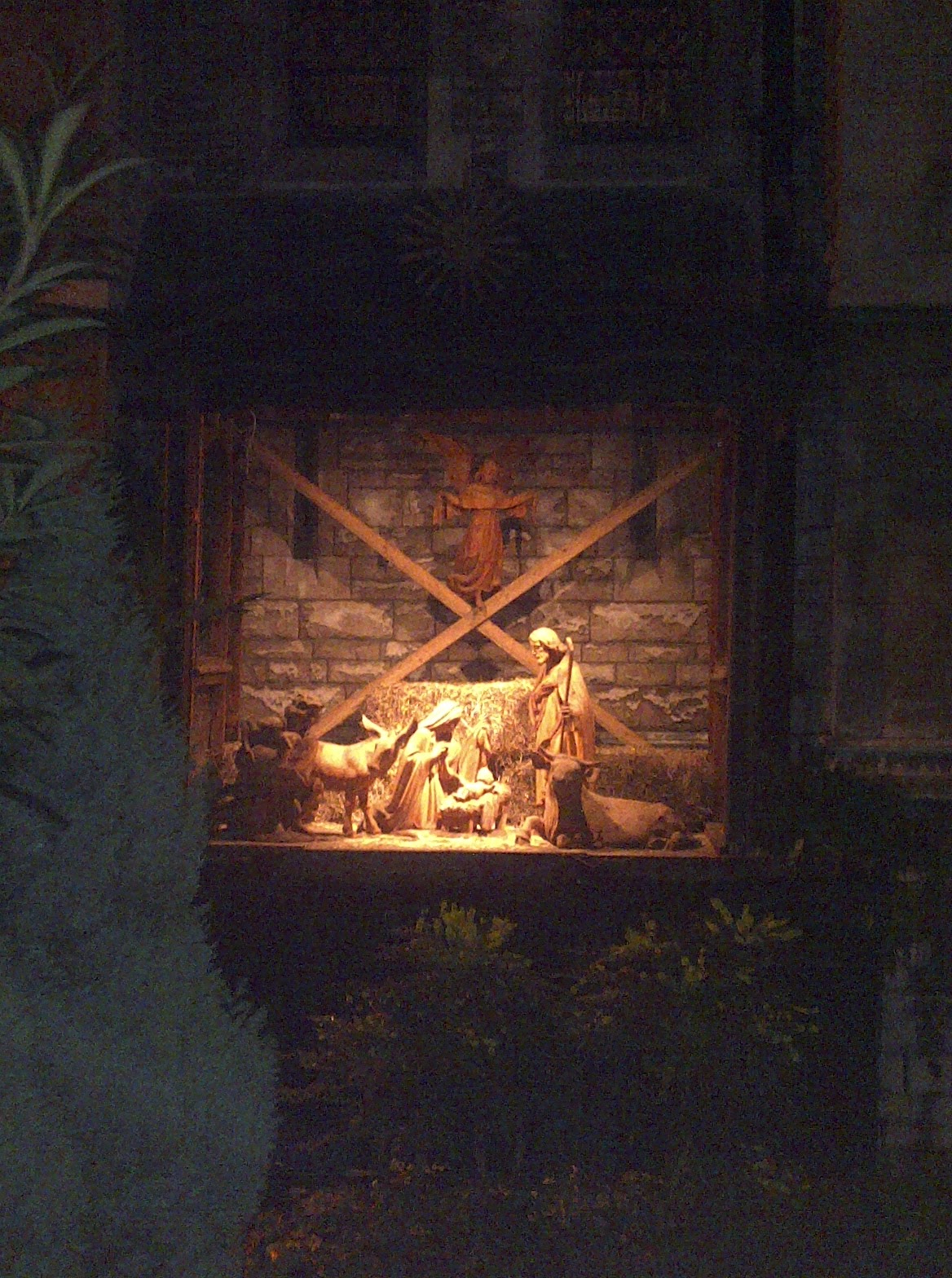
You will also find a couple of "exclusive to this blog" (well, taken by my shaky hand) photos in this blogpost on Remembrance Sunday, and in this blogpost on the subject of the parish procession on the Assumption.  High up on the right hand side of this blog's sidebar, there is a photo of St James's taken as we celebrated St James's day 2011 with the Papal Nuncio, Archbishop Mennini, as Celebrant and Homilist.  Finally, for those who haven't seen the pictures already, a Christmas blogpost showed a couple of photos that I took of the external crib at St James's. 

There are many reasons why we hope that Sunday's celebration will be a momentous event, and why we hope that many people will be there to give thanks for the Holy Father's initiative in allowing the creation of the Personal Ordinariate of Our Lady of Walsingham.  We also hope that there will be so many reasons encouraging you all to attend that none will be able to resist : the opportunity to celebrate and to give thanks; the opportunity to be among other Ordinariate friends; the opportunity to be among other Catholics and among Anglicans who wish the Ordinariate well; the opportunity to enjoy the fine Anglican Patrimony of Evensong; the opportunity to hear our Ordinary, Monsignor Newton, speak to us on this great day, and to see him give Benediction; the opportunity to hear a fine choir sing some fine music and.......... (hence the blogpost) the opportunity to do all the above in such a fine and inspirational building.

See you on Sunday.

Tuesday, 10 January 2012

Nearer and Nearer Draws the Time

And which time would that be, you may ask?  For the purposes of today's post, there are two times to which I refer.

The first, of course, is Sunday's anniversary Solemn Evensong, Procession of the Blessed Sacrament and Benediction at St James's Spanish Place.  This is shaping up to be quite an event.  Fr Colven kindly included a notice about it in this week's parish notes at St James's, inviting parishioners to join us.  The relevant extract is below.
To mark the first anniversary of the setting up of the Ordinariate of Our Lady of Walsingham (Pope Benedict’s initiative for Anglicans coming into full communion with the Catholic Church), there will be Solemn Evensong & Benediction here at Saint James’s at 5pm (note time) next Sunday 15th January – Monsignor Keith Newton will preside and Bishop Peter Elliott, the Holy See’s Delegate for the Ordinariate in Australia, will be there. Everyone is welcome to share in this example of Anglican patrimony!
Beyond that, we continue to pick up "internet chatter", as the security services say, on the subject.   We have already highlighted posts by Fr Ed Tomlinson and Fr Edwin Barnes about visitors coming to London from Tunbridge Wells, Salisbury and Bournemouth.  We have also now spotted a post by Fr Jeff Woolnough about people travelling in from Southend.  There is even an announcement on the website of the Scotland Ordinariate Groups.  All are welcome, not only Ordinariate members, but all Catholics and all Anglicans, indeed anyone who wishes to mark with joy and thanksgiving this first anniversary of the Ordinariate's existence.

A sterling job seems to have been done about spreading the word (see our earlier blogpost here).  Not only Deacon Daniel Lloyd's excellent poster (as reproduced once again, shamelessly, below) but also a mention in The Portal and a popular Facebook event.  Readers have "shared" messages that have been posted on the Marylebone Ordinariate Group's Facebook fansite on their own "walls", as well as sending emails containing links to our blogposts to their own friends.  For all this publicity, we thank you very sincerely.  Keep up the good work, and please don't relent until 4.59pm on Sunday.


The Facebook Event is intriguing.  Not everyone we know who has declared that they are coming has yet accepted on Facebook, but equally that demonstrates that a lot of people do not manage their diary via Facebook events.  Given that that is the case, we think that the number of people who have accepted on Facebook under-represents the proportion of those who have been invited via Facebook that will attend.  All this makes estimating the quantities of food and wine to purchase rather tricky.

The work associated with the preparations has been shared fairly around between us all in the Marylebone Ordinariate Group, and with Fr Christopher Pearson and Fr Christopher Colven helping and guiding us, we are hopeful that all of you who make the effort to attend will feel more than glad that you did.
  • A draft Order of Service has been prepared and awaits its imprimatur. 
  • Wine is arriving on Saturday to refresh the throats of those tired after so much singing.
  • The St James's choir is very much looking forward to the opportunity to sing from a repertoire that they don't get to sing very often at Spanish Place.  The Director of Music and the Organist, both former Anglicans themselves, are also very keen.
  • A serving team has been gathered and is shortly to be briefed.
  • Knights of Malta are at the ready to carry the canopy in procession.
Please continue to tell or to remind everyone you know about what is happening next Sunday at 5pm in St James's.  It promises to be an event to remember, and will demonstrate to everyone not just that the Ordinariate is alive and well, confident and keen to show potential joiners and all well wishers that those who join are delighted to have done so, but also that we are of sufficient scale, and sufficiently well organised, to mark our great days in this way.

So what is the other time that is drawing near?  I want to highlight a blogpost by Fr Ed Tomlinson from earlier today.  It picks up on a theme that has been circulating more and more in recent weeks, for example in Geoffrey Kirk's recent peerless article in New Directions (never has the case been argued more succinctly and more irrefutably), and indeed even here on this blog, in one of our most read posts Denial Ain't Just a River in Egypt.    The theme is that the time is coming for those Anglo-Catholics in the Church of England to face up to some tremendously difficult decisions.  We do not envy them this, leaving is never easy, and we offer our heartfelt prayers for all those who find this a very troubling time, yet for the detailed reasons set out by Geoffrey Kirk and by the inimitable and ever-forthright Fr Ed, they are being forced to arrive at the crossroads.  General Synod meets in a few weeks from now to vote on proposals that really would pull the rug out from under the feet of remaining claims of CofE catholicity: with this and with the upcoming second wave of Ordinariate joiners, it will be a difficult time for remaining faithful Anglo-Catholics.

In his post, Fr Ed explains why it is only natural that those of us in the Ordinariate should continue to be interested in and care about what is happening in our former home, and sets out his vision of the future for the various groups who would categorise themselves as Anglo-Catholics, or as being on the catholic wing of the Church of England.

We commend his whole blogpost to you.  It can be found here.  As a taster, here is Fr Ed's powerful conclusion.
I hope this post, which could do with more time to be written properly, presents the reasons I believe Ordinariate members not only have a right but a reason to debate with those left behind. Our hope is not to poach happy Anglicans – that would be rude- but to call to those people who rightfully belong in the Catholic church. And who could oppose such desire which springs from a concern for truth and spiritual welfare?

Doubtless though some readers will be angry. They will not like what I have written. I only ask this question. Is it because the analysis is wrong or because it touches a raw nerve? I have no desire to upset but surely we need clarity and honesty as we look to the future…

Perhaps it is time those who now lead the Anglo-Catholic movement to provide a coherent and convincing argument of why they claim to remain ‘Catholic’ having said no to the offer from Rome and having accepted the reality of life within a fast evolving synodically governed church?  Out of respect this needs be done without downplaying or dismissing the Ordinariate which is an initiative of the Holy Father himself.

If they cannot do this conviningly then it is surely time they were honest with their people. The Catholic option is the Ordinariate. The stay at home option is now, logic and honesty dictates, that of being- not Catholic- but congregational high church protestants within a liberalising body. I would dearly love an answer that is consistent with everything the Catholic movement of the C of E has said over the last half century. A movement which always looked to Rome and prayed for unity with Peter.
One thing that we hope and pray that Sunday will achieve is that we will be able to demonstrate that we are a happy and confident body of people, delighted with the decisions we have taken (as hard as they were) and without any regrets.  The Holy Father has offered the same welcome to all who wish it, a chance to bring treasured Anglican heritage and usually extremely "sound" catholic teaching with you into the full communion of the Catholic Church.  Let us all do our very best to make any Anglicans who attend on Sunday, and any who might read of the event, hear of it, or see photos of it, want to find out more about what makes us so happy with the path we have chosen.

See you on Sunday, DV.........

Thursday, 5 January 2012

An Idea Whose Time Has Come

We have previously mentioned Dr William Oddie's reflections in his marvellous book The Roman Option that an Ordinariate in the UK might well have come about in the 1990s.  If he is right, and certainly his writing is very convincing, then perhaps that might have smoothed the Tiber crossing for some, but our feeling is more and more that the way things have worked out is by no means an inferior outcome. 

The turn of the year is a natural time for this kind of reflection (both the end of the liturgical year and the end of the calendar year), but so too is the upcoming first "birthday" of the Ordinariate of Our Lady of Walsingham.  Preparations for the great day continue, and we are pleased to note multiple blogposts by Fr Edwin Barnes and Fr Ed Tomlinson talking of plans for their groups to join us on the big day, and we can tell from acceptances being received on the Facebook event set up to advertise the 15th that people are putting the date in their diary.


Thinking of these anniversary celebrations has brought home just how much we feel that there is indeed something to celebrate, not just something to mark or to note, but in fact something that we truly feel like celebrating with joy and thanksgiving.  There have been adjustments to make of course, not least losing such frequent contact with many very good friends from St Mary's Bourne Street, but none of our little Ordinariate group feels the slightest regret at our decision to become Catholics. 

The timing of the birth of the Ordinariate was perfect for us.  Of course we sometimes wonder, with the great benefit of hindsight, how it was that we didn't make the leap earlier, but frankly it doesn't matter.  The Ordinariate came into existence at precisely the time when we felt that our situations were starting to become untenable : the huge sense of welcome present in Westminster Cathedral on 15 January 2011 (at the ordination as Catholic priests of our three monsignori) was precisely the right thing to set us on our way.

A truly excellent article by Geoffrey Kirk in the latest edition of New Directions, and brought to our attention by the Ordinariate Portal talks of why it is that those Anglo-Catholics still trying to live out the Catholic Faith in the Church of England might also consider that the solution that the Ordinariate provides has arrived at precisely the right time for them. 

In our previous post Denial Ain't Just a River in Egypt we talked about some of the same group of people that Geoffrey Kirk considered.  There are those who do not (or in some cases who wilfully refuse to) see the clear logic of the case Dr Kirk presents.  However, our thoughts should most of all be for those who find themselves very confused by what is happening around them, who see the difficulties facing their beloved Church of England, and yet who do not feel that the Catholic Church (whether through the Ordinariate or otherwise) is right for them at the moment.  Those people are in a very tricky situation, and they fully deserve our prayers and best wishes.  We can only hope that the joy with which we feel the anniversary of the Ordinariate's existence should be marked will be a sign to them that there is a solution, and that there are people who are more than willing to help show them the clear benefits of accepting it. 

For all this discussion of now being the right time for the Ordinariate, there are nonetheless those who continue to want to knock the Ordinariate.  In the same earlier blogpost we talked of various groups of people who are not yet sure of what the Ordinariate is about, and we acknowledged a continuing obligation on the part of all of us in the Ordinariate to explain ourselves to our fellow Catholics and to interested Anglicans.  However, we also talked of those who are not belittling the Ordinariate out of unfamiliarity or ignorance, but out of a deliberate desire to be dismissive. 

For example, there are those who argue that being made up of around 60 clergy and around 1000 laity makes the Ordinariate of Our Lady of Walsingham very small.  Another c.20 clergy and another c.200-300 laity entering the Ordinariate this year doesn't seem to cause them to change their opinion on this.  The idea that if the Church of England's General Synod goes the way that most expect it to in February, there might well be one or two more Ordinariate joiners seems to fall on equally deaf ears.  True, even the most ardent fan of the Ordinariate would have to concede that these figures are not Pentecostalist in scale, but you have to be pretty obstinate to argue that this is not a significant shift.   With the obvious exception of the years following 1992-1993, how many other times in living memory has there been a shift on this scale between the Church of England and the Catholic Church in this country, with the realistic hope of more to follow? 

Others criticise the Ordinariate for not being a single homogeneous entity, with disparities between its constituent groups (though it isn't easy to see how those in the Church of England can say such things with a straight face).  It is fair to say that the groups are in many varied situations, but it seems ludicrous to suggest that this is a sign of failure or insignificance. Some groups are smaller than others; most have their own masses while the members of other groups attend parish mass with their new Catholic brothers and sisters; some are geographically in a diocese which is more overtly supportive to the growth of the Ordinariate than others; there are more groups in the south than in the north.  Yet, to this list of differences, my response would be "So what?"  There is one thing that is far more important than all these differences, and that is that all those who have joined the Ordinariate have followed our convictions and have become Catholics, by means of a structure put in place by the Holy Father, specifically recognising that we do not join with nothing, that we have years of sound teaching, sound tradition and sound faith behind us, and that we might even have something useful to bring into the Catholic Church.

The time had come for us, just as it has for many ex-Anglicans over the centuries (not just in the period following 1992-1993), and just as it will for many others who wish to avail themselves of the provisions of Anglicanorum Coetibus and come into the full communion of the Catholic Church.  The Ordinariate was there to welcome us into the fold, and it behoves all of us to do our best to ensure that anyone else who might consider joining the Catholic Church is aware of the benefits that working towards Christian Unity by being a part of the Ordinariate might bring. 

The fruits of Anglicanorum Coetibus are not limited to this country.  This is no flash in the pan, no phenomenon that will drift away quietly after the first people joining the English Ordinariate have quietened down.  We would like to congratulate Fr Jeffrey Steenson on the announcement of his appointment as Ordinary of the Ordinariate of the Chair of St Peter, the Ordinariate that will welcome former Anglicans into the Catholic Church in North America, in the same way as the Ordinariate of Our Lady of Walsingham does here.  What an excellent name for this second Ordinariate formed under Anglicanorum Coetibus, with its link both to the relic enshrined so prominently at St Peter's in Rome and to the feast day that starts the annual Week of Christian Unity. 

The establishment of this North American Ordinariate is also a source of great joy, as will be the establishment of the Australian Ordinariate later this year. 

Let us all make every effort to display that sense of joy and thanksgiving by being present at St James's for Solemn Evensong, Procession of the Blessed Sacrament and Benediction on the 15th January.  The time for the Ordinariate is indeed now, as is the time to celebrate its first year of existence, and the birth of sister Ordinariates in North America and Australia.

Tuesday, 3 January 2012

Spread the Word

A Happy New Year to all of our readers. 

January is often a slow month, painfully so.  However, the first January of the Marylebone Ordinariate Group's existence is far from slow.  Preparations for the Solemn Evensong and Benediction being held at St James's to mark the first "birthday" of the Ordinariate of Our Lady of Walsingham are well underway, and as you might expect the workload will increase day by day until we finally reach the fifteenth.   Music, clergy, serving, wine/food, orders of service, publicity etc.  The largest challenge of course is estimating numbers, much of the rest flows from that. 

The enthusiasm of Fr Christopher Pearson and the extraordinarily helpful welcome, patience and accommodativeness of Fr Christopher Colven make life much easier in putting things together.  To both of them we say thank you. 

We have been very pleased to read of the plans being made by other Ordinariate groups around the country to join this great celebration.  Fr Edwin Barnes's excellent blog Ancient Richborough (to which we provide a permanent link on the right hand sidebar of this blog) has talked of people planning to travel to London from Bournemouth and Salisbury.  Fr Ed Tomlinson's Tunbridge Wells Ordinariate Group blog (to which we also provide a permanent link) mentions that he hopes that a group will travel in from Kent.

No-one can be sure of course until we see the numbers in church on the day, but the impression we have, from emails received and internet postings spotted, is that Ordinariate members seems to be very keen on there being an opportunity to get together to celebrate one year of the Ordinariate.  For many, there will of course be the extraordinarily happy memory of a visit to Westminster Cathedral on 15 January 2011, where we witnessed the ordination as Catholic priests of our three Monsignori, and were gather together in large numbers at the birth of something really quite extraordinary.  The atmosphere of hope, joy, welcome and indeed thanksgiving that day was astonishing.

One part of that will be the music.  There will be a selection of very rousing and mostly very well known treasures of Anglican cathedral evensong repertoire.  No doubt the ever-impressive St James's Spanish Place choir will turn in a excellent performance.   What a joy it will be to hear this music in our new Catholic setting. 

You can see what music has been chosen on the Facebook Event page for our celebrations.  You do not have to be signed up to Facebook to view this, but if you are and if you intend to come along, please do sign up to attend, and from there you will have the option to invite your own Facebook friends.  This is a fantastically easy and efficient way to spread the word about the 15th, so please do invite people you know through the Facebook system: if they have already been invited by someone else, Facebook will stop you inviting them a second time, so there is no need to worry about deluging your friends.

Indeed, more generally, do please tell all your friends about this event, and if you run a blog of your own, please do mention it there too.  This could be a great occasion, when we will have the chance to come together and express our joy at where the last year has brought us, and along with Catholics and Anglicans present, give thanks for this wonderful gift of the Holy Father to the cause of Christian Unity. 

You may wish to display a poster on your church noticeboard.  If so, you can find the very attractive poster designed by Deacon Daniel Lloyd of the Oxford Ordinariate Group below.  Decent A4 prints will result even from saving and printing this image.


Finally, you might find the article in this link interesting.  There, William Oddie talks about how some of the linguistic treasures of the Book of Common Prayer are being brought into the Catholic Church through the Ordinariate, particularly the newly Catholic service of Evensong and Benediction.  His article talks of earlier evensongs run by the Oxford Ordinariate Group, following Monsignor Burnham's pioneering work in sorting out a form of evensong approved for use in the Ordinariate. 

Don't forget : tell all your friends about the 15th.

Thursday, 29 December 2011

A Catholic Christmas

A few days ago, on Christmas Eve, we put up a blogpost shortly before going to Midnight Mass, our first Midnight Mass as Catholics.  In it, we talked of looking back to how we had marked Christmas in previous years, and sent our best wishes to our friends at Bourne Street.  No doubt you are all dying to know how it all went, and how we felt in the new environment.  Worry no more.

First of all, a couple of photos : before and after photos of the Outdoor Crib at St James's, taken upon leaving from and arriving for Midnight Mass.


The pictures may be of too poor quality for you to notice that the first one, the "after" picture, has the representation of the Infant Jesus in the manger, whereas the second one, the "before" picture does not.  If you happen to be passing St James's in the next few days, do walk along George St and have a look.

Back to the comparison between this year and last.  Last year was probably my favourite ever at Bourne St.  One of the pleasing constants between last year and this year was the Proclamation of the Nativity.  In 2010, I had the chance to chant this.  It was being sung for the first time at Bourne Street (as far as anyone could remember), inspired by noting that the chanting of this text had returned at St Peter's in Rome, and had been appearing at Anglo-Catholic parishes such as St Barnabas Tunbridge Wells and St John's Sevenoaks.  Here is a photo of that moment, and yes, I can confirm that reading the text and plainchant was not at all easy in the dark. 


This year, after carols from the choir (including the always popular O Holy Night), and at the start of Mass one of my favourite hymns (It Came upon the Midnight Clear), Fr Irwin ascended the pulpit steps and read the same well known text from the Roman Martyrology.  It was wonderful to hear those words again.

There are those who are not keen on the Proclamation of the Nativity, on the grounds that its historical accuracy is not always beyond challenge.  The text is indeed very specific about its dates, but perhaps one should not get too hung up about this, otherwise why mark Christmas on 25 December, why refer to this year as being 2011?  The point of the text, as it is read or chanted to us today, is to remind us that at a particular moment in our human history, God clothed Himself in human flesh, humbling Himself to be amongst us as one of us.  This was something that happened at a real point in time, as tangible as the time at which Midnight Mass started last Saturday night. 

St James's was packed to capacity, but with customary Spanish Place efficiency, the entire service was concluded and many hundreds communicated (to the accompaniment of the Darke setting of Rossetti's In the Bleak Midwinter) in only a little over an hour. 

As so many times before, there was a huge amount that was familiar to us about this service.  The Proclamation of course, but also the habit of sticking to a midnight start, and the habit of the Procession to the Crib occurring at the end (during that procession, what a pleasure it was to sing Adeste Fideles in Latin : I haven't done that since school). 

It was a true joy to be there.  We were delighted to have made the effort to have turned up so early, even by ten past eleven there was little seating left in the front half of the church.  The only slightly negative note was that even though St James's was absolutely full, we were conscious of those who were no longer with us, ie those at Bourne St with whom we had shared many Christmas midnights.  Prayer for Christian Unity must continue.

Happily, to distract us from any temptation towards such self-indulgent melancholy at this festive time of year, we are now very much throwing ourselves into the task of helping with the arrangements for the Ordinariate's "first birthday" service on Sunday 15th January, to be held at St James's.  It promises to be a very exciting event, the perfect occasion on which to give thanks for the creation of the Ordinariate and its huge contribution to the increase of unity amongst Christians in this country. 

At 5pm that day, we will have Solemn Evensong, followed by a Procession of the Blessed Sacrament and finally Benediction.  The music list is now being put together, and promises to be spectacular.  Those of you who know St James's will know that the choir is of a very high standard, so we will all be able to look forward to hearing some very fine and mostly familiar pieces of Anglican choral music in a splendid new Catholic setting. 

We have asked you before, and we will ask you again, do please come along on the 15th, and do please encourage all your friends to do so too, Catholics and Anglicans. 

To conclude, what else but O Holy Night.  Not in the choral setting in English that we all know, but in the original French : the Cantique de Noel Minuit, Chrétiens by Adolphe Adam, here sung by Robert Alagna. 

Tuesday, 20 December 2011

Anniversary Artwork

We have already mentioned the event being held on Sunday 15 January 2012 at St James's Spanish Place, but here is another reminder (the first of many to come), this time including some artwork. 

At 5pm on that happy day, to mark the Ordinariate's first "birthday", Monsignor Newton will preside over a service of Solemn Evensong, Procession of the Blessed Sacrament and Benediction.   More details to follow.

Please do make every effort to attend, and do encourage your friends to do the same.


20111220-080800.jpg

Monday, 19 December 2011

Annuntio Vobis Gaudium Magnum

It seems that almost every time I have attended Mass at Westminster Cathedral over the past year, something newsworthy happens in connection with the Ordinariate.  Yesterday seems to have been no exception.  Before announcing what the news of great joy is (in the unlikely event that you don't already know), here is yet another of my grainy pictures, this time showing the procession leaving after the 5.30 Mass yesterday evening.


There were several things that struck me about yesterday's Mass.  The fact that the animatrice not only had an excellent voice, but that she was extremely useful (my experience of witnessing people perform this role before has not always been as happy).  The powerful intercessions, asking God's blessing on and guidance for those preparing to make their Advent confession, and equally for the priests preparing to hear Advent confessions.  The singing of O Come O Come Emmanuel by the congregation, which seemed to fill over 80% of the seating, impressive on a bitingly cold December evening. 

One thing, more than anything else, stood out yesterday.  It wasn't particularly seasonal at all, and indeed I have witnessed it before (including precisely one week ago), but it really spoke to me yesterday.  Canon Christopher Tuckwell was the Celebrant : at the censing, as he stood alone under that magnificent baldacchino, facing the Cross on the altar, it really was the clearest vision imaginable of the priest going into the holy of holies, preparing for something truly momentous, going alone to the altar in persona Christi to offer that most perfect sacrifice.  Somehow the simple sight of a solitary figure standing before and then moving around that massive and splendid altar generated a clarity of vision that I had rarely experienced before. 


Back to the great news.  You may have noticed on the Ordinariate website, or in their newsletter, or even on the Facebook site of the Marylebone Ordinariate Group (if you haven't yet signed up to "like" our Facebook page, please do so), that there is a special anniversary coming up.  On January 15, it will be exactly one year since that momentous day in Westminster Cathedral when Monsignor Newton, Monsignor Broadhurst and Monsignor Burnham were ordained as Catholic priests by Archbishop Vincent Nichols.  That day was the day on which the Ordinariate of Our Lady of Walsingham was formally erected.

That day was also of huge importance in the progress of the members of the Marylebone Ordinariate Group towards becoming Catholics.  The huge and joyous congregation, the sense of warmth and welcome and that this was precisely the right thing to be doing, the dignified liturgy, the excellent music, the feeling of there being a shared purpose and a shared set of beliefs, the goal of Christian Unity coming nearer: these were all factors that combined to become a significant influence on us and no doubt on many others. 

Therefore, it is only right that this day should be marked in some way. 

At 5pm on Sunday 15 January, by kind permission of the Rector, Fr Christopher Colven, there will be a service of Solemn Evensong and Benediction (in the rite approved for use in the Ordinariate) at St James's, Spanish Place.  Monsignor Newton will preside.  As St James's is the parish church in which the Marylebone Ordinariate Group meets, we are of course particularly delighted about this event.

(Those of you who have not yet read William Oddie's excellent book The Roman Option, written in 1997, which sets out with astonishing prescience a vision of what is only now beginning to come to fruition, will not have seen the excellent letter included as an appendix to the book : it was a letter written in 1995 by Fr Colven when he was the Vicar of the Anglican parish of St Stephen's Gloucester Road, talking to his parishioners about his decision to join the Catholic Church, and the possibilities for some of them to do the same.  It is most definitely worth reading.)

Much is in the planning still for this service of Solemn Evensong & Benediction, and so cannot yet be revealed, but this promises to be a very exciting day.  We have much to give thanks for, and much on which to ask for guidance.  Marking this occasion in the form of a Solemn Evensong & Benediction, perhaps one of the "trademark" services of Anglo-Catholicism and yet perfectly adaptable to Catholic worship, in such a beautiful church seems exactly the right thing to do. 

We ask you all to publicise this event as widely as you can, perhaps by sending this blog article to your friends, sharing the Facebook link to this post, and/or by increasing awareness of the event in any way you can find.  We want Ordinariate members, all Catholics, any interested Anglicans, and indeed all wellwishers to be there to express their support by their presence and through their prayers.  The Ordinariate is the Holy Father's personal project, and certainly all Catholics will most surely want to do everything they can to advance it. 

Even as we watch and wait in the last days of Advent, in preparation for the great Solemnity ahead of us this Sunday, let us give thanks and praise to Almighty God for the existence of the Ordinariate of Our Lady of Walsingham, for the nascent Ordinariates in the USA, Australia and Canada, and indeed for Pope Benedict XVI's marvellous initiative of Anglicanorum Coetibus.

Tuesday, 18 October 2011

From Geneva to Oxford with St Luke

A daytrip to Geneva today.  From here in Paris, where I work, the capital city of the Eldest Daughter of the Church, to the home of Calvinism.  Readers will be glad to know that I managed to return without having had a change of heart on having joined the Catholic Church.  One can imagine that for a certain kind of Anglican visiting the Eternal City of Rome at the moment, such a trip might be rather tougher on the convictions, but as it is, I remain steadfast in the Faith.

However, Geneva is a wonderful place, and the weather today certainly beats the grim drizzle that greeted me on my return to Paris a little earlier on.  The first picture was taken just after lunch in the Place du Molard, the second on Lake Geneva, and the third in the sunshine of Paris.


Today is the Feast of St Luke, author of the Gospel of Luke and of the Acts of the Apostles.  These texts are of course full of very widely known passages, but perhaps in the context of a blog related to the Ordinariate, it makes sense to refer to the Magnificat.  The Magnificat is the Canticle of Mary, one of the most ancient hymns of the Church, and certainly one of the most ancient Marian texts.

There is a link there of course to Our Lady of Walsingham, but in any discussion of Anglican Patrimony, the topic of Solemn Evensong and Benediction comes up, and there one can find a veritable wealth of Anglican music that can be used in a Catholic setting.  The Oxford Ordinariate group has done some pioneering work in this regard, already having held a service of Solemn Evensong and Benediction, and planning to hold another one tomorrow night (19 October at 19h30) for the Feast of the Patron Saint of Oxford, St Frideswide.  Here is the Magnificat as sung at their June Solemn Evensong and Benediction.


The poster for their event tomorrow night is shown below.


It is hoped that we may eventually be able to co-ordinate something similar to occur at St James's, Spanish Place, but this is yet in the planning and subject to the agreement and consent of many parties.  It could be a great opportunity to gather together, from all across London and the South East, a decent number of Ordinariate members, non-Ordinariate Catholics who like the tradition of Solemn Evensong and Benediction, and Anglican friends of the Ordinariate eager to see an example of Anglican Patrimony in use.

The big question now is which Stanford Magnificat to include as the closing piece of music in this blogpost.  Stanford is perhaps the classic composer of Anglican settings of the Magnificat for Evensong.  His best known setting is arguably the one in B flat, a staple of parish church choirs and public school chapels up and down the land, but that is perhaps not the finest.  For me, it is a tie between Stanford in G (with the image, created by the "spinning" of the quaver accompaniment to the treble solo, of the maiden at her wheel) and the majesty and delicacy of Stanford in G.  In for a penny, in for a pound - let's have both. 


Our Lady, pray for us.
St Luke, pray for us.