Showing posts with label Blessed John Henry Newman. Show all posts

Thursday, 1 November 2012

Slow Moving Traffic in London

As Ordinariate members who used to be part of the Anglican Diocese of London we were, of course, intrigued by the news that Richard Chartres has at long last persuaded somebody to fill the vacancy created by the departure of Monsignor Broadhurst.  We sometimes wonder about what might have been, and indeed about what could still be, for Anglo-Catholics who live in that great and historic territory.  In spite of this topic being so close to home for our group, it is not something we have yet explored in any detail here.  As so far only an occasional contributor to this blog, I thought it might be appropriate for a new(ish) voice to offer some thoughts on this, and thereby to remedy this oversight.

In an earlier post on the subject of Anglican Patrimony, we highlighted the danger to blood pressure levels that goes with reading comments on news articles, and more particularly on blogposts. Once you go even further and start to read internet forum discussions, then you really are starting to take risks with your health.

Mercifully, comments on this blog (if they make it past censorship) are often complimentary, and are invariably constructive either of themselves, or through allowing an important point to be made in response.

Notwithstanding this health warning, recent perusal of a few internet forums that touched on Ordinariate matters revealed a comment that is worth exploring. The comment asked about the Ordinariate in London, specifically in the area where the Ordinariate's territory overlaps with that of the Archdiocese of Westminster. This area is next to territory covered by the Archdiocese of Southwark and the Diocese of Brentwood, where some of the largest Ordinariate groups in the land can be found: yet where the Ordinariate overlaps with the territory of the Anglican Diocese of London, we are not (yet) present in large numbers.


The comment suggested that, because of this, we should all simply forget about the Ordinariate in this area, and that any Anglican who wants to join the Catholic Church should do so solely through the RCIA process in his or her nearest parish. That option is of course available to any who wish to follow it, and always has been, but we have discussed at very great length (here and here, for example) how that recommendation betrays unfamiliarity with, and severely underestimates the tremendous wisdom of, the Holy Father's personal project. That is not a criticism: more than anything else, the comment reflects the ongoing need for the Ordinariate to continue explaining its origins, its purpose and its status in the Church. We referred to this phenomenon here and here, and we understand that an "awareness" programme (to use trendy language) is being planned.

Still, the observation that generated the comment merits further consideration. Why is it that the Anglican Diocese of London, particularly the Two Cities Area (ie the City of London and the City of Westminster), has, so far, seen fewer moves to the Ordinariate than other regions? First we need some historical perspective, then we might speculate as to some of the other causes of this phenomenon (noting, of course, that no one parish and no one individual will have the full combination of the causes suggested).

In "the old days", London was seen as one of the bastion dioceses of Anglo-Catholicism in the Church of England. Alongside other Anglican dioceses like Chichester and Blackburn, it was once at the heart of that movement. Names such as Charles Lowder and Alexander Mackonochie still stand out in Anglo-Catholic history. We have talked before on this blog about the Ritualist Riots at St Barnabas Pimlico, and how the Anglo-Catholics of that time maintained their faith in face of the strongest opposition. Why then, should London, and Central London in particular, not yet have shown itself to be keener on the Ordinariate?


There are many factors that have come together to give rise to this situation, and of course each (and others) might be present in any combination in the minds of those who might have been thought likely to join the Ordinariate, but who have not (yet) done so.

First of all, yes, London was indeed one of the bastions of Anglo-Catholicism, but it has never been a wholly Anglo-Catholic diocese, nor anything like it. There has always been a mix of middle-of-the-road and evangelical parishes, and in more recent times there was seemingly a pattern of appointing diocesans from alternating "churchmanships" (this was a practice that ended when Monsignor Graham Leonard was replaced by Dr David Hope, both Anglo-Catholics upon appointment). Yet, this is in no way special: for the last 150 years, most Anglican dioceses have contained an extremely diverse base of "churchmanship".

One can conjecture that having historically been one of the bastion dioceses London has seen proportionally more than its fair share of departures across the Tiber. Before and after the major exodus around 1993, when hundreds of clergy and thousands of laity left the Church of England for the Catholic Church, there has been a constant and steady trickle of people coming into full communion, still continuing today. The turmoil around 1993, which centred around whether the Church of England, by a system of democratic votes among both its clergy and its laity, had the authority to decide on a major change (whatever that change's merits might or might not be) to Holy Order, saw London very well represented in the transfers.

This was all happening at the zenith of London having Anglo-Catholicism as almost its very own established religion, and as such the fall out was bound to be considerable.

Monsignor Graham Leonard, the then recently retired diocesan bishop, joined the Catholic Church, the most senior Anglican cleric ever to do so, and soon became a very high profile example of ordination sub conditione. One of the London suffragan bishops (in Anglican parlance, this means an assistant bishop to the diocesan) also became a Catholic priest: now Monsignor John Klyberg, he had been a very vocal and visible presence in the Anglo-Catholic world. The present Rector of St James's Spanish Place, where our Ordinariate group attends Mass, was at that time the Vicar of the Anglican Parish of St Stephen's Gloucester Road: over the years since he left, somewhere between 70-100 people have followed him to Rome. If we think of our own former Anglican home, St Mary's Bourne St, some 30-40 left for Rome in the early to mid 90s (the tales of the empty rows at the front of the epistle side of church are still fresh), with a small trickle that has never completely dried up continuing thereafter.


Given that attendances in Anglican parishes in Central London are typically around the 80-120 level, these are significant numbers. Just as we have seen with the Ordinariate, the people who leave are often among some of the most committed, not merely those with the most knowledge of the Faith, but also those who give the most of their time (and sometimes of their money) to the running of the parish. How could the impact of these departures have been anything other than significant on the forceful drive for Catholic Unity that was once the proud boast of many an Anglo-Catholic parish?

How was this dealt with? In many parishes, the solution adopted was (and still is) quite simply not to talk about it. A number of people had gone, that was sad but there it was: life went on. One can understand, up to a point. By not talking about what had happened, by putting away considerations of why it had happened, a false sense of calm and tranquility could prevail. The divided opinions were there, but opportunities for them ever to come to a clash were carefully avoided. This despite the fact that a PCC of such a parish might contain any combination of (1) those worried by Anglican developments and on the impacts on Unity; (2) those in agreement with developments in principle, but not with the way they were being introduced; (3) those vehemently in favour of the developments; (4) a fierce anti-Roman or two; and (5) a healthy sprinkling of people who had no knowledge of or interest in what was going on in the Church of England more widely.

The last group often has much in common with a significant proportion of many a congregation, who quite simply like what they see before them every Sunday morning, and are not in the least bit worried if somewhere else, someone they have never heard of is causing difficulties for other people they have never heard of on a subject for which they care little.  One can understand: church politics are rarely appealing.

The Fawlty Towers style solution "Don't mention Catholic Unity, I mentioned it once but I think I got away with it" was and still is the best way of keeping calm and carrying on, even if it also recalls the childlike response to any overbearing problem "Don't think about it and it will go away."

To be fair to those involved, even at the best of times, the situation would have been extremely difficult to manage. Through years where many leaders of one's constituency had gone, and where holding together existing congregations was tough, leading a parish, politically, theologically and ecclesiologically was a task that few would choose to tackle head on. The conspiracy of silence that resulted did indeed hold many congregations together, papering over cracks whenever necessary, but it also had a rather deleterious side effect, from all perspectives.

In the 1990s, there was a certain amount of flow between many of the Anglo-Catholic parishes in London. Some would move to somewhere more in favour of what was going, others would move to somewhere less in favour, but there was little net change in numbers overall. However, a trend emerged for those from a more mainstream Anglican tradition to start attending what had been Anglo-Catholic strongholds (perhaps because of the music, the language - both real and faux Cranmerian - the architecture, or even the aesthetic appeal of a respectfully executed liturgy with vestments), at first this seemed like a wonderful opportunity for bringing new people into the Anglo-Catholic fold, but in an atmosphere where robustly pro-Catholic teaching had to be handled delicately, the result was in fact of dilution of previously resolutely Anglo-Catholic practice. If you want proof of this, just take a look at how many entering an Anglo-Catholic church now lustrate themselves upon entering the building, ask the Vicar about numbers for confession, consider how many of the congregation at a service marking the Immaculate Conception or the Assumption are from the regular Sunday congregation, and if they are, how well they understand the feast of the day.

None of what is described above is necessarily a bad thing, none of the paragraph above is a criticism. Nurturing faith is a good thing. Blessed John Henry Newman himself, hardly an apologist for Anglicanism, made reference to God's grace existing in the Church of England "through the overflowings of His dispensation". Catering for all, not just for its dedicated constituency or even just for its churchgoers, has historically been a huge strength of the Church of England, and it is an element of Anglican Patrimony of which everyone should be extremely proud.


One could say that if you visit many a Catholic parish, the parish priest might comment on some of the same things. However, for the Anglo-Catholic movement, the inessentials of the Faith, such as lustration and making the sign of the cross have been vitally important. “Vitally” in both senses, both in terms of the "inessentials" being, in fact, essential parts of the movement, and in terms of their being a sign of life in the movement. Members of the Catholic Church never had to prove that they were Catholic, whereas Anglo-Catholicism sought to prove that its members were, sometimes by being "more catholic than the Pope" in adherence even to these small signs and gestures.

This shift in balance bears witness to a certain degree of de-catholicisation of the once entrenched catholic practices of Anglo-Catholicism. When there are so many in a congregation who like the way the "worship" looks, sounds or feels, but would never dream of genuflecting or of asking for the intercession of Our Lady themselves, why should one expect there to be a rush to join a body designed to welcome Anglicans into the universal fold of the Catholic Church?

David Hope, Monsignor Leonard's successor as Anglican Bishop of London, maintained the diocese on a steady course, and held it together as it was. Nothing new of a dramatic nature happened, to the diocese at least, during his tenor.


Then we come to Richard Chartres, whose complex relationship with Anglo-Catholicism was described in our most popular post so far, More Than Words.  Going beyond what was said in that post, there are perhaps two points to highlight.

First, the recent history of the Anglican Bishopric of Fulham. The person who held that post until December 2010 was the Ordinariate's Monsignor John Broadhurst and his predecessor was Monsignor John Klyberg. Before Monsignor Klyberg, there was Brian Masters, who after three years at Fulham was translated to take on what had arguably become the London area bishopric most associated with Anglo-Catholicism, Edmonton. Brian Masters died a little over a decade later in 1998, at the young age of 65, and had a funeral service in St Paul's Cathedral that by all accounts did not leave a dry eye in the house, perhaps because of the ecclesiology disappearing from sight as much as for the loss of great man. Having run the Edmonton area in as Anglo-Catholic a way he could, he was replaced by Peter Wheatley, who, like his boss Dr Chartres, is rather less pro-Roman. Now Dr Baker is to pack up his cappa magna and forsake Pusey House for Fulham, presumably never having discovered the whereabouts of Ebbsfleet, so brief was his tenure there.  One should, perhaps, not be surprised that he has elected to leave the home of lost causes in order to join another, for the ever-diminishing band of Anglo-Catholic clergy are thought better together.

The Church of England heading in a new direction?
Second, the wider history of Provincial Episcopal Visitors, the “PEVs”, and their involvement with London.  Outside London, alternative episcopal oversight was provided by PEVs, the famous "flying bishops", which roles our own Monsignor Newton, Monsignor Burnham and indeed Monsignor Barnes have each held. In London (and in the neighbouring Anglican dioceses of Rochester and Southwark), this role was carried out by the Anglican Bishop of Fulham, except in the Two Cities Area of the diocese. In the Two Cities Area, alternative oversight to the diocesan bishop is provided by another Anglican bishop called......Dr Richard Chartres. Will those central-London Anglo-Catholic parishes presently under the direct rule of Dr Chartres now seek the alternative oversight of Dr Baker?  We will watch with interest.

As mentioned in our post More than Words, whether acting in his capacity as diocesan or in his capacity as provider of alternative episcopal oversight, Dr Chartres let Anglo-Catholic parishes get on with things, allowing the temptation for individual parishes to think that all was well in their world to continue, allowing them to think that all was safe in their comfortable bubble, that the publicity surrounding troubles in the Church of England at large was nothing to do with them.  After all, did not their diocesan bishop still come along, vest properly (more or less) and do pretty much everything that was asked of him liturgically?  Outwardly, all was well.

Beyond this reasoning, why so little movement?

There are those who very properly feel that they should not disrupt their family life or who are understandably reluctant to give up homes and financial security. Some will argue that they do not want to surrender their role as "parish priest" ministering to all within their territory even though such a role has long ceased to have any real meaning in central London. Yet others will be reluctant to abandon a lifestyle that would be less readily tolerated in the Catholic Church. And then there are those who enjoy being a part of the Establishment, even, we suspect, those who covet the opportunity to wear scarlet cassocks, whether given in Anglican shape by HM the Queen or tailored into multi-buttoned catholicity for the more particular clerics.

Perhaps, though, we delude ourselves if we think there are vast numbers of Anglo-Catholics (whatever that term now means, that arguably being exactly the point) who are in some way languishing in the CofE, feeling that they should be elsewhere, who accept what Rome teaches and who are not among those who convince themselves that they ought to be contented with their lot.

Clearly, there are some in that position, perhaps even a good many. However, there are not thousands upon thousands of them. There are many who would describe themselves as Anglo-Catholic who are extremely happy with where the Church of England is going. We might not share their view, but nor do they see themselves as ignoring a call that they ought to answer.  We might challenge their self-definition as any kind of Catholic, but they might challenge the Catholic Church’s claim to hold the monopoly on the use of that term.

They are Anglicans, and happy to be so. There is absolutely nothing wrong, of course, about being a happy Anglican. These are good and honest people who stand by genuinely held positions.

Perhaps, then, what William Oddie foresaw in The Roman Option has come to pass, a positive conclusion where people have a clearer idea of where they stand and of where they want to stand. Perhaps we will now see a Church of England happier in what it is, less divided, more confident in itself and in its interpretation of Christianity, not feeling the need to follow Rome or the Orthodox. Those who wanted to be Catholics have mostly moved on, those who have a different vision are in a place where they are free to proclaim and share that vision without what they might see as being "held back" by those of a more Catholic leaning.

As the Vicar of St Peter's London Docks has written on his own blog :

Whatever the House of Bishops offer, whatever Synod decides, Anglo-Catholics in 2013 will need a new way to see and understand their identity, mission and long term role within Anglicanism. A simple overwhelming 'I'm a Roman Catholic paid by the Church of England' will no longer do, not morally, not spiritually, not liturgically, not theologically and not practically.


Perhaps, therefore, this article's premise is entirely wrong, perhaps it is incorrect to wonder why there hasn't been more traffic moving at speed towards the Ordinariate in London. Perhaps Dr Oddie was right all those years ago, and that a happy and more defined, even if rather strange and, for many, largely unexpected result has been attained.


Whether anything will change once Dr Chartres has either retired or been translated elsewhere, who knows, but for now, it seems that most people are where they want to be. Whether it is where they should be and what they may think they are doing there is the subject for another post. 

The Catholic Church: heri et hodie ipse et in saecula  

Saturday, 13 October 2012

Mystici Corporis Christi - Part I

Almost three years have now passed since the apostolic constitution, Anglicanorum Coetibus, was given by Pope Benedict XVI providing for the creation of personal ordinariates for Anglicans wishing to enter into full communion with the Catholic Church. That same apostolic constitution requires under Article XI that the Ordinary must go to Rome every five years for an ad limina visit to report on his ordinariate’s status. Since the Ordinariate of Our Lady of Walsingham has now been in existence for about a third of that time, it seems an appropriate time to consider what the Ordinary might relay to the Holy See if he were called now to account for the past year and a half.


First, however, it is necessary to return to that original document which, along with its Complementary Norms issued by William Cardinal Levada, forms the basis of the ecclesiastical authority and form of the ordinariates, but also entrusts them with their mission and vocation. This return to those founding documents will then provide us with the means to consider both what the objectives of the ordinariates must be, as formed in the mind of the Successor of S. Peter, but also to assess whether the ordinariates, particularly that established here in the Dowry of our Blessed Mother, have achieved anything of what they were created to accomplish, and whether they are well-placed to bring to fulfilment the prayers of Our Lady to win our country back for God. The aims of the ordinariates as expressed in Anglicanorum Coetibus can be refined into three distinct yet complementary objectives, and it is upon these that our assessment of the Ordinariate will be based.

The Lord’s mandate to the Successor of S. Peter to preside over and safeguard the universal communion of all the Churches

Since the Second Vatican Council much emphasis has been placed upon ecumenism, and yet since the publication of Lumen gentium, some elements within the Church have in certain ways lost a true sense of what ecumenism actually entails, and indeed what the Council Fathers understood by it. Across the world events involving other religions and communities have taken place which have sought to not only open up the Church to an understanding and dialogue with those traditions, but also to proclaim as equals the Catholic Faith and interpretations of the religion of Jesus Christ.  Furthermore, and particularly relevant to the Anglican Communion, there had been a not insignificant move away from position held for many centuries culminating with the conclusion reached in Apostolicae Curae that Anglican orders are ‘absolutely null and utterly void’. Despite there never having been an official retraction or amendment to that position, an attitude has arisen in sections of both the Catholic Church and the Anglican Communion that their respective clergy were speaking the same words each Sunday morning, wearing the same vestments, and were performing equally valid and wholesome acts: all this as if they were each utterly interchangeable.


Clearly, this is not the truth that comes from God as received by the Church whose teachings are as His own. Lumen gentium itself made clear that ‘the sole Church of Christ which in the Creed we profess to be one, holy, catholic and apostolic, which our Saviour, after His Resurrection, commissioned Peter to shepherd, and him and the other apostles to extend and direct with authority, which He erected for all ages as 'the pillar and mainstay of the truth,' as a society in the present world…subsists in the Catholic Church, which is governed by the successor of Peter and by the bishops in communion with him’.

The Creed is the identity of the Church expressed Sunday by Sunday during the Mass and declared by each individual wishing to assume that identity as their own in baptism. What is evident in the current pontificate is a clear longing for a recovery of this identity faithful to Christ’s own teaching which Anglicanorum Coetibus proclaims as ‘visibly manifested in the bonds of the profession of the faith in its entirety…united with its head, the Roman Pontiff’. The Holy Father has not only sought to recover traditional identity by drawing in Anglicans who hold firm to that which they received from S. Augustine and grew through faithful adherence to those teachings. The universal liberation of the Extraordinary Form of the Roman Rite as something that ‘earlier generations held as sacred, remains sacred and great for us too’ in Summorum Pontificum reminds the Church of her holy tradition which has professed our blessed Faith in all generations. It is this calling to mind of the Truth that makes us free which the apostolic constitution seeks to achieve first and foremost. The pastoral concern of the Vicar of Christ for the sheep entrusted to him cannot accept the ever more aggressive advances of the dictatorship of relativism, whether inside communities of faith or otherwise.

The apostolic constitution itself responds to those who, as illustrated earlier, appear to hold confused positions on orders apart from the Church. Article VI outlines provisions for those who ministered as Anglican deacons, priests, or bishops to be ordained as priests. The document does not make any comment on whether they are, or even might in certain cases arguably be, deacons, priests, or bishops in the sense meant in the Catholic Church. Whilst it is entirely right, as the constitution quotes from Lumen gentium, that ‘many elements of sanctification and of truth are found outside [the Church’s] visible confines’, Anglicanorum Coetibus requires even the tiniest element of doubt to be removed, and ordination to Holy Order to take place.  Why would anyone wish to argue that even an iota of doubt should be allowed to remain?

What is strongly stated immediately following that quotation is that the gifts of sanctification and truth properly belong to the Church, and as such ‘they are forces impelling towards Catholic unity’. Many commentators on the Church’s position on ecumenism and the position of other baptised communities fail repeatedly to grasp the implications and force of this statement. To include it in his apostolic constitution founding the Ordinariate is a clear statement from the Holy Father that we are to be strong and firm in the Faith, and not to shy away from boldly proclaiming it.

Since the publication of Anglicanorum Coetibus, and particularly in the first days after its release, there has been widespread shock and criticism from leaders in the Anglican Communion, and indeed within the Church in England. Many expressed their distaste for the proactive approach taken by the Pope, and equated it with landing tanks in front of Lambeth Palace. Yet this is the mission of the Pope as Successor of St. Peter, the Rock on which Christ Himself wished to build His Church. Pope Benedict, in his own words, ‘could not fail to make available the means necessary to bring this holy desire to realisation’.

Has the Ordinariate of Our Lady of Walsingham succeeded in its efforts to realise the will of Pope Benedict in this regard? Clearly the result of the first objective is of success. Over a thousand souls have been received into the Church through the Ordinariate, and the stream of men and women, young and old, of diverse backgrounds continues week by week. In many ways this success renders the remainder of this post redundant, as the most precious and immediately important concern of the Church is to bring as many as possible to partake in the sureness of salvation won on Calvary’s tree, guaranteed in the faithful reception of the sacraments as acts of love and devotion for the Lord.

Yet in reality the number of Anglicans who have felt the call of the Holy Spirit and obeyed the command of Christ to be one could have been higher. Explanations for this are certainly complicated and multifaceted, and they can also be confusing.  Some of those Anglo-Catholics who are still in the Church of England, claiming  to be remaining loyal to the church of their baptism, have themselves petitioned repeatedly and insistently for fuller communion with the Pope, and continue to pray for him in the Roman Canon each day, and affix images of him to sacristy walls, exactly as though they were in that fuller communion from which they, in fact, prefer to separate themselves. 

The Ordinariate is called in Anglicanorum Coetibus to proclaim afresh the Faith of the Church so that England may indeed be free. The brave decision of the Ordinary to lead the Forty Days For Life prayer vigil this Autumn is one powerful example of how the Ordinariate can achieve this objective in the fight against one of the greatest evils of our generation. The commitment of the laity and clergy of the Ordinariate to the fight against the redefinition of marriage has been exemplary, and the devotion of priests in the worthy celebration of the Mass has become an ordinary part of the Ordinariate’s daily cycle.

This is not to say that there remain no issues. There are some who have the mistaken impression that the Catholic priesthood in which Ordinariate clergy serve is identical to the Anglican priesthood in which they served so recently.  To take this view is to see their Catholic priestly ordination as merely a confirming in their pre-existing orders for the wider Church, signalling a failing in sacramental theology and also in understanding of the Catholic insight into holy orders. Similarly the sacrament of Confirmation which, along with Holy Orders and Baptism, cannot be repeated, with simulating such being sacrilege. It is absolutely wrong for clergy to preach or teach such divergences from the Faith, or to instruct candidates that they are merely continuing exactly what they have always enjoyed, with nothing whatsoever having changed. Whilst such deviations from the teaching of the Church are rare, they can be found, and for as long as they continue, the Ordinariate will have an extra challenge placed before it as it seeks to fulfill its fullest potential as a sign and symbol of Christ to the English people. Certainly we must preach to our separated brethren by kindly words, and we must at all times take great care to avoid arrogant pride: but in that spirit of friendship and humility, we must not hide or deny the integrity which we attained when we decided that it was indeed better to be together with the Sucessor of St Peter.


In the Vatican Council’s decree Unitatis redintegratio, the Fathers noted the numerous communities of the baptised which present themselves to men as the true inheriters of Jesus Christ, but also that whilst it is true that division amongst the baptised wounds the Church and causes scandal, those separated communities fall short of what those in the Ordinariate now achieve. It is essential, therefore, that the Ordinariate does not falter in its preaching of the Church being ‘the all-embracing means of salvation’, which all men must embrace so that they can be sure of being able to benefit fully from the means of salvation within her.

Continues.

Friday, 7 September 2012

Looking the Right Way?

When we go on and on, as we often do on this blog, about Christian Unity, perhaps we give the impression that we think Anglicanism has become isolationist.  Of course, it hasn't, but we would accept that sometimes the way we express things might lead people to think that this might be our opinion.

Our recent post A New Direction talked of an isolationist strategy, but there we were not referring to Anglicanism as a whole.  More broadly, Anglicanism is clearly not isolationist.  We acknowledged this in our post entitled Christian Unity, if only in regret that the outward looking moves were towards like-minded state churches of Northern Europe. 
We have talked recently about the views of Metropolitan Hilarion (of the Russian Orthodox Church) on some of the developments in the Church of England. Everything that General Synod does to move away from Unity, it does not only against Unity with Rome and the Church in the West, but also against Unity with the Orthodox. The sole moves that General Synod seems to want to take towards Unity seem to be towards unity with a small band of like-minded national churches (the Porvoo Communion, for example), a process that bizarrely seems to be evolving into overtures from some connected to the US-based Polish National Catholic Church to disaffected members of the Church of England who cannot yet accept the idea of reunion with Rome (the PNCC has recently established a small presence in Norway and smaller ones in Germany and Italy).
This of course is something that can be seen in "western" Anglicanism generally, not just in the Church of England, as this video recently highlighted by Damian Thompson shows : here we see what looks like a very joyful celebration of a mid-offertory, pre-secret dance by the Anglican Archbishop Fred Hiltz, leader of the Anglican Church of Canada, and Lutheran Bishop Susan Johnson of the Evangelical Lutheran Church of Canada, who are in full communion with each other. 


Cardinal Kaspar said to the Lambeth Conference in 2008 that :
We would see the Anglican Communion as moving a considerable distance closer to the side of the Protestant churches of the 16th century, and to a position they adopted only during the second half of the 20th century
The ultimately doomed Jerusalem Bishopric project, the final straw for Blessed John Henry Newman's time as an Anglican was an earlier if brief manifestation of this same phenomenon, a move towards the Protestant churches of the 16th century.   Newman was horrified at the idea of the Church of England being involved in a project that would provide an Anglican bishop as overseer to those without the same understanding of, among many other things, episcopacy.  He considered that for the Church of England to be doing this was to give ammunition to those who doubted its claim to catholicity: in a tone that seems much more shocking now than it would have done in the nineteenth century, he says that he thought it appalling that the Anglican Communion should coalesce with those such as Lutherans, Calvinists and others of heretical belief. 

We wouldn't put it that way now of course.  Most certainly the Church of England wouldn't, as through Porvoo it is now formally in communion with those whom Newman might rather bluntly have said held heretical beliefs.

Ignoring those objections, the Church of England pressed ahead with its Jerusalem project.  Newman would have liked these disagreements and challenges to have been faced up to rather than buried as unimportant details, or dare I say it, as second order issues.   On Christmas Day 1841, he wrote :
Has not all our misery, as a Church, arisen from people being afraid to look difficulties in the face? They have palliated acts, when they should have denounced them.
He found the idea of the planned system of alternating English-sourced and Prussian-sourced bishops quite ludicrous.  The entities involved had no shared understanding even of what a bishop was, so what was it that they were going to be sharing?   In what is, once again, a rather forthright manner typical of its time, he wrote the following letter to The Times (unpublished) in November 1841:
What is the worth of Episcopacy without orthodoxy?  What is it, but a husk pretending to be what it is not?  Do the Prussians take the orthodox view of the sacraments?  What respect is due to a Bishop who denies the grace of Baptism?  Surely it is an evil great enough to find Bishops heretics, without going on to make heretics Bishops? 
Newman wondered where to look for help, and in his reflections thought of recourse that in our day seems utterly incredible for someone seeking solid Catholic orthodoxy, being the Scottish Episcopalian Church and the forerunner of the US Episcopal Church.  He concluded that any such scheme would create Anglican schism, and of course we all know where his ultimate destination lay, in Rome.

As ever, much of Newman's writing speaks to us directly just as it did to his contemporaries.    Do the themes of pressing ahead regardless, of entering into schemes that provide ammunition to those who question the Church of England's catholicity, and of looking everywhere and anywhere but Rome for assurance not ring a few bells?

True Christian Unity, prayed for explicitly in the Gospel, cannot exist without the Churches of East and West.  Heading in the opposite direction is not a labour likely to achieve Christian Unity: rather, through the act of seeking like-minded friends with whom to ignore the Churches of the First Millenia, and thereby reassuring one's self that doing so is right, it brings with it the danger of preserving the larger existing divisions.

Tuesday, 4 September 2012

The Marylebone Group's First Anniversary

We are now Catholics of one year's standing.  What a joy that is.  As mentioned in our previous post, One Year On, September 3rd, the Feast of St Gregory the Great, marks the first anniversary of the day when Monsignor Newton received the first three members of the Marylebone Ordinariate Group into the full communion of the Catholic Church.  We celebrated this happy anniversary in some style yesterday: due to work commitments, sadly one of our group couldn't be with us, but we did what we could to make the day as jolly as possible, notwithstanding his absence.

As well as having another favourable mention in the parish notes at St James's, and having Fr Christopher Pearson in attendance to concelebrate with Fr Colven, we were invited to prepare our own leaflet, to be distributed to all the congregation attending the 1030 Solemn Mass.  The production of the leaflet allowed us to share in the Ordinariate's ongoing task of explaining its purpose to our fellow Catholics.  Thanks are due to Fr Colven for offering us this opportunity. 


The leaflet also included the words and the melody of a hymn we have mentioned before, Though The Streets of Heaven, written for St Mary's Bourne St, our former home in our Anglican days.  To mark our first anniversary in full visible communion, the post-Mass hymn at St James's yesterday was that very Bourne St hymn, so typical of the heyday of Anglo-Catholicism, and so much a part of the patrimony we bring with us.  The same hymn had been sung at our reception one year earlier.   We have previously posted footage of Though The Streets of Heaven being sung at Bourne Street, here it is being sung at St James's yesterday.


My only regret is that, by inadvertently touching the wrong button at the wrong time, I stopped recording not only just as the congregation were getting to know and indeed to enjoy the hymn, but also before the organist dazzled us with his reharmonisation of the last verse.

Perhaps those readers who run parishes or ordinariate groups, or who are responsible for the music there, might consider introducing this great example of Anglican Patrimony into their regular repertoire.  Here are the words and music of Wilfred Knox's 1921 hymn: do download this and try to find an occasion to sing it.


The setting of the ordinary of the Mass was the Mozart Missa Brevis in C K257.  Having had the privilege of Viennese settings so often at Bourne Street (not that, in any way, we can easily call that an example of Anglican Patrimony), it was particularly pleasing that yesterday was a day when we were similarly blessed. 

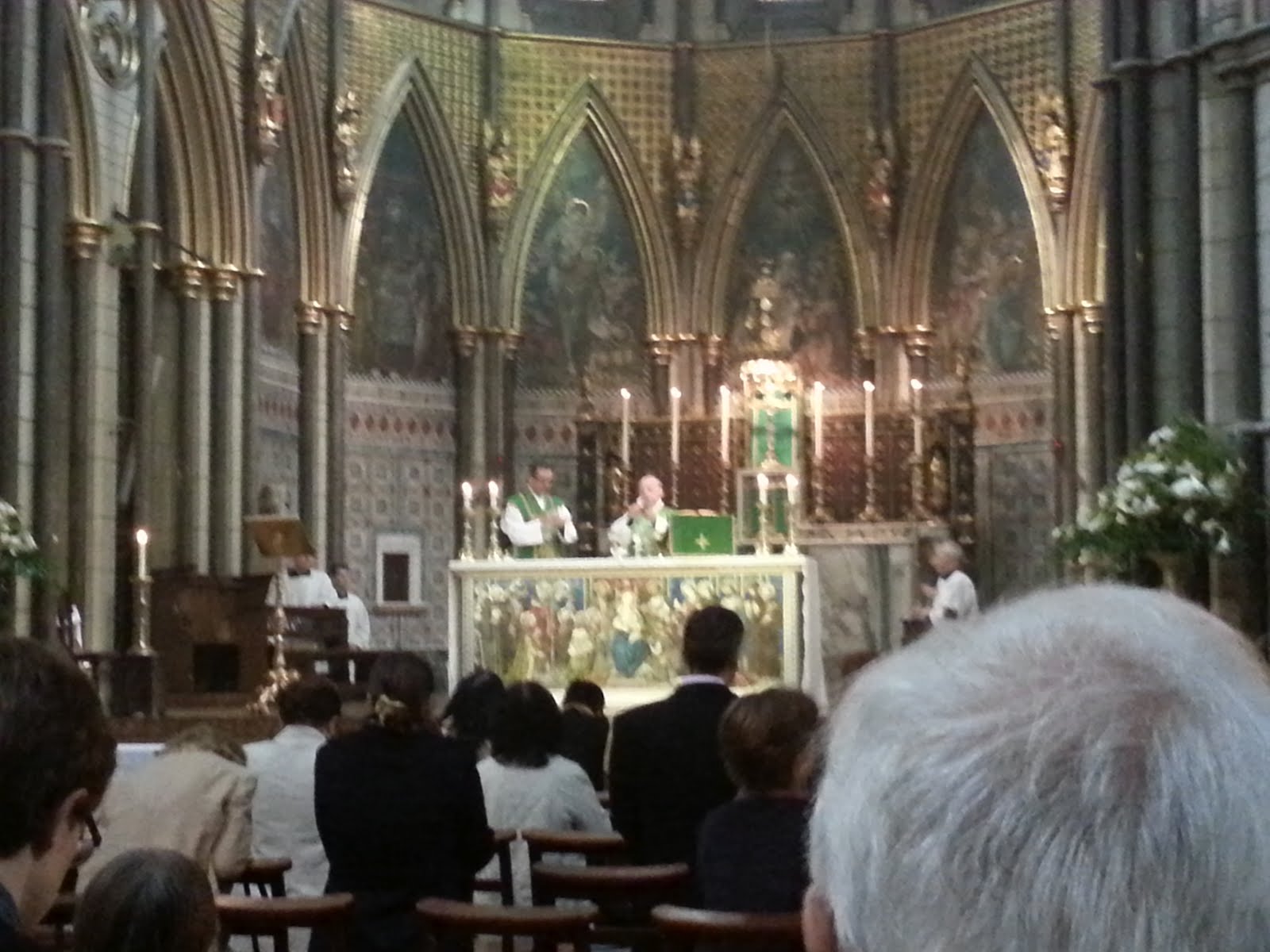
We are happy below to include a few photos taken during yesterday's liturgy (better quality versions can be found on our Flickr photostream).  The photo of Fr Colven giving the homily shows not only a Crucifix and the image of the Sacred Heart, but also a large statue of St Peter.  In this context, Fr Colven's homily might perhaps have reminded us of one of the many Newman quotations that we have recently included on this blog.  The readings at Mass talked of the importance of looking beyond the externals of religiosity and ensuring that there is true faith, love and right belief underlying religious practice.  This is not to say that religious practice, religion, the Church are unimportant, far from it, but it is to say that they are part of a bigger picture.  Blessed John Henry Newman :
Look into the matter more steadily; it is very pleasant to decorate your chapels, oratories, and studies now, but you cannot be doing this for ever. It is pleasant to adopt a habit or a vestment; to use your office-book or your beads; but it is like feeding on flowers, unless you have that objective vision in your faith, and that satisfaction in your reason, of which devotional exercises and ecclesiastical appointment are the suitable expression. They will not last in the long run, unless commanded and rewarded on Divine authority; they cannot be made to rest on the influence of individuals. It is well to have rich architecture, curious works of art, and splendid vestments, when you have a present God; but, oh! what a mockery if you have not.
This and the other photos tell their own story, of faithful and respectful liturgy executed properly, in the full communion of the Catholic Church, in communion with the Successor of St Peter. 

After Mass, we continued our festivities with another example of Anglican Patrimony, a long lunch in honour of a special occasion.  Deo gratias, and, Deo volente, may there be many more anniversaries to be marked. 

 
Fr Colven gives the homily, under the splendid tester with its dove symbolising the Holy Spirit.  To the left of the photo, you see the statue of St Peter to which we referred above.

 
Offertory 1.

 
Offertory 2.

 
Offertory 3.

 
Offertory 4.


Consecration.


Hoc est enim corpus meum.


Ecce Agnus Dei.


The group sits down to a celebratory anniversary lunch with Fr Pearson and Fr Colven.


The group by the 1973 Gavin Stamp poster for St Mary's Bourne St,which includes the Martin Travers image of Our Lady holding St Mary's.

 
In the post A New Direction, we referred to prints of Pusey and Newman hanging side by side.  Here's the proof. 


Friday, 31 August 2012

One Year On

The Feast of St Gregory the Great on 3rd September will mark the first anniversary of the reception into the full communion of the Catholic Church of three of us who were formerly members of the congregation of the Anglican church of St Mary’s Bourne Street, and of our formation of the Marylebone Ordinariate Group at St James’s, Spanish Place. 


At the time that this initial group of three was received, most members of the Ordinariate were being (or perhaps had already been) received as a single parish group accompanied by one or more of their former Anglican priests, or had joined with others, lay and clerical, from the same locality to form a new group. For the most part these groups now worship together in a local Catholic church at a mass celebrated by their Ordinariate priest using, to some extent, distinctive liturgical rites and traditions which, while consonant with the Catholic Faith, represent part of their Anglican patrimony.

The Marylebone Ordinariate Group has remained unusual among Ordinariate groups in that its members are few, were received without an accompanying priest and, even if very much involved in wider Ordinariate events such as the Ordinariate's Anniversary Evensong or the upcoming Pilgrimage to Walsingham, share in parish masses (in a parish run by a clergy team made up of former Anglicans) rather than in a specifically Ordinariate mass. We were permitted to form in this way as it was recognised that our experience of a very particular style of Anglo Catholic worship in a central London church fitted rather better to form a group within the distinctive character of St James’s than with those who had had the benefit of a more conventional, albeit equally Anglo-Catholic, parish background in the Church of England.

From St James’s we aim to reach out to those who might also not be part of a larger group preparing to move to the Ordinariate, and who are perhaps from a similarly unconventional ecclesiastical background, uncertain as to their future, nervous of leaving the Church of England, and in need of our prayers, reassurance and support to bring them home to Holy Mother Church.

Our reception into the Catholic Church has been a source of great joy, a joy we very much want to share. Even beyond the help we have received from Ordinariate clergy, the support and encouragement given to our group and to the Ordinariate in general by Fr Colven and his fellow clergy, together with the warmth of our welcome from the congregation, has made what we had feared would be a difficult move the easiest and happiest of steps. There have been no regrets, except for those left behind and for the loss of their regular society, and no temptation to look back.

We look forward resolutely, now that we are finally set on the right path, but though it would be easier never to look back and to question ourselves, some of us at least must now surely ask the question, why did it take so long?

From its earliest days, St Mary’s Bourne Street, under the leadership of its churchwarden the 2nd Viscount Halifax, was in the vanguard of the movement for the corporate reunion of the Church of England with the Catholic Church.


The culmination of a lifetime’s work for Lord Halifax was the Malines Conversations, a series of meetings held in the 1920s between senior members of the Church of England and the Catholic Church, with the tacit approval of both hierarchies. Although those meetings ended in failure it was ever afterwards the ardent prayer of St Mary’s that Rome and Canterbury should again be one. If challenged, as one often was, about the role of St Mary’s in modern ecumenism it was usual to reply that St Mary’s was a bridge leading from Canterbury to Rome (a phrase that appears in a 1999 book issued to celebrate the 125th Anniversary of the dedication of the church); a bridge very well-trodden over the years.

However, now we stand, so to speak, on the other side, we find ourselves sharing the wonder and surprise expressed by Blessed John Henry Newman in his Discourses to Mixed Congregations.
When we consider the beauty, the majesty, the completeness, the resources, the consolations, of the Catholic Religion, it may strike us with wonder, my brethren, that it does not convert the multitude of those who come in its way. Perhaps you have felt this surprise yourselves; especially those of you who have been recently converted;……… but what may fairly surprise those who enjoy the fullness of Catholic blessings is, that those who see the Church ever so distantly, who see even gleams or the faint lustre of her majesty, nevertheless should not be so far attracted by what they see as to seek to see more, should not at least put themselves in the way to be led on to the Truth, which of course is not ordinarily recognised in its Divine authority except by degrees.
Those words are, of course, a challenge also to us, for we too had seen the Church ever so distantly, some of us for many years and some of us indeed not so distantly, and had failed to seek to see more.  We were the very people Blessed John Henry Newman addressed in Certain Difficulties felt by Anglicans in Catholic Teaching, as quoted in a previous blogpost.
So month has gone on after month, and year after year; and you have again and again vowed obedience to your own Church, and you have protested against those who left her, and you have thought you found in them what you liked not, and you have prophesied evil about them and good about yourselves; and your plans seemed prospering and your influence extending, and great things were to be; and yet, strange to say, at the end of the time you have found yourselves steadily advanced in the direction which you feared, and never were nearer to the promised land than you are now.
We stayed because we were very comfortable as we were, we enjoyed celebrating what we genuinely believed to be the externals of the Catholic faith, we enjoyed being part of a small, eccentric (indeed exuberant, as Rowan Williams said) group within the wider Church of England, we loved (and still love) the place and the people, but above all perhaps we enjoyed being different. It was our show and we ran it in our own way.  Fr Whitby, a towering figure in St Mary's history and Vicar from 1916-1948 is said to have wanted St Mary's to be how the Church of England might have been, had the reformation never happened: in a similar way, we, with generally like-minded friends, lay and clerical, ran St Mary's as our vision of how things should be.  Indeed, we saw the gleam in the not too-far distance, but we hastily averted our gaze.

That, however, is only part of the reason we stayed so long.  Those responsible for our teaching over the years, and much of it was very good teaching from very good and learned souls, took great care never directly to address those issues which might touch on the Church and its unity. Fierce argument might be had about the validity of holy orders for Anglican women; touch but lightly on the subject of the validity of orders for Anglican men and one would receive a withering rebuke or, more likely, a studied silence. Indeed, now that the game is clearly up and one sees Anglican clergy - and not a few of the laity - falling over themselves in their rush to reverse long-held, much-vaunted positions, one finds it hard to resist the conclusion that, for many Anglo Catholics, recent debates have been a fortunate distraction from the more fundamental issue of the increasingly fragile claims of the Church of England to catholicity.

At no point was this refusal to face uncomfortable facts seen more clearly than with the promulgation of Anglicanorum coetibus. This was, or should have been, the most important Å“cumenical development in the lives of all Anglo Catholics. For St Mary’s Bourne Street in particular, we thought that it represented the potential coming to fruition of seeds planted 90 year ago by Lord Halifax. Here truly was a subject at the very least worthy of debate, whatever that debate's conclusion: a subject surely demanding of response, whatever that response might be. In the end, it received not even a mention.

While in some parishes Anglican clergy led (and in some parishes, still do lead) Ordinariate Exploration Groups, or at least explained (some with their minds already made up, others most definitely not) what was going on and why it was or was not relevant, in many other places across the Church of England even clergy who had signed the famous open letter to the Archbishops of Canterbury and York in 2008 had no desire to mention the word Ordinariate, let alone discuss what it might mean or offer.

Some, if they spoke on the matter at all, even indulged in a particularly weak tu quoque argument, saying that the Ordinariate was pointless and that Ordinariate members should just become "proper Catholics".  For those deniers, this mudslinging at the Ordinariate was a poorly disguised means to deflect the same criticisms from being levelled at them to much greater effect.

In the pews at Bourne Street, while acknowledging that there were strongly and honestly held views on all sides of the debate, and that quite probably we were in the minority, we waited for guidance and discussion, but answer came there none, even in a place where barely 15 years earlier the Cardinal Archbishop of Malines and the Anglican Bishop of London had attended Solemn Vespers to mark the 70th anniversary of the end of the Malines Conversations. 


More broadly in the part of the Anglo-Catholic movement that was determined to stay but had not joined the ranks of Affirming Catholicism, this became the time to rehearse not the arguments for corporate reunion but rather to begin the quest for those glib excuses for doing nothing we hear uttered with such relentless regularity today, while not forgetting, many of them, hastily to revise their communion rite so it would fall in line with the revisions in the Catholic ChurchOld principles they did revoke and set conscience at a distance.

For it now appears that the bridge from some parts of Anglo Catholicism to the Catholic Church has turned out to be a drawbridge. It may have come down from time to time to allow for brief undemanding exchanges, to allow those for whom the faint lustre had become the shining vision to slip away, but now it has been pulled up with a resounding bang leaving those inside somewhat bitter together. We who are safely away now realise an awful truth; some key element of Anglo Catholicism had developed so as to be about disunity, not unity, about congregationalism not catholicity, about outward appearance and personal views about how things should be, not objective Truth.

The extraordinary gesture of love and welcome shown by Pope Benedict in Anglicanorum coetibus signalled a great outpouring of grace for which we in the Marylebone Ordinariate Group shall ever give thanks. As Blessed John Henry Newman put it:
What thanks ought we to render to Almighty God, my dear brethren, that He has made us what we are! It is a matter of grace. There are, to be sure, many cogent arguments to lead one to join the Catholic Church, but they do not force the will. We may know them, and not be moved to act upon them. We may be convinced without being persuaded. The two things are quite distinct from each other, seeing you ought to believe, and believing; reason, if left to itself, will bring you to the conclusion that you have sufficient grounds for believing, but belief is the gift of grace. You are then what you are, not from any excellence or merit of your own, but by the grace of God who has chosen you to believe. …….God gives not the same measure of grace to all. Has He not visited you with over-abundant grace? And was it not necessary for your hard hearts to receive more than other people? Praise and bless Him continually for the benefit; do not forget, as time goes on, that it is of grace; do not pride yourselves upon it; pray ever not to lose it; and do your best to make others partakers of it.
We pray with him for, and ask his prayers for, our separated brethren, those whom he addressed as :
You my brethren...who are not as yet Catholics, but who by your coming hither seem to show your interest in our teaching, and you wish to know more about it, you too remember, that though you may not yet have faith in the Church, still God has brought you into the way of obtaining it. You are under the influence of His grace; He has brought you a step on your journey; He wishes to bring you further, He wishes to bestow on you the fullness of His blessings, and to make you Catholics.
In honour then of St Gregory the Great, upon whose Feast Day in 2011 we finally crossed that bridge and sought to see more, here is the well known hymn in his honour, written by St Peter Damian, eleventh century Bishop, Saint, and Doctor of the Church, with its famous wordplay on anglorum and angelorum.


Anglorum iam apostolus,
nunc angelorum socius,
ut tunc, Gregori, gentibus,
succurre iam credentibus.


Our Lady of Walsingham, pray for us
St James the Great, pray for us
St Gregory the Great, pray for us
Blessed John Henry Newman, pray for us

Deo gratias.

Tuesday, 28 August 2012

Eternal Definitions, Reasonable Changes?

For most of our group, the first anniversary of being received into the full communion of the Catholic Church approaches.  Fr Colven included some very kind words on this subject in this week's parish notes at St James's, and went on to offer a little publicity for an event we hope you will all either attend or include in your prayers.
Sunday 2nd September will mark the first anniversary of the reception into full communion of the local group of the Ordinariate of Our Lady of Walsingham. We will pray for them especially during the 10.30am Mass and would want them to know how their presence within the parish community is valued. The secondary patron of the Ordinariate is Blessed John Henry Newman and to celebrate his feast day there will be Solemn Evensong & Benediction here in Saint James’s on Sunday 7th October at 5.30pm. The preacher will be Father Paul Chavasse of the Birmingham Oratory who has long been associated with the cause for Blessed John Henry’s canonisation.
The poster below should help inspire you to clear a space in your diary, and a Facebook Event has been set up in order to help spread the word.  If you are on Facebook, do please "share" the Event.


Longstanding readers of this blog will remember a fondness on our part for hymns sung by the late Frank Patterson (see here for Hail Redeemer, King Divine and here for Bring Flowers of the Rarest).  News of this upcoming Evensong gives us an excuse to share with you this powerful and rather moving performance of Blessed John Henry Newman's Lead, Kindly Light.


A couple of weeks before this special event, there is the no less significant milestone of the Ordinariate's pilgrimage to Walsingham, taking place on Saturday 15 September.   Another Facebook Event has been created for what promises to be an excellent day in England's Nazareth.


Apart from making kind mention of Ordinariate members in the parish notes last Sunday, Fr Colven took the opportunity of the Gospel readings appointed for the day to make an interesting comparison in his homily, one that can indeed be broadened out even further in order to apply to the context that gave rise to the Ordinariate. 

The Gospel reading had told of how some had found the teachings of Jesus too much, too difficult, too demanding. 
This is intolerable language. How could anyone accept it?
Many left Jesus, but the twelve disciples remained faithful.   Our Lord did not respond to this by altering His message to make it more popular: His message was, and still is, His message.   

Certainly it must be presented in ways that our times can understand, but at the heart of any such presentation must always be that same unchanging message of good news, love and redemption.  Where we water down the message in order to be more popular, then what we convey is no longer His message, but rather it is what we think His message ought to be in order to have more followers, as if we were doing no more than marketing a Facebook fanpage.
Jesus was aware that his followers were complaining about it and said, 'Does this disturb you? ............... After this, many of his disciples went away and accompanied him no more.  Then Jesus said to the Twelve, 'What about you, do you want to go away too?' Simon Peter answered, 'Lord, to whom shall we go? You have the message of eternal life, and we believe; we have come to know that you are the Holy One of God.'
Truth does not depend on popularity, nor indeed on the support of a majority in General Synod.  Fr Colven talked of Blessed John Paul II, who during his long papacy was much appreciated and loved far beyond the Catholic Church and even beyond the realm of Christians, but not everyone who admired this exceptional man wanted to hear the detail of what he had to say.

We might add that the Venerable Fulton Sheen, whose awe-inspiring addresses have featured before on this blog, expressed similar sentiments extremely succinctly and forcefully, as you will see if you scroll down the right-hand side bar of this blog.

Somewhat less succinctly and forcefully, we talked of the same issue in our post Missing the Point, when we explained that joining the Ordinariate is not tantamount to looking at the Catechism and saying "Wow, yes, I would have written exactly that myself," rather it is about accepting what the Catholic Church teaches and the basis of the authority it has to teach.
When you join the Ordinariate, you are not asked to say that if you had the chance to make up your own religion, according to what you felt would represent a popular view in your times of what was good, you would come up with something that was word for word identical to the Catechism. You are not asked to state that there are no hard teachings in the Catechism. You are asked to say that you accept the Catholic Faith as presented in the Catechism. You are asked to say that in Christian obedience you accept that the Church is, using the words of 1 Timothy 3.15, the "...pillar and bulwark of the truth...", and that therefore you accept the teachings of the Church. Specifically, you are asked to declare your faith through the Creed, and to say:
I believe and profess all that the holy Catholic Church believes, teaches, and proclaims to be revealed by God.
You are asked to say nothing more than you have probably sung a hundred times even in your Anglican days, now of course appreciating more completely the meaning of this verse from the hymn (Firmly I believe and truly) drawn from Newman's Dream of Gerontius :
And I hold in veneration
For the love of Him alone
Holy Church as His creation
And her teachings as His own
This has sometimes been criticised as meaning that you must switch your brain off upon becoming a Catholic. That just isn't so. Blessed John Henry Newman explained this point in the Apologia:
From the time that I became a Catholic, of course I have no further history of my religious opinions to narrate. In saying this, I do not mean to say that my mind has been idle, or that I have given up thinking on theological subjects; but that I have had no variations to record, and have had no anxiety of heart whatever. I have been in perfect peace and contentment; I never have had one doubt. I was not conscious to myself, on my conversion, of any change, intellectual or moral, wrought in my mind. I was not conscious of firmer faith in the fundamental truths of Revelation, or of more self-command; I had not more fervour; but it was like coming into port after a rough sea; and my happiness on that score remains to this day without interruption.
He had not changed, he was not a different person. What had happened is that he found himself in a place where what the Church taught was the Truth, however convenient or inconvenient the Truth might be.
That Gospel reading speaks powerfully of a clear message, being the Truth, that is not variable depending upon how popular it is in any generation.  The witness of Blessed John Paul II and of the Venerable Fulton Sheen show the same in two Catholics who lived in our time. 

Those who have left the Church of England to join the Catholic Church are somewhat familiar with the concept, even if on a much less imposing scale.  No-one can say that we have done what we have done in order to be popular.  What we have done is in response to the direct call for Unity expressed in the Gospel, and is, to build on Cardinal Cormac Murphy O'Connor's comments published recently in the Catholic Herald, a step away from the seeming reasonableness of adapting church teaching without reference to Scripture or Tradition towards an understanding of the divinely ordained nature of the Church, its teaching authority, and its guardianship of the deposit of faith.

In the Apostolic Constitution Fidei Depositum, issued in October 1992 upon the publication of the Catechism of the Catholic Church, Blessed John Paul II wrote:
Guarding the deposit of faith is the mission which the Lord has entrusted to his Church and which she fulfils in every age. The Second Vatican Ecumenical Council, which was opened 30 years ago by my predecessor Pope John XXIII, of happy memory, had as its intention and purpose to highlight the Church's apostolic and pastoral mission, and by making the truth of the Gospel shine forth, to lead all people to seek and receive Christ's love which surpasses all knowledge (cf. Eph 3:19).

The principal task entrusted to the Council by Pope John XXIII was to guard and present better the precious deposit of Christian doctrine in order to make it more accessible to the Christian faithful and to all people of good will. For this reason the Council was not first of all to condemn the errors of the time, but above all to strive calmly to show the strength and beauty of the doctrine of the faith. "Illumined by the light of this Council", the Pope said, "the Church... will become greater in spiritual riches and, gaining the strength of new energies therefrom, she will look to the future without fear... Our duty is... to dedicate ourselves with an earnest will and without fear to that work which our era demands of us, thus pursuing the path which the Church has followed for 20 centuries."
The message is the message.  We can and must adapt how we present it and explain it, but the message remains unchanged. 

Finally, a brief follow up on a comment received on our recent post A New Direction.  The comment invited us to look at the St Peter's London Docks blog to find out about the latest thinking among Anglo-Catholics still in the Church of England but who used to say that a Code of Practice will not do.

The Peterite blog used to be a very regular read for members of the Marylebone Group, and has been praised in these pages before.  We much admired the continuing efforts of Fr (now also Dr) Jones to teach the Catholic faith in a church whose parish and indeed whose parish clergy have played such an important part in the history of Anglo-Catholicism.  Given our Pusey House connections, we also liked the Ascot Priory link.  However, in the cold light of day, perhaps we might reasonably wonder if our enthusiasm for the Peterite blog was, with absolutely no criticism intended, a reflection of our own views of our then situation as Anglicans associated with a historically Anglo-Catholic parish in the Diocese of London, a parish that, utterly lovely as it is, bears little resemblance to the reality of the rest of the Church of England.  Did we like the blog because it allowed us to imagine that we were a little less congregationalist?

The person who left the comment on our recent post was perhaps referring in part to this, the penultimate paragraph of Fr Jones's recent post.  It encourages a new vision, rather than just pretending that more of the same is possible, and for throwing out this challenge, Fr Jones is much to be admired.  He goes along with Better Together, but he also knows that as a defining vision, it is somewhat limited and risks appearing hollow:
Well, one way or the other, much will be known and decided before Christmas this time, but nothing will be over or ended. There will however be a new paradigm for Anglo-Catholics to grasp. Whatever the House of Bishops offer, whatever Synod decides, Anglo-Catholics in 2013 will need a new way to see and understand their identity, mission and long term role within Anglicanism. A simple overwhelming 'I'm a Roman Catholic paid by the Church of England' will no longer do, not morally, not Spiritually, not Liturgically, not theologically and not practically.
While we might find the first part of the paragraph rather striking in its "We're staying, come what may" approach (and Dr Kirk certainly would), the second part is perhaps a helpful indication of where things are heading.  No longer the claim that Anglo-Catholics are separated from the wider Church solely by accident of Tudor history and misfortune, no, there is now an acknowledged need for frankness and clarity about what is different, and about why it is felt that difference should not only be allowed to persist but should be cherished. 

Those in Affirming Catholicism have for a long time been clear about why they don't agree with Rome, but perhaps Fr Jones is right that the time has come for Anglo-Catholics more broadly to define their position, now that there is no tangible sense of a move towards unity, of a positive trajectory towards reunion, indeed now that in some instances there is an apparent pride in the opposite. 

As Fr Jones says, the approach exemplified by Dr Eric Mascall's famous fictional Ultra-Catholic is no longer possible: there now needs to be an explanation other than procrastination, fence-sitting or anxiety over practicalities for not joining the Catholic Church.  That explanation might perhaps be extremely good (one hopes that it is about more than second order issues), but it has yet to be given. 
I am an Ultra-Catholic -No 'Anglo, I beseeech you!
You'll find no trace of heresy in anything I teach you.
The clergyman across the road has whiskers and a bowler,
But I wear buckles on my shoes and sport a feriola.

My alb is edged with deepest lace, spread over rich black satin;
The Psalms of David I recite in heaven's own native Latin,
And though I don't quite understand those awkward moods and tenses,
My ordo recitandi's strict Westmonasteriensis.

I read the children in my school the Penny Catechism,
Explaining how the C. of E.'s in heresy and schism.
The truths of Trent and Vatican I bate not one iota.
I have not met the Rural Dean. I do not pay my quota.

The Bishop's put me under his 'profoundest disapproval'
And, though he cannot bring about my actual removal,
He will not come and visit me or take my confirmations.
Colonial prelates I employ from far-off mission stations.

The music we perform at Mass is Verdi and Scarlatti.
Assorted females form the choir; I wish they weren't so catty.
Two flutes, a fiddle and a harp assist them in the gallery.
The organist left years ago, and so we save his salary.

We've started a 'Sodality of John of San Fagondez,'
Consisting of five young men who serve High Mass on Sundays;
And though they simply will not come to weekday Mass at seven,
They turn out looking wonderful on Sundays at eleven.

The Holy Father I extol in fervid perorations,
The Cardinals in curia, the Sacred Congregations;
And, though I've not submitted yet, as all my friends expected,
I should have gone last Tuesday week, had not my wife objected.