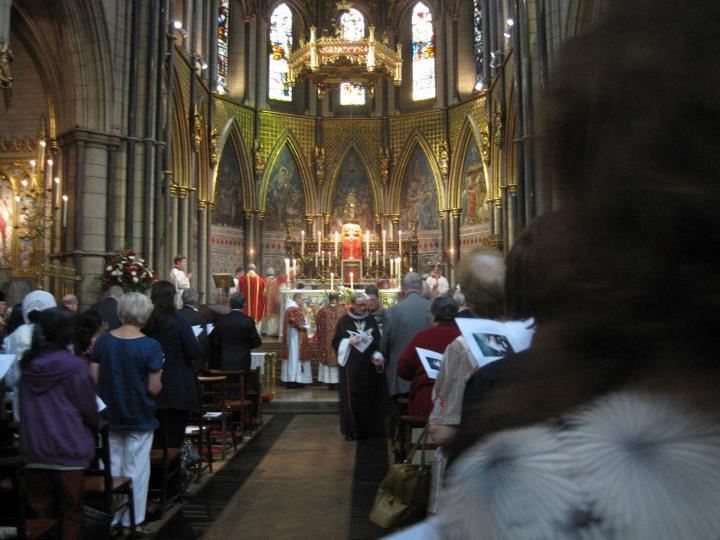
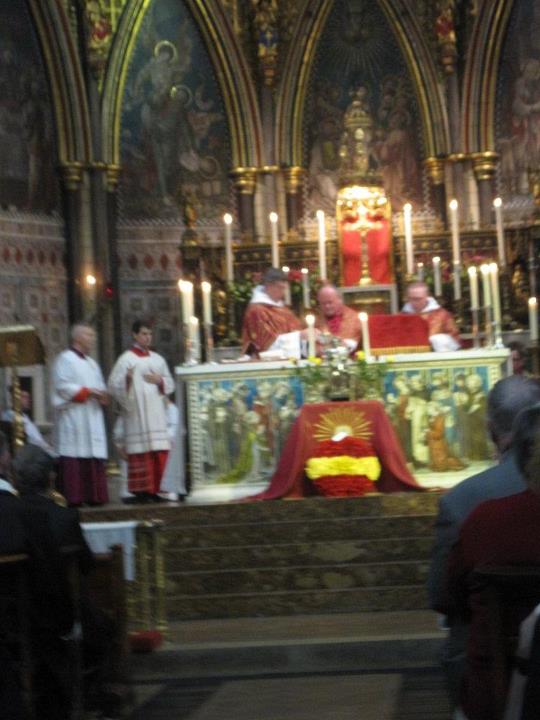
A joyful week of celebration at St James’s, Spanish Place. Wednesday was the Feast of Title, and the Right Reverend Dom Cuthbert Brogan, Abbot of Farnborough, celebrated and preached at Solemn Mass.
The Spanish Ambassador was also present, marking the historic connexion between the people of Spain and St James. Like so many of the older parishes in the Westminster diocese (parish records date back to 1732), St James's Spanish Place can trace its origins to penal times and to the benefactions of a nearby Catholic embassy, and a fascinating explanation of the parish's history can be found on the parish website.
Having previously been based in Ely Place, the Spanish Embassy was once in Hertford House (now the Wallace Collection) and in 1791 a chapel was built in Spanish Place (close to the site of the present church, and of sufficient renown to have been mentioned by Thackeray in Vanity Fair as the church attended by the Marchioness of Steyne) to serve the needs of Catholics serving there.
Although the Embassy moved elsewhere long ago and the London Vicariate assumed control of the chapel in 1827, and although the chapel was replaced by the present building in the 19th century, there are many reminders of Spanish heritage in the church, including Alfonso XIII's personal standard, which hangs above the door from the sacristy into church, and the twin crowns situated above two prime positions in choir set aside for visits from the King and Queen of Spain. It is, however, mere coincidence that the colours of the Spanish flag are reflected in the colours of the Marylebone Cricket Club.
A great occasion, happy for the parish of course and for those of us privileged to be hosted by it, but also happy very specifically for us in the Marylebone Ordinariate Group, because now we found ourselves reunited with one from whom we had been separated. A certain extract from Blessed John Henry Newman's Apologia pro Vita Sua came to mind.
And I earnestly pray for this whole company, with a hope against hope, that all of us, who once were so united, and so happy in our union, may even now be brought at length, by the Power of the Divine Will, into One Fold and under One Shepherd.
We were also delighted to note that among the clergy in the sanctuary, Fr Christopher Pearson was one of the concelebrants.
For us, the highlight among a venerable feast of music was Victoria's O Lux et Decus Hispaniae.
O lux et decus Hispaniae Sanctissime Jacobe, qui inter Apostolos primatum tenens, primus eorum martyrio laureatus. Alleluia.
O light and grace of Spain, most holy James, he who held primacy among the Apostles, was the first of them to take the laurels of martyrdom. Alleluia.
This powerful piece, previously unknown to us, sat beautifully alongside other much more familiar music. The setting of the ordinary of the mass was Mozart's Coronation Mass, and as well as a Jubilate Deo from Giovanni Gabrieli, we were delighted to hear the Finale from Vierne's Organ Symphony No. 1, which had also been played after the Ordinariate's Anniversary Solemn Evensong and Benediction at St James's earlier this year. Those of you interested in hearing what music in St James's sounds like, as well as merely seeing plenty of photos of this stunning building, can find a video on our post entitled A Perfect Setting.
A few photos of the great day follow below. Those of you interested in the Spanish connection will note that the picture of the Abbot preaching (so reminiscent of the excellent photos of Monsignor Newton preaching in that same place some months ago) shows the aforementioned personal standard of King Alfonso XIII of Spain in the background.
It is always a joy to welcome fellow former Anglicans into the full communion of the Catholic Church. This weekend, we heard of the reception of Geoffrey Kirk by Monsignor John Broadhurst, and even though this was expected (not only through the self-evident logic for an Anglo-Catholic of joining the Ordinariate, but also in the more practical fact that we spotted Dr Kirk in the congregation at the Ordinariate Anniversary Evensong and Benediction), we are delighted to learn of the arrival amongst us of so eminent a former Anglo-Catholic.
On Sunday 1 July 2012 Monsignor John Broadhurst received The Reverend Geoffrey Kirk into the full communion of the Catholic Church through the Personal Ordinariate of Our Lady of Walsingham at the Church of the Most Precious Blood, London.
Fr Kirk was an Anglican Priest for 40 years and Vicar of St Stephen’s, Lewisham for 30 years. As Secretary of Forward in Faith, Fr Kirk worked closely with its Chairman, Fr Broadhurst, over the past 20 years in developing Forward in Faith’s vision for unity and truth together with its statement on communion.
He also wrote extensively for “New Directions”, the monthly journal of Forward in Faith. Fr Kirk’s sponsors were Deacon Robbie Low and his wife Sara who were also both closely involved in work of FiF, Robbie was editor of "New Directions", before becoming Catholics several years ago.
The reception took place during the regular 11am Mass at the Church where the London (South) Ordinariate Group worships. Fr Christopher Pearson, the Pastor of the group, prepared Fr Kirk for his reception and said:
Many people have been inspired by Fr Geoffrey’s teaching, preaching and pastoral care over the years. His intellect, writing and wit encouraged a generation in the Catholic movement within the Church of England. I hope that they will now be similarly inspired to follow Fr Kirk's actions in seeking visible unity.
Dr Kirk has been mentioned on this blog before, in connection with a stunning article he wrote for Forward-in-Faith's magazine New Directions. We reproduce it in full below. It is shocking in just how clear it is about the reality of the situation for any who still consider themself catholic in the Church of England. It reminds the reader that inaction is not possible, an ostrich-like head in the sand approach is not possible, the Egyptian approach Denial Ain't Just a River in Egypt is not possible. If you like what the Church of England is doing, good for you, then we can all behave like adults and wish each other well in our disagreement. However, if you don't, then there is only one logical path for you, and it does not involve sticking your fingers in your ears, pretending nothing is happening and claiming, despite ever-increasing evidence to the contrary, to be part of the Universal Church.
‘Final Approval of the current draft Women Bishops legislation is not a foregone conclusion; the best way to secure its safe passage would be to amend it to provide properly for traditionalists; modest amendment of the legislation, together with a suitably drafted Code of Practice could yet enable the Church of England to move forward together on women bishops in 2012. Failure to amend the legislation could result in the failure of the legislation at Final Approval, which would delay the introduction of women bishops for many years to come’ Thus the leader of the Catholic Group in Synod of the forth-coming debate ¨ [note - Dr Kirk's article was written shorly before the Church of England's General Synod debates in February 2011].
So it has come to this: a movement which once embraced a vocation to reassert and affirm the Catholic nature of the Church of England, to defend its orders as those of the Universal Church, and so to progress the unity of Christendom, is reduced to horse-trading for its very existence, arguing in favour of what it most bitterly opposes in order to eke out a ghetto existence in the home it once supposed to be its own. A group of bishops, most of whom (and some immediately before they were so recently consecrated) sought arrangements of reconciliation with the Holy See, are now the sponsors of a ‘Society’ within the Church of England which promises a future which without compromise it cannot deliver.
What am I to say?
This ignominious ending to a long and hard-fought campaign is properly a cause of grief and shame. Shame, because it is a betrayal of the entire Catholic movement – of Keble as well as Newman, of Pusey as well as Froude. Grief, because it has exposed a fault-line which, in our generous optimism, many of us supposed not to be there. When Benedict XVI called their bluff, men whose rallying cry had been ‘Look to the Rock from which we are hewn!’ looked the other way. When the life-boat was launched, they complained about its colour. They claimed to act out of affection for the Church of their baptism and ordination. Tragically that is a demonstration of loyalty which, in the course of time, the Church of England will discover that it can well do without.
It may simply be that there is, even among Anglo-Catholics, a residual, irrational, atavistic anti-Romanism which the passage of time has not been able to erode. But I think there is a deeper and more disturbing explanation for this sorry state of affairs.
A characteristic of modern Anglicanism, of all parties and opinions, has been creeping indifferentism. In increasing numbers people have concluded that doctrine does not matter – that it is merely ‘theological’, in the Harold Wilson sense of abstruse and irrelevant. How vividly I remember Dennis Nineham celebrating in the college chapel in a chasuble bought by Austin Farrer, behaving for all the world as though he believed in the Real Presence, when he did not even believe in the Incarnation. And I wondered what John Keble would have made of that. The virus has proved not only lethal but catching. It was doctrinal indifferentism which allowed the development of the so-called ‘Doctrine of Reception’ which was embraced by opponents of women priests more or less tongue-in-cheek. And that has left its doleful mark.
‘Reception’ was an idea borrowed from the world of ecumenism, where for two generations and more, theologians had been practising the dark arts of fabricating agreement where truly none was to be found. By ‘Reception’ the Church of England was enabled to authorise orders about whose validity it freely admitted that it was itself uncertain – thus undermining its own trustworthiness and reliability. By ‘Reception’ bishops were enabled to license to the cure of souls ‘which is both mine and thine’ clergy about whose orders they were in doubt, and whose administration of the dominical sacraments was therefore equally dubious – thus jettisoning their own claim to be guardians of faith and sacraments.
‘Reception’ was, of course, a scam in which the proponents of women priests did not for a moment believe. By embracing it, to whatever degree, opponents nurtured the seed of their own downfall: they compromised the doctrine of sacramental assurance which lay at the heart of their ecclesiology. Now the Catholic Group is eager to ‘move forward together on women bishops’. Will they, I wonder, vote for the legislation they have so long opposed in order to secure the minimal concessions to which they are sure to be condemned? Nothing could be more demeaning; but anything is possible when principle and self-respect alike have been abandoned.
Those who live by the Synod die by the Synod. And where traditional Anglo-Catholics are concerned the writing on the Synodical wall has for some time been visible to all but the most determinedly myopic. From the failure to receive the Blackburn Report in July 2000 to the defeat of the Archbishops’ amendment in July 2010 the message has been clear. There is, therefore, something verging on the pathological about the expectation that there will be a last minute change of heart. Like a neurotic victim of domestic violence, the optimists are compulsively returning to the scene of their own suffering.
Let enough be enough. The time has come for opponents of women priests and bishops to admit that the game is up, that the battle is lost, and that the logic of the proponents’ arguments will not admit the possibility of a mixed economy. The future has already happened; let them look to The Episcopal Church of the United States and to the Church of Sweden to see the shape of things to come.
When still an Anglican, Dr Kirk gave a truly excellent talk at an Ordinariate Study Day held at St Agnes Kennington, a church which saw a significant number of its members accepting the call to unity that is at the heart of Anglicanorum Coetibus, and following Fr Christopher Pearson to form the core of the London (South) Ordinariate Group, now meeting at the Church of the Most Precious Blood near London Bridge, the church where Dr Kirk was received into the Catholic Church at the weekend.
If you have Anglican friends who are wavering about whether to become Catholics or not, I suggest that you share this video with them. The sound quality settles down very quickly, so do bear with it.
They may find Dr Kirk's speech particularly useful if they have read the Anglican Association's "Is the Ordinariate for you? Some considerations for thoughtful Anglicans" a pamphlet reviewed very effectively by Dr Kirk here.
There was a wonderful feeling of reassuring familiarity, of being in the right place, yesterday at St James's as we marked the Solemnity of Corpus Christi. In our previous blogpost, we referred to a sentiment that our arrival in the Catholic Church was the only logical outcome for those who shared the understanding of Anglo-Catholicism that we did: yesterday reinforced that.
As usual, given the busy mass schedule at St James's, we arrived while the prayers after the 0930 Extraordinary Form mass were being said. This always provides, very conveniently, a few quiet moments of preparation for the Solemn Latin Mass (OF) at 1030. Once these were over, the organ launched into JS Bach's Chorale Prelude Schmücke Dich, O Liebe Seele BWV654. This piece, a favourite of mine in my organ-playing days, is based on the tune of a eucharistic hymn very often sung in Anglican churches, and eminently suitable for Corpus Christi.
Deck thyself, my soul, with gladness,
Leave the gloomy haunts of sadness;
Come into the daylight’s splendour,
There with joy thy praises render
Unto Christ Whose grace unbounded
Hath this wondrous banquet founded.
Higher o’er all the heav’ns He reigneth,
Yet to dwell with thee He deigneth.
The procession entered, the Kyrie and the Gloria were sung, and then like a thunderbolt came Latin words that were utterly familiar to us. Dare I say it, and with apologies for being arrogant, they might even have been more familiar to us than they were to some of our friends at St James's.
Deus, qui nobis sub sacramento mirabili, passionis tuae memoriam reliquisti: tribue, quaesumus, ita nos corporis et sanguinis tui sacra mysteria venerari, ut redemptionis tuae fructum in nobis iugiter sentiamus.
The collect for Corpus Christi of course, but also the collect used at Benediction. Every Sunday, the rite of benediction at Bourne St is performed in Latin - that being the result of a congregational vote in the 1970s - and so those of us who had been regular servers and members of the congregation there over the years were immediately struck by these familiar words, now in what was for us their new setting.
The beautiful chant of the sequence for Corpus Christi, Lauda Sion, rang out around the arches of St James's as we prepared to hear the Gospel.
The guest preacher was Fr Christopher Pearson, who is the Ordinariate priest who guided us on the process towards our reception into the Catholic Church. Fr Pearson's homily reflected, amongst other things, on how differently we consider blood now as compared to how it was considered by those who lived at the time of the Gospels or before: this was in no small part due to a lack of familiarity with blood, not only in the way we live but also in the nature of our worship, the blood sacrifices made regularly in the Temple are very different to our re-presentation and witnessing of the one perfect sacrifice, made once.
One might also have reflected on how homilies such as he delivered, on the Holy Sacrifice of the Mass, are now pretty rare in our former Anglican home. What once was familiar teaching in Anglo-Catholicism is now unfamiliar. Now in the Catholic Church, the contents were familiar, they were very much at home.
The prayers of the faithful also contained an echo of Anglo-Catholic history. The intercessor prayed that we might all recognise Our Lord in the Sacrament, and that in so doing, we might also be better able to recognise Our Lord in the faces of the poor and needy. This recalled the speech of Frank Weston, Anglican Bishop of Zanzibar, given at the conclusion of the 1923 Anglo-Catholic Congress in the Albert Hall.
Weston, even if he was only "in place" as such for a pitifully short time, was the only clear leader that the Anglo-Catholic movement had really known and recognised since Blessed John Henry Newman left for Rome in 1845 (and, with no disrespect to our three monsignori in their days of leading the movement, is probably unsurpassed as leader since). He was addressing the gathering of sixteen thousand on the importance of building on what they had achieved, using their theological, liturgical and ecclesiastical achievements in God's service. This quotation, his last charge to the Anglo-Catholic movement (he died one year later, at the tragically early age of 53), sums up in a few lines something that was historically at the heart of Anglo-Catholicism, bringing Our Lord, and the Catholic Faith that leads to Him, to His people.
. . I say to you, and I say it with all the earnestness that I have, if you are prepared to fight for the right of adoring Jesus in His Blessed Sacrament, then, when you come out from before your tabernacles, you must walk with Christ, mystically present in you, through the streets of this country, and find the same Christ in the peoples of your cities and villages. You cannot claim to worship Jesus in the tabernacle if you do not pity Jesus in the slum. . . . It is folly, it is madness, to suppose that you can worship Jesus in the Sacrament and Jesus on the throne of glory, when you are sweating Him in the bodies and souls of His children. . . . You have your Mass, you have your altars, you have begun to get your tabernacles. Now go out into the highways and hedges, and look for Jesus in the ragged and the naked, in the oppressed and the sweated, in those who have lost hope, and in those who are struggling to make good. Look for Jesus in them, and, when you have found Him, gird yourself with His towel of fellowship and wash His feet in the person of his brethren.
For any of you who have not read Frank Weston's speech, I would implore you to read it here. It is very, very stirring stuff.
After our previous blogpost, when we recalled the different understandings of Anglo-Catholicism, specifically as regards the importance of unity, it is interesting to note that Weston made the groundbreaking move of sending the following telegram to Rome during the 1923 conference.
Sixteen thousand Anglo-Catholics in congress assembled offer respectful greetings to the Holy Father, humbly praying that the day of peace may quickly break.
He was of course savaged by the press and the protestant elements of the hierarchy for having dared to open the door to communication with Rome, but he also suffered rebukes from a number of prominent Anglo-Catholic friends, including some who were comfortably installed in the Anglican establishment.
Back to Sunday at St James's. It was by delightful co-incidence that most of us in the Marylebone Ordinariate Group happened to kneel at the right place before the altar rail for Fr Pearson to be able to communicate us. It could not have worked out better.
The procession around church was a joy (even if I must confess to being no fan of indoor processions of the Blessed Sacrament where the laity join in, if only to avoid traffic management issues and to encourage the faithful to pray in adoration upon their knees). A be-coped Fr Colven bore the monstrance around the church, under a canopy, flanked by Fr Pearson and Fr Irwin (another former Anglican) as his assistants. Fr Nicholas Kavanagh was also in procession (photos of Fr Kavanagh in his Anglican days as curate at St Mary's Bourne St can be found here).
A small number of photos are shown below, but perhaps the greatest joy of the procession was the hymns.
The first hymn is one we have mentioned before on this blog. The immensely moving O Bread of Heaven, as sung at the Ordination Mass of our three Ordinariate monsignori came first, as the procession formed up and moved off.
O Bread of Heaven, beneath this veil
Thou dost my very God conceal:
My Jesus, dearest treasure, hail!
I love Thee and, adoring, kneel;
Each loving soul by Thee is fed
With Thine own Self in form of Bread.
O food of life, Thou Who dost give
The pledge of immortality;
I live, no 'tis not I that live;
God gives me life, God lives in me:
He feeds my soul, He guides my ways,
And every grief with joy repays.
O Bond of love that dost unite
The servant to his living Lord;
Could I dare live and not requite
Such love - then death were meet reward:
I cannot live unless to prove
Some love for such unmeasured love.
Beloved Lord, in Heaven above
There, Jesus, Thou awaitest me,
To gaze on Thee with endless love;
Yes, thus I hope, thus shall it be:
For how can He deny me Heaven,
Who here on earth Himself hath given?
The second hymn was again full of significance for former members of the congregation of St Mary's Bourne Street congregation. It was the Fr Faber classic Jesus, My Lord, My God, My All. I confess, we did not sing it to a hymn tune I know, but at least we did not sing it to Stella, more often employed for Hail, Queen of Heaven, the Ocean Star. The tune I had hoped we would have was the following one, a very beautiful melody called Sweet Sacrament.
Fr Faber's hymn can be found in the St Mary's English Hymnal Supplement, few copies of which are in existence now, but being a hymnbook that, in pre-New English Hymnal days, filled in a few of the "gaps" as we might say in the catholicism of the English Hymnal. Proving that Bourne St was once at the vanguard of catholic teaching, the words in the Supplement are Fr Faber's, whereas those in the NEH are somewhat different.
The third verse of the hymn, as a friend once observed, has the very distinct ring of an Eric Mascall sermon, of the kind he would preach at Bourne Street between Evensong and Benediction. Eric Mascall has been mentioned at great length on this blog before, in the context of wondering what the great man might have done had he lived a little longer.
Jesus, my Lord, my God, my all,
How can I love Thee as I ought?
And how revere this wond'rous gift,
So far surpassing hope or thought.
Sweet Sacrament, we Thee adore.
O make us love Thee more and more!
O make us love Thee more and more!
Had I but Mary's sinless heart,
To love Thee with, my dearest King;
O with what bursts of fervent praise,
Thy goodness, Jesus, would I sing!
Sweet Sacrament, we Thee adore.
O make us love Thee more and more!
O make us love Thee more and more!
O, see, within a creature's hand,
The vast Creator deigns to be,
Reposing infant-like, as though
On Joseph's arm, on Mary's knee.
Sweet Sacrament, we Thee adore.
O make us love Thee more and more!
O make us love Thee more and more!
Thy body, soul, and Godhead, all--
O mystery of love divine!
I cannot compass all I have,
For all Thou hast and art are mine.
Sweet Sacrament, we Thee adore.
O make us love Thee more and more!
O make us love Thee more and more!
Sound, sound His praises higher still,
And come ye Angels to our aid;
'Tis God, 'tis God, the very God,
Whose power both man and angels made.
Sweet Sacrament, we Thee adore.
O make us love Thee more and more!
O make us love Thee more and more!
Those who say that there is no Anglican tradition in Eucharistic worship in the Catholic Church would have had no choice to recant had they been present in Marylebone yesterday. It was even clearer on the 15th January at the Ordinariate's First Anniversary celebrations of course, but still, we were utterly at home yesterday.
Indeed, Eric "Patrimony" Mascall quotations have been doing the rounds of the Catholic blogs on the internet this week, showing just how much Anglo-Catholic theology has been, at its best, in tune with the very best theology of Rome herself. One particular favourite Mascall quotation on the mass is the following :
The Eucharist of the Church, is not either a commemoration or a dramatic imitation of what was done at the Last Supper; it is the same thing. ‘Do this.’ Both the Last Supper and the Eucharist bring about the anamnesis of the other.
Fresh from receiving Benediction, we left the church, greeted Fr Pearson at the door, acquired Ordinariate badges, and moved round to a nearby hostelry, where with true Anglican Patrimony we shared drinks and talked of mutual friends.
Did we feel that we had in any way missed out? Did we feel we had lost something compared to the, it must be said, beautiful and spectacular way in which Corpus Christi is marked at Bourne St? Well, it might not surprise you to learn that the answer is no. Corpus Christi 2012 was for us a wonderful way of celebrating this most sacred mystery, in communion with the Successor of St Peter, in the heart of the Church that is the guardian of the sacraments, celebrating a feast that is at the core of the Church's teaching rather than celebrating in a context where to do so is seen as extreme and eccentric.
O Lord, who in a wonderful sacrament hast left us a memorial of thy passion; Grant us so to reverence the holy mysteries of thy Body and Blood, that we may ever know within ourselves the fruits of thy redemption.
Before concluding this very long blogpost with photos of yesterday in Marylebone (and with a bonus photo of ecumenical friendship in Oxford), let us counterbalance the very old, if splendid, picture of a Corpus Christi procession in Rome that can be found above with video footage from last year.
Finally, an act of ecumenical friendship in honour of our Oxford connections: a photo of the Oxford Oratory's Corpus Christi procession as it passed Pusey House, with Pusey House regulars kneeling in the street in adoration of the Lord in the Blessed Sacrament. My Lord and my God.
Time, indeed like an ever rolling stream, has appeared to go quickly since we became Catholics. A year ago, we were in our final month at Bourne St, preparing to leave the Church of England and our status as Anglicans. We were embarking upon a eucharistic fast that was to last several months, in preparation for our eventual reception into the Catholic Church in early September. It was appropriate that one of the last services we attended as Anglicans was the Bourne Street Corpus Christi devotion, in which we could give thanks for all the grace that had been poured out upon us in our time there. Bourne Street always marks the Sunday following Corpus Christi with the grandest of services, greenery and herbs strewn on the floor during a procession, and of course some very fine music. We wish our friends there well for their celebrations tonight.
At St James's we mark Corpus Christi today with a Procession of the Blessed Sacrament after Mass. We look forward to welcoming Fr Christopher Pearson of the Ordinariate as guest preacher.
That Bourne Street service last year was the final occasion upon which I served as an Anglican, acting as MC at a service of Evensong, Procession and Benediction. How apt that the first time that I should serve at the altar as a Catholic should also be for the same form of service and in the same capacity. Below you will see a couple of pictures of the Catholic service at which I served, the Ordinariate Anniversary at St James's, followed by a couple of pictures from Bourne St.
You will see why we for us the progression seems entirely natural and normal. Very much a continuation of the same, but crucially, now in communion with the Successor of St Peter. A couple of pictures from the Bourne St archive now follow, giving a further indication of the reverence with which Corpus Christi has been treated in Anglo-Catholicism. The first picture is from 2011, the second from c1995.
Our memories of those happy days have not flown, forgotten as a dream, but are very much fresh (all these Isaac Watts quotations were not intended to link with the mention of St Anne in our previous post, but do so quite nicely). While in many ways so much has happened over this year, some of which has been recounted on this blog, in other ways we consider that what has happened was nothing more than the natural outcome for us, given the way we had understood Anglo-Catholicism. There was a predictability, perhaps even in some ways an inevitability about what has happened, even if not about the way it has been allowed to happen, through the graciousness of Anglicanorum coetibus.
Now, more than ever, it has become very clear that there was no one definition of what people understood by Anglo-Catholicism. There had always been a wide range of sub-groups, that themselves could either be virtually entirely in line with the teachings of the Catholic Church, or in reality quite far from them in some important ways. High Church Anglicanism and Anglo-Papalism are but two of the most long-established terms, but even there the difference is clear.
Over the past 20-30 years, the picture has become even more confused. Movements such as Affirming Catholicism have sprung up, which happily absorb much of the liturgical and sartorial practice of the Catholic Church, while adopting an approach to moral teaching that is not based on the Catechism but on what people feel - quite genuinely - to be right and good. It's the same old debate about there being a Truth that has been revealed, and is interpreted afresh in each generation, or there being an ongoing series of revelations in which the Truth today is not the same as the Truth yesterday (and indeed even today there can be multiple Truths, some of which can contradict each other). We touched on this topic in this recent and widely-read post. Anglo-Catholics of a more traditional outlook were sometimes prone to using the odd slightly unkind nickname for Affirming Catholics, the more printable of which include AffCaths and indeed De-Caffs. However, the same naughtiness was shown in return, with Forward in Faith and its quasi-predecessor Cost of Conscience having been unkindly labelled Backwards in Bitterness and Price of Prejudice respectively.
That debate continues with Anglo-Catholicism. With the departure of many to the Ordinariate, and the seeming acceptance of the changes likely to emerge from this summer's General Synod, the overall theme of Anglo-Catholicism seems to be shifting. The debates on the approach to moral teaching will remain, but there now seems to be a view that the primary object of Anglo-Catholicism is not [to act]..in defence of Catholic Truth and...[to labour for]...the Reunion of Christendom, (as the words on the memorial to Lord Halifax say, see the photo in this post) but rather to be one of a number of contrasting strands of Christianity that should co-exist within the Church of England, even if the teachings of those strands are in some very signficant ways utterly incompatible. The new Anglo-Catholicism now seems to be moving towards saying that if corporate reunion with the Roman Church were to come along, that would be lovely, but only if Rome moves on a number of significant matters, because Rome cannot expect to dictate to the Church of England the terms on which any such corporate reunion would take place.
Perhaps this was obviously going to be the case. The people who felt more of a draw to Rome and the Catholic Church have left or are very seriously considering leaving: yet this is not a new trend. Yes, there have the departures since the 1990s, and indeed since the Ordinariate, but ever since Anglo-Catholicism began (in the sense we understand it arising from the Oxford Movement), there has always been a steady flow over the Tiber, even before the moment that Blessed John Henry Newman concluded that his eloquent and impressive arguments about the catholic nature of the Church of England, written while still an Anglican, did not stand up to the reality of the day (see here for details of where Newman drew his line in the sand, it being, to mix metaphors, a final straw at the end of a long process).
Newman's Tract 90, in which he argued that the 39 Articles of the Book of Common Prayer were not an attack on Catholic theology but rather an attempt to limit excesses, caused a great stir. In response to protests from (Anglican clerics who were) senior in the University of Oxford (including Archibald Campbell Tait, mentioned so prominently in our most popular ever post) the Anglican Bishop of Oxford requested that there not be a Tract 91, and neither there was. Tract 90 was published in 1841, just before Newman's withdrawal to Littlemore in 1842, from where he was received into the Catholic Church by Blessed Dominic Barbieri in October 1845.
Anglo-Catholics still cite Tract 90 today in defence of the great Anglo-Catholic vision of old, but given what is happening around them, one wonders if they can really continue to do so for much longer, at least in respect of the Church of England as it is today. The drive of the Tracts for the Times, particularly Tract 90, was to show the Church of England as ecclesiastically catholic rather than protestant, ie that it was in tune with the teachings of the Catholic Faith. As we mentioned a week or two ago, Geoffrey Fisher, a recent Archbishop of Canterbury summed this view up in the following way, just after the second world war.
The Church of England has no doctrine of its own, save that of the one Holy, Catholic, Apostolic Church.
When we quoted this recently, a comment on that blogpost was picked up upon by the excellent Let Nothing You Dismay blog. There, the author pointed out
Although the idea of a synodical structure which would allow the laity, clergy and episcopate an opportunity to deliberate together on the issues facing the contemporary Church is (in theory) a laudable one, it has proved disastrous in practice. And this has been, not only because of the adoption of a quasi-parliamentary 'democratic model which has given the politicisation of church life a focus and an official platform, but because within Anglicanism there is no consensus as to what constitutes the authentic tradition.
Archbishop Fisher's comments about the Church of England having no doctrine which is not that of the catholic church are often seized upon by people like me, but the truth is that, however authoritatively they were expressed, they remain just the views of one Archbishop of Canterbury among many; they may have been an accurate snapshot of the consensus at the time within the Church, but are they any more than that? It's instructive that his comment was made just before the then established consensus (perhaps the high water mark of Tractarian influence within Anglicanism, going far beyond those who would identify themselves as 'Catholics') was about to fall apart.
As usual, the LNYD blog is spot on. You cannot argue for the catholicity of the Church of England now (I make no comment about the past, nor do I make any comment about orders, which is an entirely different point) without addressing the issue of the change of direction. You cannot logically argue using Tract 90 without volunteering to write a Tract 91, arguing the impossible, that everything that is now happening in the Church of England will not change the catholic vs protestant analysis that so obsessed the Tractarians who gave rise to what we call Anglo-Catholicism.
So in the CofE for those Anglo-Catholics who stay, change is required. You can see this even from the wording of the statement issued by the Forward in Faith bishops last week.
.....we must say something about diversity. At the heart of our theological tradition is an acceptance that the Church of England is enriched by the range of viewpoints within its spectrum. We are committed to the recognition of this diversity and to the liberty that protects it. Of course, the defence of liberty is one of the functions of justice and law, of which the monarch is guardian and symbol.
Really? Diversity, with mutually incompatible theologies, is that a good thing? Of course, this phenomenon is not new in the Church of England, but it has not always been seen as a strength of Anglicanism. It seems there is no longer the attempt to catholicise or re-catholicise the Church of England, but that diversity of opinion, Anglo-Catholic (of whatever hue) and protestant is good. Well, here we come back to what we think we mean by saying "the Church", or even "the Catholic Church".
The Forward in Faith bishops go on to say:
.....our search for unity will commit us to continuing engagement with the ARCIC process and dialogue with the Orthodox Churches.
So there you have it. Anglicanorum coetibus is not on the agenda, the outcome of July's General Synod is irrelevant. Christian Unity for the Forward in Faith bishops is the ARCIC process and the Orthodox (who, as we have noted before, do not think in the least bit favourably of the current Anglican changes). That means it is not a high priority for them. In the words of the Anglican Archbishop of New Zealand after the end of the recent ARCIC talks in Hong Kong:
There seem to be many obstacles from a human point of view, and it does not seem likely to have fully visible unity in the near future
Diversity constituted by incompatible theologies, and what risks appearing as institutional loyalty (however much any of us love our view of what the CofE is or has been) at the expense of a clear impetus towards unity, those are not goals for which any of us in the Marylebone group could have ignored this gracious call to Unity issued by Pope Benedict.
For us, it is sad to note this seemingly different approach. However, we must acknowledge that it is only sad because it relates to our vision of what Anglo-Catholicism was all about. We had always seen the Church of England as being part of the Church, but being in impaired communion, we had viewed the Catholic Church as being the rock from which....[the Church of England was]...hewn, we had seen ourselves as being separated by accident of history. We had never seen the Church of England as a standalone entity in which we could seek to maintain a strand of catholicism.
So while it may all be rather sad for us, the changes may be positive and welcome for others. The word Anglo-Catholicism has never meant just one thing, and the Anglo-Catholic movement has never had one single goal upon which all its adherents agreed.
Let us move back to Corpus Christi. Here are two contrasting pieces of music to prepare us for today. First, some Tallis, and then another appearance from Frank Patterson.
The Apostolic Nuncio celebrated the Ordinariate's first ever Chrism Mass yesterday, a great event that was held at St James's Spanish Place. People certainly came in large numbers, not only the 60+ Ordinariate priests who had travelled from across the country, but also many lay members of the Ordinariate, other Catholics encouraged by Fr Colven's announcement at Mass on Palm Sunday morning of what was to happen the following day, and no doubt a number of people who happened to be passing by and came across something rather bigger than they expected to see happening in church. The photo below shows the reception held afterwards in the St James's Social Centre, with the Nuncio and Msgr Newton in cheerful conversation.
The St James's choir was on its usual excellent form, and a number of servers from the regular St James's team kindly gave up their time to help the Ordinariate celebrate this great occasion. Thanks are due to them and to the Rector for all that they do to help the Ordinariate, in line with the Holy Father's wishes.
Monsignor Newton pointed out in his homily that since his authority as Ordinary of the Personal Ordinariate of Our Lady of Walsingham is vicarious on behalf of the Roman Pontiff, it was wonderful and entirely appropriate that the Apostolic Nuncio, His Excellency Archbishop Mennini, had come to celebrate the Ordinariate's first Chrism Mass. In this year when we mark the 30th anniversary of the establishment of full diplomatic relations between the Holy See and the Court of St James, there was an added feeling of this just being exactly right.
Archbishop Mennini's presence and obvious delight at being able to participate were a clear sign, if any were necessary, that the Ordinariate is a project that the Holy Father very actively supports. Fr Ed Tomlinson, in his blogpost last night, wrote of the Archbishop's very warm words at the end of Mass.
Something that seems to have struck a lot of people present is the total sense of Unity of the event. In theory, this ought not to be anything new, but for former Anglo-Catholics, it most certainly is. Chrism Masses are a unifying event for a particular church with its Ordinary, but since the early 1990s Anglo-Catholics never really had that. They faced the choice of attending diocesan celebrations alongside people of whose orders they were not entirely sure, or there was the option of a Forward in Faith / PEV Chrism Mass. Those latter occasions were certainly joyful, encouraging and full of enthusiasm when they began, and I remember clearly attending such an event in Reading c.1995 (the first time I had the chance to sing the hymn below, yes any excuse to include Frank Patterson.....), but even then there was a knowledge at the back of everyone's mind that the ecclesiology of a separate arrangement, out of communion with those with whom we were technically in communion, was not obviously catholic. As priests have left to join the Ordinariate, and as this trend continues, one wonders how long these PEV events will survive, particularly after the likely changes in legislation affecting the Church of England. While people are on friendly terms, having the local Anglican diocesan bishop present and involved in a PEV Chrism Mass may be a sign of hospitality and indeed even of communion, but if the future is less rosey than that, a diocesan bishop insisting on joining in might be rather political.
One member of the Marylebone Ordinariate Group summed it up like this :
..... I overheard a priest say exactly what I had said to myself at Mass, it was the first time I had been at a Chrism Mass where I felt myself fully in union with Bishop, priests and people, and that was the most joyful and moving experience of the day.
Fr Ed Tomlinson, in the blogpost mentioned above, put it this way :
It was a happy day. But above all it was a day that underlined a thrilling truth. In previous years I would always feel a pang of sorrow during the Chrism Mass because Anglo-Catholics felt unable to attend the main diocesan event and held a separate service. It was a visible sign of the disunity with which we had to live. But today there was no sorrow only joy. For this was the main event- there was only unity. A unity that exists between all Catholics the world over. It is good to be home.
As Monsignor Newton said in his homily, we have gone forward in faith together, into an environment where we are part of that Unity to which we are all called. In this respect, it was pleasing to see so many familiar faces amongst the clergy and people, with whom we are once again united.
It is also worth commenting on the enthusiastic singing from the congregation, both in the hymns and in the responses. This is one aspect of Anglican Patrimony that is immediate and audible, and which sounds wonderful in a stunning building such as St James's. It was also striking (as you can see in this photo) that the unkind rumours spread by some of the modern day deniers about all the Ordinariate clergy being pensioners is manifestly untrue.
All said, a very joyous occasion, and one that brought home that we are truly part of the Church, all in the same communion.
Just to conclude, Msgr Newton quite righly pointed out that there are many in the Catholic Church whom we thank regularly, justly so. However, we also owe a sincere debt of thanks to those very brave men (and in many cases their families) who gave up not only the Church of England as a spiritual home, but also took a far greater risk in material terms by leaving behind housing, employment and future pension accrual. We thank Fr Colven and the clergy at St James's regularly here on this blog, but we are also very pleased to take this opportunity to thank Fr Christopher Pearson publicly, Fr Pearson being the nearest that the Marylebone Ordinariate Group has to its own priest.
This is the one hundredth post to appear on this blog. The perfect opportunity, then, to reflect on what all this endless writing has been for.
The blog began as a means to record the first few weeks of a group of ex-Anglicans who had joined the Catholic Church through the provisions of Anglicanorum Coetibus. Partly, this was in line with the well-known phenomenon of there being Ordinariate groups with blogs (most notably of course Fr Ed Tomlinson's blog and Fr Edwin Barnes's blog), as well as blogs of Anglicans with Catholic-leanings who wonder about their future (for example, Let Nothing You Dismay, Ancient Briton and St Peter's London Docks). However, it was also because our little group was quite unusual, in that we had left our Anglican parish, St Mary's Bourne St, without having been led by our then clergy, and were finding our way on our own.
True, we had a huge amount of help from Fr Christopher Pearson of the London (South) Group, who with Monsignor Newton worked out the practicalities for us. Furthermore, we could hardly have ended up in a Catholic parish better suited to cope with a group of ex-Anglicans : Fr Christopher Colven and the clergy of St James's Spanish Place are former Anglicans who joined the Catholic Church in the mid 1990s. These factors were tremendously helpful, but ultimately we felt there was an unusual story, of hopefully some passing interest, to tell.
Time for a few statistics. We might not reach the heights of Fr Tomlinson's blog (over a thousand hits per day), but for a little group of three (and perhaps now four) without a priest, we have managed to drum up some reasonable level of interest.
As at the time of writing, we have reached the grand total of just over 8,900 hits.
That means each of our posts (99 having been published up to now) has been read an average of 90 times (though some have been read much much more than that), and that we have had an average of over 57 hits per day.
At the current rate, we are heading for 21,000 hits per year.
Unsurprisingly most of our hits come from the UK, but the other countries in our top ten are the USA, Australia, Canada, France, Germany, Japan, Russia, Romania and Spain. We also have regular visits from Italy, Switzerland, Latvia, Sweden, Bulgaria, Malawi, South Africa, Israel, Indonesia, Hong Kong, Mexico, Ecuador, Peru and Brazil.
A significent number of our hits still come from the Marylebone Ordinariate Group's page on Facebook, although this is a smaller proportion than before. More and more people arrive on this site either directly after searching for Marylebone Ordinariate on e.g. google, or by following a link from another blog.
77% of hits to our site are on Windows, 9% on a Blackberry, 5% on a Mac
56% of hits to our site are via Internet Explorer, 15% via Firefox and 18% via Safari or Mobile Safari.
As to the different blogposts, I think my favourite is The Angels Rejoice.....and the ex-Anglicans do too, and not because of being self-satisfied and smug at the last line of the blogpost, and only partly because of the fantastic video footage contained therein (a still photo of the event captured in the film is shown below). No, I like it because it is short (unlike many of the posts on this blog) and because it says succinctly that what we have done feels natural, we don't feel like strangers in a strange land, we don't feel lost, nor that we have somehow been crushed to conform.
How long will this blog continue, now that we have arrived and have begun to settle in properly? Christmas originally seemed like the right time to stop. Perhaps you noted the beginnings of a valedictory tone in Christmas Past, Christmas Present, but this had gone by the time we reached A Catholic Christmas, most likely due to the next "right time to stop" having appeared, the Ordinariate Anniversary Evensong celebrations. The Ordinariate anniversary came and went, there followed some comment on the outcome of the Church of England's General Synod (something that often makes people, no matter the context, think that it is the "right time to stop (breathing)"), and now here we are, at the hundredth blogpost.
We shall see. There are three more blogposts stored up in draft, which together kick the decision into touch for a while at least. In particular, there is a rather fun one ready for later this week, focussing on a towering figure of nineteenth-century English Catholicism whom we think Ordinariate members should take to their hearts, and including some excellent vintage footage.
Until then, thank you for visiting this site and for your interest in this blog and in the Ordinariate.
And which time would that be, you may ask? For the purposes of today's post, there are two times to which I refer.
The first, of course, is Sunday's anniversary Solemn Evensong, Procession of the Blessed Sacrament and Benediction at St James's Spanish Place. This is shaping up to be quite an event. Fr Colven kindly included a notice about it in this week's parish notes at St James's, inviting parishioners to join us. The relevant extract is below.
To mark the first anniversary of the setting up of the Ordinariate of Our Lady of Walsingham (Pope Benedict’s initiative forAnglicans coming into full communion with the Catholic Church), there will be Solemn Evensong &Benediction here at Saint James’s at 5pm (note time) next Sunday 15th January – Monsignor Keith Newton will preside and Bishop Peter Elliott, the Holy See’s Delegate for the Ordinariate in Australia, will be there. Everyone is welcome to share in this example of Anglican patrimony!
Beyond that, we continue to pick up "internet chatter", as the security services say, on the subject. We have already highlighted posts by Fr Ed Tomlinson and Fr Edwin Barnes about visitors coming to London from Tunbridge Wells, Salisbury and Bournemouth. We have also now spotted a post by Fr Jeff Woolnough about people travelling in from Southend. There is even an announcement on the website of the Scotland Ordinariate Groups. All are welcome, not only Ordinariate members, but all Catholics and all Anglicans, indeed anyone who wishes to mark with joy and thanksgiving this first anniversary of the Ordinariate's existence.
A sterling job seems to have been done about spreading the word (see our earlier blogpost here). Not only Deacon Daniel Lloyd's excellent poster (as reproduced once again, shamelessly, below) but also a mention in The Portal and a popular Facebook event. Readers have "shared" messages that have been posted on the Marylebone Ordinariate Group's Facebook fansite on their own "walls", as well as sending emails containing links to our blogposts to their own friends. For all this publicity, we thank you very sincerely. Keep up the good work, and please don't relent until 4.59pm on Sunday.
The Facebook Event is intriguing. Not everyone we know who has declared that they are coming has yet accepted on Facebook, but equally that demonstrates that a lot of people do not manage their diary via Facebook events. Given that that is the case, we think that the number of people who have accepted on Facebook under-represents the proportion of those who have been invited via Facebook that will attend. All this makes estimating the quantities of food and wine to purchase rather tricky.
The work associated with the preparations has been shared fairly around between us all in the Marylebone Ordinariate Group, and with Fr Christopher Pearson and Fr Christopher Colven helping and guiding us, we are hopeful that all of you who make the effort to attend will feel more than glad that you did.
A draft Order of Service has been prepared and awaits its imprimatur.
Wine is arriving on Saturday to refresh the throats of those tired after so much singing.
The St James's choir is very much looking forward to the opportunity to sing from a repertoire that they don't get to sing very often at Spanish Place. The Director of Music and the Organist, both former Anglicans themselves, are also very keen.
A serving team has been gathered and is shortly to be briefed.
Knights of Malta are at the ready to carry the canopy in procession.
Please continue to tell or to remind everyone you know about what is happening next Sunday at 5pm in St James's. It promises to be an event to remember, and will demonstrate to everyone not just that the Ordinariate is alive and well, confident and keen to show potential joiners and all well wishers that those who join are delighted to have done so, but also that we are of sufficient scale, and sufficiently well organised, to mark our great days in this way.
So what is the other time that is drawing near? I want to highlight a blogpost by Fr Ed Tomlinson from earlier today. It picks up on a theme that has been circulating more and more in recent weeks, for example in Geoffrey Kirk's recent peerless article in New Directions (never has the case been argued more succinctly and more irrefutably), and indeed even here on this blog, in one of our most read posts Denial Ain't Just a River in Egypt. The theme is that the time is coming for those Anglo-Catholics in the Church of England to face up to some tremendously difficult decisions. We do not envy them this, leaving is never easy, and we offer our heartfelt prayers for all those who find this a very troubling time, yet for the detailed reasons set out by Geoffrey Kirk and by the inimitable and ever-forthright Fr Ed, they are being forced to arrive at the crossroads. General Synod meets in a few weeks from now to vote on proposals that really would pull the rug out from under the feet of remaining claims of CofE catholicity: with this and with the upcoming second wave of Ordinariate joiners, it will be a difficult time for remaining faithful Anglo-Catholics.
In his post, Fr Ed explains why it is only natural that those of us in the Ordinariate should continue to be interested in and care about what is happening in our former home, and sets out his vision of the future for the various groups who would categorise themselves as Anglo-Catholics, or as being on the catholic wing of the Church of England.
We commend his whole blogpost to you. It can be found here. As a taster, here is Fr Ed's powerful conclusion.
I hope this post, which could do with more time to be written properly, presents the reasons I believe Ordinariate members not only have a right but a reason to debate with those left behind. Our hope is not to poach happy Anglicans – that would be rude- but to call to those people who rightfully belong in the Catholic church. And who could oppose such desire which springs from a concern for truth and spiritual welfare?
Doubtless though some readers will be angry. They will not like what I have written. I only ask this question. Is it because the analysis is wrong or because it touches a raw nerve? I have no desire to upset but surely we need clarity and honesty as we look to the future…
Perhaps it is time those who now lead the Anglo-Catholic movement to provide a coherent and convincing argument of why they claim to remain ‘Catholic’ having said no to the offer from Rome and having accepted the reality of life within a fast evolving synodically governed church? Out of respect this needs be done without downplaying or dismissing the Ordinariate which is an initiative of the Holy Father himself.
If they cannot do this conviningly then it is surely time they were honest with their people. The Catholic option is the Ordinariate. The stay at home option is now, logic and honesty dictates, that of being- not Catholic- but congregational high church protestants within a liberalising body. I would dearly love an answer that is consistent with everything the Catholic movement of the C of E has said over the last half century. A movement which always looked to Rome and prayed for unity with Peter.
One thing that we hope and pray that Sunday will achieve is that we will be able to demonstrate that we are a happy and confident body of people, delighted with the decisions we have taken (as hard as they were) and without any regrets. The Holy Father has offered the same welcome to all who wish it, a chance to bring treasured Anglican heritage and usually extremely "sound" catholic teaching with you into the full communion of the Catholic Church. Let us all do our very best to make any Anglicans who attend on Sunday, and any who might read of the event, hear of it, or see photos of it, want to find out more about what makes us so happy with the path we have chosen.