Showing posts with label Victoria. Show all posts

Tuesday, 31 July 2012

O Lux et Decus Hispaniae

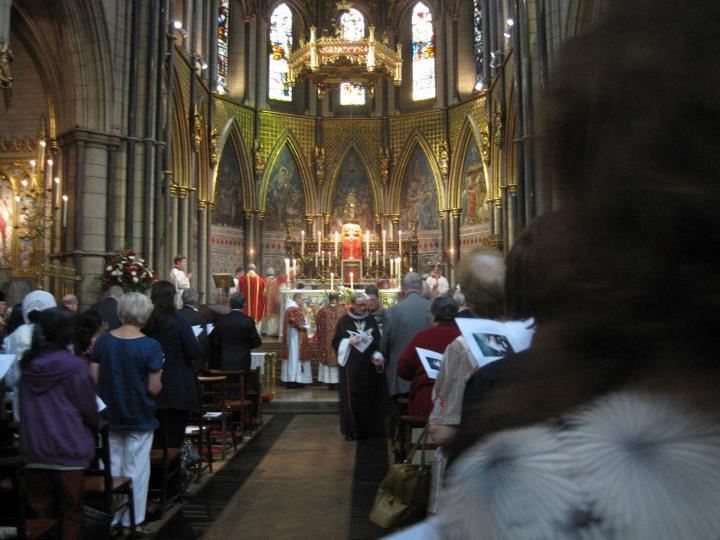
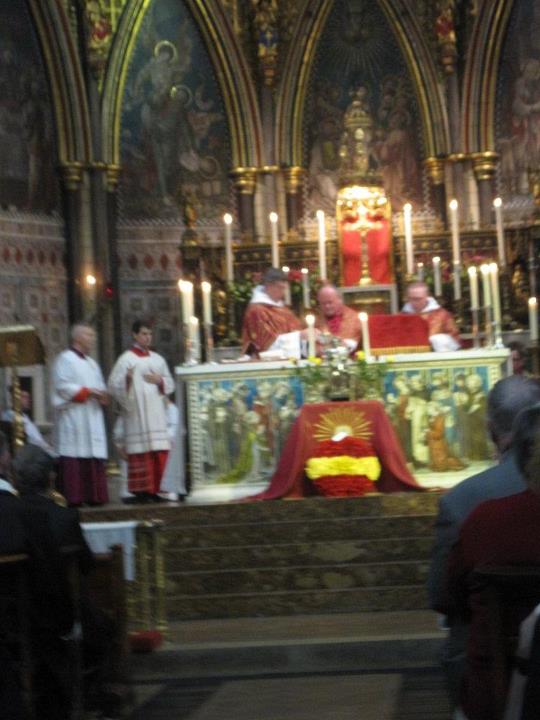
A joyful week of celebration at St James’s, Spanish Place.  Wednesday was the Feast of Title, and the Right Reverend Dom Cuthbert Brogan, Abbot of Farnborough, celebrated and preached at Solemn Mass. 


The Spanish Ambassador was also present, marking the historic connexion between the people of Spain and St James.  Like so many of the older parishes in the Westminster diocese (parish records date back to 1732), St James's Spanish Place can trace its origins to penal times and to the benefactions of a nearby Catholic embassy, and a fascinating explanation of the parish's history can be found on the parish website.

Having previously been based in Ely Place, the Spanish Embassy was once in Hertford House (now the Wallace Collection) and in 1791 a chapel was built in Spanish Place (close to the site of the present church, and of sufficient renown to have been mentioned by Thackeray in Vanity Fair as the church attended by the Marchioness of Steyne) to serve the needs of Catholics serving there.


Although the Embassy moved elsewhere long ago and the London Vicariate assumed control of the chapel in 1827, and although the chapel was replaced by the present building in the 19th century, there are many reminders of Spanish heritage in the church, including Alfonso XIII's personal standard, which hangs above the door from the sacristy into church, and the twin crowns situated above two prime positions in choir set aside for visits from the King and Queen of Spain.  It is, however, mere coincidence that the colours of the Spanish flag are reflected in the colours of the Marylebone Cricket Club.

At that mass last week, the Marylebone Ordinariate Group was also joined for the first time by its newest member, Rupert Brennan Brown.  Known to most of the group from his time at St Mary’s Bourne Street (and the third member of the group to be married there), Rupert was received into the Church some years ago but has now joined the Ordinariate, taking advantage of the provision that enables former Anglicans who were received into the Church prior to Anglicanorum Coetibus to become members of the Ordinariate.

A great occasion, happy for the parish of course and for those of us privileged to be hosted by it, but also happy very specifically for us in the Marylebone Ordinariate Group, because now we found ourselves reunited with one from whom we had been separated.  A certain extract from Blessed John Henry Newman's Apologia pro Vita Sua came to mind.
And I earnestly pray for this whole company, with a hope against hope, that all of us, who once were so united, and so happy in our union, may even now be brought at length, by the Power of the Divine Will, into One Fold and under One Shepherd.
We were also delighted to note that among the clergy in the sanctuary, Fr Christopher Pearson was one of the concelebrants. 

For us, the highlight among a venerable feast of music was Victoria's O Lux et Decus Hispaniae.
O lux et decus Hispaniae Sanctissime Jacobe, qui inter Apostolos primatum tenens, primus eorum martyrio laureatus.  Alleluia.

O light and grace of Spain, most holy James, he who held primacy among the Apostles, was the first of them to take the laurels of martyrdom. Alleluia.
This powerful piece, previously unknown to us, sat beautifully alongside other much more familiar music.  The setting of the ordinary of the mass was Mozart's Coronation Mass, and as well as a Jubilate Deo from Giovanni Gabrieli, we were delighted to hear the Finale from Vierne's Organ Symphony No. 1, which had also been played after the Ordinariate's Anniversary Solemn Evensong and Benediction at St James's earlier this year.  Those of you interested in hearing what music in St James's sounds like, as well as merely seeing plenty of photos of this stunning building, can find a video on our post entitled A Perfect Setting.


A few photos of the great day follow below.  Those of you interested in the Spanish connection will note that the picture of the Abbot preaching (so reminiscent of the excellent photos of Monsignor Newton preaching in that same place some months ago) shows the aforementioned personal standard of King Alfonso XIII of Spain in the background. 


Thursday, 17 May 2012

Ascendens Christus in Altum Alleluia

Having been used to a pattern of feasts based on the BCP kalendar (for example, our friends at Bourne St mark the Ascension tonight), one of the little adjustments we have had to make as new Catholics is the keeping of solemnities such as today on the following Sunday. 


This caused a little confusion amongst us this morning as we sorted out plans for when to attend an Ascension mass, it being a Holy Day of Obligation, even if that obligation is transferred in England and Wales to next Sunday. 

Just to cause a little extra complexity, I had travelled this morning from Paris, where it is a French public holiday, marking indeed the Ascension.  On this Solemnity last year, while still an Anglican, I attended mass at my Paris parish church, S Pierre de Chaillot, mentioned before on this blog in respect of this year's Ash Wednesday liturgy.  Yet, this year, I was speeding on the Eurostar over to a country where the obligation had been transferred, and could not make the 11am Extraordinary Form Mass being celebrated at St James's..... Sunday it will have to be.

Whenever you mark the Ascension, a most blessed feast day to you.   Two pieces of music to help you celebrate today, the first a setting by Victoria of Ascendens Christus in Altum, the last Responsorium of the Second Nocturn of Matins for the Ascension; the second some well known Anglican Patrimony, a staple of Anglican cathedrals and colleges, the Finzi setting of God is gone up, the text coming from a meditation by Edward Taylor.   My search for a top quality recording on youtube of the Philips setting of Ascendit Deus continues: last year I had hoped to find one for the St Mary's Bourne St Facebook page, but to no avail, and no success this year either.  Let's hope for something for next year. 


Ascendens Christus in altum, alleluia.
Captivam duxit captivitatem, alleluia.
Dedit dona hominibus, alleluia.
Ascendit Deus in jubilatione,
et Dominus in voce tubae, alleluia.
Dedit dona hominibus, alleluia.

Saturday, 7 April 2012

Good Friday

The Sacred Triduum continued yesterday at St James's with the most moving Good Friday liturgy that many of us had experienced.  It was, of course, very familiar, but the depth of the ceremonies was tremendous, not least to those of us experiencing Good Friday for the first time as Catholics.


Taking account of the speed in which St James's filled up on Thursday evening, I arrived almost half an hour before the liturgy began, to find that the front half of church was pretty much already full, with the back half filling up gradually.   More impressive than that was the total silence, even with all those people present, a silence that was fully maintained.

Yesterday was mostly sunny and light, as this picture taken on my way to St James's shows.  However, inside the church, there were no lights on at all, and this effect, coupled with several well-timed passing clouds lessening what sunlight was coming in, made for the perfect sombre setting.  On account of the lighting, there are no photos of the inside to share today.


The liturgy began in utter silence at 3pm, with all four of the parish clergy following the servers in and prostrating themselves before the altar, as around 500 people knelt down in the body of the church.  It was very powerful. 

Before the Passion, we all sat in silence as the choir sang this motet by Anerio.  The way the music appears to die, but then pushes on after the first "usque at mortem" is a homily in itself.


Following the beautiful singing of the Passion by three choir members (including the Byrd setting for the choral parts, which was new to me), Fr Colven gave a homily that addressed two main points.  First, in John's Gospel, where no textual detail is merely padding, that Pilate's order that INRI be written in Greek, Hebrew and Latin was a sign that what happened on Good Friday was part of something that was for everyone and would change existence for everyone, there was a universality to it.  Second, that what changed is that, as the Catechism says, death is not to be feared, and this is for all who put their trust in Christ.

The Solemn Prayers had a particular resonance and logic to new Catholics, the prayers for separated brethren in particular.

Perhaps the most striking part of the liturgy was the Procession of the Cross (with Fr Irwin singing the Ecce Lignum Crucis rather well) and the Veneration.  The Veneration must have taken around half an hour, purely on account of the number of people present. 

During the Veneration, the choir sang several motets and hymns.  The question raised on the famous New Liturgical Movement website a couple of weeks ago was answered at Spanish Place with the beautiful setting by Victoria.


Among the hymns, the popular but moving When I Survey was included.  This verse in particular never fails to pull heartstrings.

Forbid it, Lord, that I should boast,
Save in the death of Christ my God!
All the vain things that charm me most,
I sacrifice them to His blood.


As we returned to our seats following Veneration, we were each handed a card with a prayer of Blessed John Henry Newman :


....shine through me and be so in me that every soul I come in contact with may feel Thy Presence in my soul; let them look up, and see no longer me - but only Jesus.


This text tied in perfectly with the Holy Father's Chrism Mass homily, which has been so widely covered elsewhere, but which talked about sacrifice of self and dedication.

We wait for tonight's vigil and the resurrection with the rest of the Church.