Showing posts with label Pope Benedict XVI. Show all posts

Thursday, 2 August 2012

Monsignor Newton on The Future of Ecumenism

A video recording of Mgr Newton's address given at the Church of St Mary Magdalen in Brighton has been in circulation for some time, but it is only now that the quiet days of August allow the members of the Marylebone group to view it and to provide a few personal thoughts on it.


It can come as no surprise that we find ourselves wholeheartedly in agreement with what Mgr Newton says (and no, we are not saying that simply because he is our Ordinary).

To prove that, do please note that we have often referred (for example here and here) on this blog to our sadness that the warnings given by many, including by Cardinal Kaspar in 2006 (to the Church of England's House of Bishops) and in 2008 (to the Lambeth Conference) have not been taken into account.  His 2006 speech called for the Church of England not to erect new impediments to unity.  Cardinal Kaspar's 2008 text included the following as part of his longer address :
We would see the Anglican Communion as moving a considerable distance closer to the side of the Protestant churches of the 16th century, and to a position they adopted only during the second half of the 20th century.
The 1966 Common Declaration signed by Pope Paul VI and Archbishop Michael Ramsey called for a dialogue that would “lead to that unity in truth, for which Christ prayed”, and spoke of “a restoration of complete communion of faith and sacramental life”. It now seems that full visible communion as the aim of our dialogue has receded further, and that our dialogue will have less ultimate goals and therefore will be altered in its character. While such a dialogue could still lead to good results, it would not be sustained by the dynamism which arises from the realistic possibility of the unity Christ asks of us, or the shared partaking of the one Lord’s table, for which we so earnestly long.
The advice of those such as Cardinal Kaspar has been ignored even although senior clergy from the Orthodox Church have addressed leading Anglicans on the same point (certain kinds of Anglicans like to turn a deaf ear to Rome, fondly but vainly imagining that Constantinople or Moscow will say something rather more to their liking).  At a 2010 address to the Nicaea Club at Lambeth Palace, Metropolitan Hilarion, of the Russian Orthodox Church, after recalling the warm history of co-operation between Anglicanism and the Orthodox, and having taken several none-too-subtle swipes at the über-liberal practices of certain parts of the Anglican Communion, went on to comment that the Church of England's approach on certain issues was not conducive to Christian Unity.
We have studied the preparatory documents for the decision on female episcopate and were struck by the conviction expressed in them that even if the female episcopate were introduced, ecumenical contacts with the Roman Catholic and the Orthodox Churches would not come to an end. What made the authors of these documents so certain?
The effect of what is now happening is that the underlying raison d'être for the no doubt friendly and sincere ecumenical dialogue that carries on is fundamentally different from that envisaged by the 1966 Common Declaration.  No longer does even the most Panglossian optimist think that any kind of corporate unity is likely in the lifetime of anyone living today.  The unquestionably warm friendships and contacts at the parish and personal level continue, but the true Unity for which Christ prayed is further away than it was.  The conclusions of ARCIC I and the zenith of hope for reunion that was attained when Blessed John Paul II knelt in prayer beside Archbishop Robert Runcie in Canterbury Cathedral seem so very far distant now.

Well, that's all old ground, you might say.  Cardinal Kaspar and Monsignor Newton have said it all rather better than you, and indeed you have written of this in the past.  All true.  We'll leave it there.
 
However, what we would want to do is to pick up on something else that Monsignor Newton mentioned.  He talked of an address given by the Archbishop of Canterbury to a symposium at the Gregorian University in Rome in 2009, marking the centenary of the birth of Cardinal Willebrands, the first president of the Pontifical Council for the Promotion of Christian Unity.

Dr Williams talked of the many things upon which Catholics and Anglicans agree being first order issues (by which he meant important points), and of those upon which we did not agree being second order issues (by which he meant less significant matters that ought not to get in the way of the bigger points).  He also talked of how the way that the Anglican Communion handles differences might be a potential model for Catholic-Anglican discussions, but we shall make no comment upon that, sticking rather to his differentiation in significance of topics.

When reading of Dr Williams's talk at the time, my reaction to the first order and second order analysis was  that I wanted to apply it rather differently.  If these points really are second order (in an Anglican understanding thereof), why then (of relevance to Anglicans) does General Synod not only spend seemingly all of its time discussing them, but also (of relevance to Catholics too) place such a high value on them that they are allowed to wound shared understandings of first order issues?

Whatever we might think of any of these "second order issues", do any of them really trump the following:
Ut omnes unum sint, sicut tu Pater in me, et ego in te, ut et ipsi in nobis unum sint, ut credat mundus, quia tu me misisti.

That they all may be one; as thou, Father, art in me, and I in thee, that they also may be one in us; that the world may believe that thou hast sent me.
In this context, Anglicanorum coetibus can indeed be seen very clearly as a practical ecumenical gesture, as Monsignor Newton rightly said.  To Anglo-Catholics who didn't wish their response to the Gospel call to Unity to be subject to second order issues, it was indeed the perfect ecumenical gesture.


Let us conclude with two musical settings of the words of Psalm 132 (or Psalm 133, depending on which counting system you follow....).  The first version is very definitely Anglican Patrimony, it is Anglican chant sung by the choir of King's College, Cambridge.  The second is a setting that has featured previously on this blog, written by Fernando de las Infantas in 1570 to commemorate the founding the Holy League, the alliance of Catholic Nations that in 1571, under Don John of Austria, would emerge victorious from the Battle of Lepanto, as Fr Hunwicke evoked so clearly for us at St Mary's Bourne St in 2010.
Ecce quam bonum et quam iucundum, habitare fratres in unum.  Sicut unguentum in capite, quod descendit in barbam, barbam Aaron.  Quod descendit in oram vestimenti eius, sicut ros Hermon, qui descendit in montem Sion.  Quoniam illic mandavit Dominus benedictionem, et vitam usque in saeculum.

Behold how good and joyful a thing it is, brethren, to dwell together in unity.  It is like the precious ointment upon the head, that ran down unto the beard, even unto Aaron's beard.  And went down to the skirts of his clothing, like as the dew of Hermon, which fell upon the hill of Sion.  For there the Lord promised his blessing and life for evermore.


Wednesday, 27 June 2012

Tu es Petrus

Given that there are more than a few postings scheduled for this blog over the next few days (due to rather special Ordinariate events), we have decided to post this article two days earlier than we might have done.  It would never do for those who have joined the Catholic Church in search of the Unity called for by Christ Himself and assured by the Successor of St Peter to omit to mention Friday's great Solemnity.

When the Solemnity of Ss Peter and Paul arrives, as well as remembering to attend mass (some of us in our group at St James's, some of quite possibly at St Mary Moorfields), let us give particular thanks for the priestly ordination 61 years ago that day of our Holy Father Pope Benedict.   


Let us give thanks for the life and witness of this truly remarkable man, this Pope of Christian Unity, who has done so much to reunite the scattered flock - something of which we members of the Ordinariate are particularly aware.  Let us ask for the intercession of Our Lady, St Peter, St Paul and all the saints, that with renewed strength in the Lord, our Holy Father might continue to work valiantly and succesfully for the unity of all Christians and for the greater glory of God. 

We reproduce below a text that we included on this blog very recently, taken from an Angelus address given by the Holy Father in August 2008, in which he describes the particular role of the Church and of the Pope within it.
"You are the Christ, the Son of the living God". Jesus answers Peter's inspired profession of faith: "You are Peter, and on this rock I will build my Church, and the powers of death shall not prevail against it. I will give you the keys of the Kingdom of Heaven". This is the first time that Jesus speaks of the Church, whose mission is the actuation of God's great design to gather the whole of humanity into a single family in Christ. Peter's mission, and that of his Successors, is precisely to serve this unity of the one Church of God formed of Jews and pagans of all peoples; his indispensable ministry is to ensure that she is never identified with a single nation, with a single culture, but is the Church of all peoples - to make present among men and women, scarred by innumerable divisions and conflicts, God's peace and the renewing power of his love. This, then, is the special mission of the Pope, Bishop of Rome and Successor of Peter: to serve the inner unity that comes from God's peace, the unity of those who have become brothers and sisters in Jesus Christ.
It seems to us that the Petrine ministry is such a tremendous gift to the Church and to the world.  It allows us to move away from a fragmented, dismembered vision of Christianity, ever ready to fracture itself further, and instead, in union with Rome and the other ancient churches, to move together towards greater unity. 


Thursday, 21 June 2012

Songs of Thankfulness and Praise

There has been some wonderful news for the Ordinariate.  Our previous post reflected briefly on the Sacred Heart and its importance as a devotion recognising the unbounded love of Our Lord for humanity, and so it is most appropriate that in this the month of the Sacred Heart, we as new members of the Church should feel not only the love of Our Lord, but also the love of our Holy Father and of fellow Catholics for their new brethren.  Today, there has been an announcement that, in Monsignor Newton's own words :
....is a further sign of our Holy Father's love and warmth towards [the Ordinariate].
At the plenary meeting for Ordinariate clergy held at Allen Hall in London today (the photo below comes from the Ordinariate's Facebook page), it was announced that the three other former anglican bishops serving now as priests in the Ordinariate of Our Lady of Walsingham have been raised to the rank of Monsignor by the Holy Father in recognition of their long and fruitful ministry undertaken in the Church of England.


It is yet another sign not only of how much the Holy Father is keen to show his support for the Ordinariate, but also of how enthusiastic he is about recognising the immense value of the service that Ordinariate clergy have previously given.  All the polemic put about by some, with a degree of stridency (and we suggest error) worthy of E P Thompson or even Richard Holloway, to the effect that the Catholic Church requires prospective Ordinariate clergy to renounce their past, is put to utter ridicule by news such as this.

Congratulations then to Monsignor Edwin Barnes, Monsignor Robert Mercer and Monsignor David Silk.  We rejoice with you that together we have found our place in the Catholic Church, and that our Holy Father Pope Benedict continues to value so highly, and to recognise so publicly, not only the Anglican Patrimony that we bring with us, but also the undisputed value of our previous Christian life.

We are of course particularly delighted to read of Monsignor Barnes's honour.  In the Marylebone group, we are devoted fans of Monsignor Barnes's blog (to which a permanent link is provided in the right hand sidebar of this blog), and readily admit to having "borrowed" a couple of photographs he posted on his blog, including in this post.  We also have a couple more of his photos stored up ready for a future post.  Here though is a picture (copyright Fr James Bradley, and taken from the Ordinariate's own Facebook site) of Fr Barnes taken on the day of his priestly ordination.


There is a personal connection between the Marylebone group and Monsignor Barnes.  In the interregnum at Bourne St that ended with the appointment of the current Vicar, one of our group was a St Mary's churchwarden, and as such, in consultation with the assistant parish clergy, co-ordinated the list of visiting preachers.

One of those preachers was the great Fr John Hunwicke, whose powerful sermon that day can be found here.  We all know of course of this erudite, charming and holy man's upcoming priestly ordination in the Catholic Church, and indeed some of our group intend to make the journey up to the Oxford Oratory that day.

Another of the guest preachers was scheduled to be Monsignor Barnes.  However, events took over, such that, following the faster than expected establishment of the Ordinariate, it was no longer possible to secure his speaking presence among us.  We were utterly charmed by our interaction with Monsignor Barnes during those discussions, as we were when we had the pleasure of meeting him again at the Ordinariate Anniversary celebrations in January this year. 

Taking into account that not everyone at Bourne St was quite as catholic in their sensibilities as we were, in the interests of fairness, celebrity cleric Giles Fraser was also invited.  Given his fascinating views on Holy Saturday (as mentioned here), as on some other subjects, perhaps it worked out for the best that, although he accepted the invitation, a date could not be agreed. 

Another visitor was Dr Robin Ward, Principal of St Stephen's House in Oxford.  Wearing a mozzetta that would befit even the grandest of monsignori, he preached extremely well.  This, of course, was exactly as expected.  A more intelligent, thoughtful, witty and able preacher does not exist in the Church of England.  A few months before Dr Ward's visit, we had very much enjoyed reading the sermon he gave at the 125th Anniversary Celebrations of Pusey House, including his reference to Blessed Pius IX comparing Dr Pusey to a church bell, ever summoning people to church but never entering it himself.  Fr James Bradley has already commented very effectively upon this sermon on his blog (to which we provide a permanent link in the sidebar), but we can certainly confirm that the sheer intellectual force of Dr Ward's argument in that text was no small factor in our decision to accept the Holy Father's invitation to follow the Gospel's call to Christian Unity. 


Dr Ward is, of course, one of Monsignor Barnes's successors at St Stephen's House as Principal (Monsignor Burnham was Vice-Principal at one time, and Bishop Peter Elliott, the Australian bishop responsible for supervising the establishment of the new Ordinariate of Our Lady of the Southern Cross, is a former student).  Who can say whether Dr Ward might one day share another of Monsignor Barnes's titles by himself becoming a monsignor in the Ordinariate.  A "larger room" for that very fine mozzetta, perhaps. 

To bring together the themes of Our Lord's love for His creation, and the Church's and the Holy Father's love for all humankind and in particular for those considering joining the Catholic Church, we might mention very briefly a book that over the past few years seems to have helped many in their journeys "across the Tiber" into the Church founded by Our Lord Himself.  It is very hard to read this book (and one chapter in particular) and not to feel a bout of Roman fever, as the Anglo-Catholics say, coming on.

Pope Benedict's book, Jesus of Nazareth, is designed to reunite the artificially separated concepts of the "Historical Jesus" and the "Christ of Faith".   By focussing too much on the first - as important a concept as it undisputedly is - we lose sight of the second, we risk obsessing about minutiae rather than pondering the momentous nature of the Son of the living God's presence among us.  If we focus only on the second, we fail to consider sufficiently the very glory of the Incarnation, that God was made man at a specific point in time and in a particular place.  In his book, the Holy Father said it rather more eloquently, of course :
What can faith in Jesus as the Christ possibly mean, in Jesus as the Son of the living God, if the man Jesus was so completely different from the picture the Evangelists painted of Him, and that the Church, on the evidence of the Gospels, takes as the basis of her preaching?
The chapters move through different aspects of Our Lord’s life and teachings, often grounding the analysis in details from each of the synoptic gospels, building on the context that was set by the introduction’s explanation of Deutoronomy’s promise of a new Moses: not merely a miracle worker, a sufferer of trials or a leader, but in fact someone close to God.

Former Anglicans now in the Ordinariate are understandably very interested by the chapter on the Confession of Peter and the Transfiguration. We see that Peter is recorded in all four Gospels stating clearly his confident belief that Jesus is Christ, the Son of God, the Messiah, but from our perspective we perceive very lucidly that there is both a confession and a commission, a creed from Peter but a commission from Our Lord, a calling in response.  It is almost a challenge : you say you believe this, well this is how you exercise that belief.

Peter and others were witnesses to the Truth.  They saw it, recorded it, reported it.  They were not a committee or a general synod that debated what the Truth was: it was before their very eyes, and in Peter's confession he made it clear that he had recognised it.   Truth, not opinion.  It is on this Truth, and on this rock, that the Church is built.  Tu es Petrus, et super hanc petram, aedificabo ecclesiam meam.

In some of the articles on this blog, we have touched upon that theme of Tu es Petrus, and with hindsight it seems extremely fortuitous that we have talked of a journey into Unity, and of a continuing journey thereafter.  For example, in this post we mentioned the journey towards joining the Ordinariate, and in this post we highlighted the eternal yet immediate invitation, indeed the call, towards Unity that is issued to many different groups who lie outside the full and unimpaired visible communion of the Catholic Church.  In this post, we referred to the power of a particular piece of music to drive people along the road of that journey.

We cannot claim that this consistent language of journeying was deliberate, but happily it reflects something that the Holy Father talks of in the chapter on Peter's Confession.
The great period of preaching in Galilee is at an end and we are at a decisive milestone: Jesus is setting out on the journey to the Cross and issuing a call to decision that now clearly distinguishes the group of disciples from the people who merely listen, without accompanying him on his way – a decision that clearly shapes the disciples into the beginning of Jesus’ new family, the future Church. It is characteristic of this community to be “on the way” with Jesus – what that way involves is about to be made clear. It is also characteristic that this community’s decision to accompany Jesus rests upon a realization – on a “knowledge” of Jesus that at the same time gives them a new insight into God, the one God in whom they believe as children of Israel…

… The disciples are drawn into his solitude, his communion with the Father that is reserved to him alone… They are privileged to see what the “people” do not see, and this seeing gives rise to a recognition that goes beyond the “opinion” of the people. This seeing is the wellspring of their faith, their confession; it provides the foundation of the Church.
When the Holy Father talks of "the Church", we know very clearly that he talks of the Catholic Church.   The Catholic Church, founded by Christ Himself, which presents the Truth today as then, not as one of a suite of alternative theories from which we can select as we choose, but as divinely revealed Truth.   This is our call today, we are called to be members of that same Church, to accept that same Truth.

Joining the Ordinariate was a journey for all of us: a journey of faith, certainly, but clearly also a journey of trust.  This is so for all who left behind happy years with long-established friends in Anglican churches across the country, but it is perhaps most so for those brave clergy who left behind established careers and career paths, housing and membership of a pension scheme to follow their consciences.

There will be some uncharitable souls who, in response to the above, will mutter that those of the Ordinariate clergy who were already retired did not give up as much as the others.  Well, unkind and somewhat snide remarks of that nature fail when we remember that our three new monsignori laid down episcopal status to serve the Lord as priests in His Holy Catholic Church.  They gave up a comfortable position among the "great and the good" of retired Anglican bishops (status among the "great and good" is very popular in some quarters), and they gave up direct exercise of the role of a Successor of the Apostles, a most honourable calling whether retired or not.  This is not something that can be easily dismissed, either by the more worldly or the more spiritual of the deniers.

So, once again, we give thanks to Almighty God for giving all of us that sense of trust and that vision of unity, such that we have become capable of being brought at length, by the Power of the Divine Will, into One Fold and under One Shepherd.

Monsignori: congratulations, and thank you.  Please be assured that what you have done is right, and that we offer our prayers for you and for all the Ordinariate clergy, as well as for all those still wrestling with their response to the call to unity.  Your journey into the Catholic Church is an example to all, and is no less than you playing your part in the work of this our Pope of Christian Unity.


Peter confessed that Jesus was the Christ, the Son of the living God.  In response, Peter received Christ's commission, part of which was to gather together all who believe in one fold.  Let us rejoice that our lives as Christians, where we already shared in Peter's confession, have been made more whole by our response to Our Lord's commission to Peter, through joining that same Church built on that same rock.

The Holy Father, in an Angelus address given in August 2008, once again expressed all this far more eloquently :
"Upon this rock I will build my Church"

The Lord directly questioned the Twelve: "But who do you say that I am?". Peter spoke enthusiastically and authoritatively on behalf of them all: "You are the Christ, the Son of the living God". This solemn profession of faith the Church continues to repeat since then. Today too, we long to proclaim with an innermost conviction: "Yes, Jesus, you are the Christ, the Son of the living God!". Let us do so in the awareness that Christ is the true "treasure" (Mt 13,44) for whom it is worth sacrificing everything; he is the friend who never abandons us for he knows the most intimate expectations of our hearts. Jesus is the "Son of the living God", the promised Messiah who came down to earth to offer humanity salvation and to satisfy the thirst for life and love that dwells in every human being. What an advantage humanity would have in welcoming this proclamation which brings with it joy and peace!

"You are the Christ, the Son of the living God". Jesus answers Peter's inspired profession of faith: "You are Peter, and on this rock I will build my Church, and the powers of death shall not prevail against it. I will give you the keys of the Kingdom of Heaven". This is the first time that Jesus speaks of the Church, whose mission is the actuation of God's great design to gather the whole of humanity into a single family in Christ. Peter's mission, and that of his Successors, is precisely to serve this unity of the one Church of God formed of Jews and pagans of all peoples; his indispensable ministry is to ensure that she is never identified with a single nation, with a single culture, but is the Church of all peoples - to make present among men and women, scarred by innumerable divisions and conflicts, God's peace and the renewing power of his love. This, then, is the special mission of the Pope, Bishop of Rome and Successor of Peter: to serve the inner unity that comes from God's peace, the unity of those who have become brothers and sisters in Jesus Christ.
As we are still in the month of the Sacred Heart, I think we can be permitted one further example of the fine hymnody that is associated with this devotion.  A few days ago, we included O Sacred Heart.  Today, we include the hymn that was sung after Mass at St James's last Sunday To Jesus' Heart All Burning.  This is followed by a very familiar setting of the Te Deum, in thanksgiving for the love, support and recognition shown by the Holy Father to his flock in the Ordinariate, and no less in thanksgiving for the long years of service given by Monsignors Barnes, Mercer and Silk in their Anglican days.


Thursday, 19 April 2012

Ad Multos Annos, Sancte Pater

People talk about remembering where they were when Kennedy was shot, or when the World Trade Center came down in September 2001.  I remember exactly where I was on 19 April 2005 when Cardinal Ratzinger became Pope Benedict XVI. 

My family and I were living in Hong Kong at the time, and I had fallen asleep in front of the television, watching CNN's wall-to-wall coverage of what was happening in Rome.  At around 2am Hong Kong time, I was woken up by the loud cheering that greeted Cardinal Estevez as he emerged to make his great announcement :
Anuntio vobis gaudium magnum;  habemus Papam: Ementissimum ac Reverendissimum Dominum, Dominum Iosephum Sanctae Romanae Ecclesiae Cardinalem Ratzinger qui sibi nomen imposuit Benedictum XVI.
Cardinal Ratzinger had been much talked about as a likely candidate, but I had first become properly aware of him just over a decade before, when I was still an undergraduate.  One of the Anglican clergy at Pusey House at the time, now a Catholic, was keen on extolling his virtues, and this made a lasting impression on me.


Dear Brothers and Sisters: After the great Pope John Paul II, the Lord Cardinals have elected me, a simple and humble worker in the vineyard of the Lord. I am consoled by the fact that the Lord knows how to act, even... with inadequate instruments and above all I entrust myself to your prayers. In the joy of the Risen Lord, trusting in His permanent help, as we go forward the Lord will help us, and His Mother, Mary Most Holy, is on our side. Thank you. 
Did any of us know in 2005 just what a massive difference Pope Benedict XVI would make to us personally?  Of course not.  The Holy Father's vision for Unity has brought the members of the Marylebone Ordinariate Group, and well over a thousand others in England alone, into the full communion of the Catholic Church.  Thank you, Pope Benedict, for making this possible. 

The Provost of the London Oratory put it like this :
Another of the Holy Father’s outstanding achievements is his inspiring work for Christian Unity in setting-up the Ordinariates for former Anglicans. What a brilliant way of cutting through the plethora of mealy-mouthed verbiage and foggy thinking that has characterized so much ecumenical activity in recent decades, verbiage and fogginess which may indeed have had the very best of intentions, but which nevertheless achieved so little in real terms.

Let us also pray with all our heart and mind and strength that our vitally important ecumenical journey with our Greek and Russian Orthodox brethren will continue apace, that our charitable and respectful dialogue with them will bear much fruit, so that the universal Church might once again breathe with two whole lungs, and so that soon there may be but one flock and one shepherd. Domine, ut sit!
To add to the achievement of greater Unity brought about by Anglicanorum Coetibus, it looks like there could be a great reconciliation with the SSPX.   We have mentioned before on this blog that there are parallels, even if far from exact, between the situations of these two groups that are being / have been / will be brought (back) into full visible communion.  Those still outside full visible communion might be interested in reading this letter. 

In this great week when we have celebrated Pope Benedict's 85th birthday, and now the 7th anniversary of his election as our Pope, we give thanks for his mission among us, for the inspiration he provides and for his faith and devotion.  Most of all, we give thanks for his achievements in working for unity. 

In the words of an earlier Prince of the Church, who showed great support for Anglicans joining the Church, "God Bless Our Pope".  Ad multos annos, Sancte Pater. 

Thursday, 22 March 2012

This is the Appropriate Moment

Anglo-Catholics might be interested in an open letter that was sent earlier this week, on the Solemnity of St Joseph, by Monsignor Nicola Bux (Consultor to the Congregation of the Doctrine of the Faith) to Bishop Bernard Fellay and to all the priests of the Society of St Pius X.  Christian Unity is high up the agenda in Rome. 

The letter contains much that is entirely specific to the situation of the SSPX.  However, if one excludes those sections, could the text not equally be addressed to some of those in the Anglican Communion pondering their futures?  The letter, driven by the efforts of Pope Benedict XVI, this Pope of Christian Unity, to reunite the flock in one fold under one shepherd, contains points that will resonate deeply with many in that situation.


You can find the complete text in English on the website of the Rorate Coeli blog, but here are some relevant extracts of their translation from Monsignor Bux's French original. 
........Christian brotherhood is stronger than flesh and blood because it offers us, thanks to the divine Eucharist, a foretaste of heaven.

Christ invited us to experience communion, this is what our "I" is made of. Communion means loving one's neighbor a priori, because we have the one Savior in common with him. Based on this fact, communion is ready for every sacrifice in the name of unity; and this unity must be visible, as the last petition addressed by Our Lord to his Father teaches us - "ut unum sint, ut credat mundus" -, because this is the decisive testimony of Christ's friends........

.....With Saint Catherine of Siena, we wish to say: "Come to Rome in complete safety," next to the house of the common Father who was given to us as the visible and perpetual principle and foundation of Catholic unity......

......How not to think of the contribution you could give to the welfare of the whole Church, thanks to your pastoral and doctrinal resources, your capabilities and your sensibility?

This is the appropriate moment, the favorable time to come. Timete Dominum transeuntem: let not the occasion of grace the Lord offers you pass by, let it not pass by your side without recognizing it.

Will the Lord grant another one? Will not we all one day appear before His Court and answer not only for the evil we have done, but above all for the good we might have accomplished but did not?

The Holy Father's heart trembles: he awaits you anxiously because he loves you, because the Church needs you for a common profession of faith before a world that is each day more secularized and that seems to turn its back to its Creator and Savior hopelessly.

In the full ecclesial communion with the great family that is the Catholic Church, your voice will no longer be stifled, your contribution will be neither ignorable nor ignored, but will be able to bring forth, with that of so many others, abundant fruits which would otherwise go to waste........

........On this day dedicated to him, may Saint Joseph, spouse of the Blessed Virgin Mary, Patron of the Universal Church, inspire and sustain your resolutions: "Come to Rome in all safety".
How else to follow something like that but with one of our favourite youtube clips, certainly provided here before, and featured as a permanent video on the right hand sidebar of this blog.

Tu es Petrus: et super hanc petram aedificabo ecclesiam meam.  Et portæ inferi non prævalebunt adversus eam: et tibi dabo claves regni cælorum. 


Friday, 16 March 2012

Here We Go Again

Old issues keep cropping up, time and again.  Although in some places a constructive and engaged dialogue continues, in other places there is merely shouting (or as the French, in their unashamedly un-pc way, say un dialogue de sourds).  Currently, there are two very different examples of this phenomenon that are floating around the public consciousness (one rather more than the other), although there was a third example, to my mind in no way less important, which has been obliterated from the forum.


The first topic is the one that is all over the UK media, being the question of same-sex marriage and its near certain introduction into the English legal system (indeed the government now tells us that it doesn't matter how many people say they are for or against it, it is going to happen, come what may).  I am not going to dig a hole for myself by getting involved in that debate (and so it is unlikely that any comments will be published) : there are already plenty, far more eloquent and informed than I could ever be, on both sides of the discussion, who have made their case, just as there are those on both sides of the debate who have merely shouted at each other.  However, I will say a couple of things, writing purely in a personal capacity.

It is to be hoped that people on both sides of the debate understand that people on the other side do genuinely feel strongly about their position.  They each very honestly believe that they are putting forward a case that is robust, just, and in many ways, they feel, so obvious that it barely need be spoken.  That last part being the reason why the debate often gets so heated.  Some express themselves better than others, some show a deeper awareness of the contrary arguments than others, the words of all of them alike are twisted into grotesque (yes, I know the reference I am making, and no, read the original, Cardinal O'Brien did not say that anyone was grotesque) soundbites by the media, but underneath it all, they know that they sincerely hold the views they express and they know that their debating partners are no less sincere in their belief.

There are times when this slips and the situation turns unpleasant, though I won't name names : we can all think of examples on both sides. 

It should be emphasised that whatever else it is doing, and whatever else it may be perceived to be doing, the Catholic Church is not throwing itself into an attack on any particular group in this debate.  Those who like to deride the Catholic Church sometimes talk about its "unhealthy" obsession with sin, and how it imbues an enduring sense of "Catholic guilt" in its members : well, that in itself is an old debate, but in this context I would answer the "charge" by saying that all Catholics are indeed taught that they all sin, every one of them, each in their own ways, that none of them should feel superior to anyone else in this regard, and most importantly that they can all, if they want, receive God's forgiveness.  In support of this assertion, I could cite a familiar Bible text about motes, but in addition I would draw your attention to this recent homily given by the Holy Father.

The Catholic Church is defending something, not attacking something.  The letter from the Archbishop of Westminster and the Archbishop of Southwark read out in parishes last Sunday morning was a reasoned and calm, but very clear, defence of the traditional understanding of the institution of marriage. 

One big fear - and you don't have to agree with the Catholic Church's understanding of marriage to see this - is that the government just hasn't thought this through in detail.  The implications are not insignificant (for example, an interesting debate recently about something as basic as vocabulary, will the words husband, wife and even mother and father become politically incorrect?).  There is a special concern in the Church of England, whose statement yesterday points out the naivety of imagining that the dividing line between civil and religious marriage is quite as neat and tidy as seems to be assumed in the case of the established church, whose clergy are licensed to perform marriages.   

If the change is brought in, and it must be said that it seems very likely that it will be, it will probably be manageable for the Catholic Church to find a way to work with the new realities.  It will be messy, it will be difficult, but it will somehow be achievable.  There is after all the precedent of the mariage civil  and the mariage réligieux, as well as similar precedents from a few other countries, even if those do not quite replicate the context we will find here.  The time will surely come when even this will not be acceptable, and one can foresee the day when the government demands that any organisation that conducts marriages should do so for any who ask, regardless of how the request fits the organisation's own criteria for marriage. When that day comes, it might be necessary, as was suggested on the Valle Adurni blog a few weeks ago, for the Catholic Church simply to stop conducting any marriage ceremonies at all in order not to be in a position where it breaks the law where it "supplies services" to some but not to others.

The poor old CofE will have a tougher time, partly on account of its established status, but also on account of its rapidly growing body of evangelicals, who will struggle to come to an accommodation on this with the liberal wing, many of  whom would have no issue at all with conducting same-sex marriage ceremonies.

It must be conceded that those who have no religious belief must find it immensely frustrating that a group of people, however large, and based on whatever history and tradition, is perceived as trying to restrict some of those who have no interest in them. It behoves those advocating a traditional understanding of marriage to bear that in mind, just as we would ask those looking to bring same-sex marriage into existence to take account of the genuine reasons why people do not agree with them, rather than just lazily assuming that it must be down to one kind of prejudice or another.

A Stonewall lobbyist remarked that Catholics who are not in favour of same sex marriage should simply be careful to ensure that they don't enter into such an arrangement.  Some people found that flippant, but I must admit that I found it quite funny.  In return, a mildly amusing anecdote about the famous Labour MP Tom Driberg, later Lord Bradwell (immortalised in a rather unkind, if funny, 1977 Derek and Clive sketch about an exchange between taxi drivers that is definitely not for the faint of heart). 

Driberg, despite never making a secret of his homosexuality, decided to get married in 1951.  In a ceremony at St Mary's Bourne St in June that year (described as "outrageously ornate" by his biographer), at which his bride was first baptised and then entered church to the accompaniment of an organ arrangement of The Red Flag, Driberg made vows that he didn't end up keeping in front of a full house.  Among those present, so (possibly apocryphal) Bourne St legend relates, was Winston Churchill, who is said to have remarked unkindly of the bride's looks "Well, buggers can't be choosers."

On a more serious note, Driberg left instructions for the sermon to be given at his funeral.  It wasn't at all a celebration of how wonderful he was, of what a joyous and exuberant life he had led.  It was a powerful address, given by the Revd Gerald Irvine, on how Driberg had fallen short in his life, how he (exactly like everyone else, no better, no worse) was a sinner, which of the Seven Deadly Sins had plagued him most.  All of us can learn a lesson from Driberg in that respect, an awareness that no matter what our own little cocktail of pecadilloes might be, we all fall short, every one of us.

Interestingly, although Driberg maintained his lifelong Anglo-Catholicism (Lancing to Pusey House to St Mary's Bourne Street and onwards), he was supportive of someone whose life's path crossed his own on many occasions but who left Anglo-Catholicism.  Evelyn Waugh did what in 1930 was, even if not criminal, barely less scandalous socially than were Driberg's pastimes - he became a Catholic.  Did Driberg reject him as a bigot?  No - Driberg was Waugh's only guest upon his reception into the Catholic Church, and Driberg gave Waugh column space in the Daily Express subsequently to defend himself against charges of blasphemy from The Tablet (now doesn't that sound strange to the modern ear).

************

Another old issue that crops up again and again is the path to reunion between the Church of England and the Catholic Church.  Everyone with even the slightest interest in Christian Unity rejoices that the Archbishop of Canterbury and Holy Father jointly attended Vespers in Rome, and that together they gave thanks for the mission begun by St Gregory the Great of sending St Augustine of Canterbury to increase the spread of Christendom in the British Isles and to strengthen the links between the Church in England and Rome.  That Rowan Williams goes to Rome so often, and continues to be invited back, is a very good thing.  Christian Unity is a Gospel imperative, and however distant it seems, we must all seek it.

Still, there are those who see this as proof that everything can carry on exactly as before, that there are no new impediments to Christian Unity being gleefully erected by parts of the Anglican Communion.  I regret that those people would seem to be in Egyptian mode.  A strange comment on this was made by the American Episcopal Church's Pierre Whalon, who took the opportunity to have a little go at the Ordinariates formed under Anglicanorum Coetibus, declaring that they had no ecclesiological basis and that as pastoral measures would only last a decade or two.  Well, as an American he ought to know that the US Pastoral Provision, creating the Anglican Use in the Catholic Church in the USA was brought in 32 years ago. Furthermore, as the head of ECUSA's European branch, which overlaps with the Church of England's Diocese in Europe, he ought to know something about the endurance and ecclesiology of multiple jurisdictions of the same denomination co-existing in the same geographic territory.

This film of the event by Rome Reports shows the clear and genuine affection and respect that exists between the Holy Father and the Archbishop of Canterbury.  However, even though Pope Benedict XVI is most definitely the Pope of Christian Unity, the debate has moved on and there can be few who seriously believe that any kind of corporate reunion is possible in their lifetime (even if there were many who believed precisely that even twenty or thirty years ago).


************

Finally, the third old story that came briefly to public attention, yet has quickly been displaced by the two old stories above, particularly the first one, is abortion.  That, in itself, is sad.

However, the saddest thing is that those academic ethicists who argued (even if in the context of academia) that infanticide (or if you prefer, post natal abortion) could be justified did not expect the reaction they got.

We all know the difficult cases where there are heart-rending tales used to argue in favour of and against abortion.  The victim of rape who can't bear the thought of a permanent reminder of the awful crime that befell her.  The mother of several children who cannot see how she could possibly cope with more children without causing severe difficulties for her existing children.  The adult who might so nearly have been aborted when in the womb but wasn't.  The disabled child who brought joy to their parents.  We all understand the difficulties here, all of us know that glib answers just won't do, and we all know that you can find people for and against any such cases (even when Church teaching is very clear). 

However, is the world really such a horrible place that shock and revulsion at the very idea of infanticide come as a surprise to some?

Wednesday, 25 January 2012

Christian Unity

So here we are.  The end of the Week of Prayer for Christian Unity 2012, we have come from the feast of the Chair of St Peter at Rome on the 18th to today's feast of the Conversion of St Paul.  The Holy Father will mark this by celebrating Solemn Vespers this afternoon (perhaps one year, when Rome and Canterbury finally reunite, it will be Solemn Evensong and Benediction).

The Ordinariate is, at its heart, about heeding the call to Unity that is expressed in the prayer of Our Lord on the night that he was betrayed that all might be one.  That is why Ordinariate blogs go on and on (and on) about how important Unity is.  Those of us who follow Ordinariate news on Facebook or Twitter have been kept very efficiently up to date with events in Rome this week for the Week of Prayer for Christian Unity (if you haven't signed up to follow Ordinariate news, then you can do so at #UKOrdinariate or http://on.fb.me/fZWBJ5).  Unity is a topic that Ordinariate members most definitely follow.

Pope Benedict XVI truly is, as we argued in a post last October, the Pope of Christian Unity.  In that blogpost, you can see a picture of the Holy Father walking side by side with Bartholomew the Ecumenical Patriarch, which surely points to progress in healing the greatest of the rifts in Christianity, something about which Blessed John Paul II was particularly passionate.  While we on these shores focus on the Ordinariate in certain circles, and while many of us, perhaps more so in Ireland and Scotland, focus on a Protestant vs Catholic divide, all this, even if desperately important (not least on a personal level to us Ordinariate members), is small in scale compared to the need to work for resolution to the millenium old divide between Catholicism and Orthodoxy.

It is sometimes tempting to think that if we in England had a wider of sense of international perspective, the Church of England's General Synod would not consider matters of Unity as being of so little importance.  It's too easy to say "We don't care what those awful Romans say, they'll come round in the end once they've understood that we are right, and anyway we prefer Orthodox spirituality".  Add a little bit of the English cultural undercurrent of suspicion towards Catholicism into the mix, and Synod's alacrity in forgetting about Unity is easily explained.

We have talked recently about the views of Metropolitan Hilarion (of the Russian Orthodox Church) on some of the developments in the Church of England.  Everything that General Synod does to move away from Unity, it does not only against Unity with Rome and the Church in the West, but also against Unity with the Orthodox.  The sole moves that General Synod seems to want to take towards Unity seem to be towards unity with a small band of like-minded national churches (the Porvoo Communion, for example), a process that bizarrely seems to be evolving into overtures from some connected to the US-based Polish National Catholic Church to disaffected members of the Church of England who cannot yet accept the idea of reunion with Rome (the PNCC has recently established a small presence in Norway and smaller ones in Germany and Italy).

Some people who in one breath will dismiss Mormonism will with the next happily state, without a hint of irony, that yes indeed the truth, the right way forward (in total contradiction to what has gone before) is being revealed to them and to them alone, leaving hundreds and hundreds of millions of other Christians (mostly the non-English speaking ones) in the dark.  Francis Wagstaffe is alive and well, and God is an Englishman.

Even if someone hates everything that Rome says and does (which is certainly not the attitude of faithful Anglo-Catholics remaining in the Church of England), they must surely concede that there can, quite simply, be no Christian Unity without Rome.   Through history, through tradition, through the Gospel appointment of St Peter and through his successors, Rome is at the heart of Christianity : it is the "rock from which we were hewn", as Anglo-Catholics have been so fond of saying.

Unity is important, vitally so.  Christianity should not be seeking new and exciting ways in which to hack itself apart: it should be seeking ways to increase mutual understanding and co-operation with a definite goal of reunion.  Ecumenism, in its now somewhat tarnished sense of everyone having a nice cup of tea and talking pleasantly to each other while pretending not to disagree, is not a bad thing of itself as long as all involved are well-intentioned, realistic and sincere : however, if it leads nowhere, and if it becomes less and less likely that it ever will lead anywhere, then serious thought needs to be given to whether it is in fact more of a distraction than something that serves any useful purpose.  True ecumenism, true moves towards unity, are always useful and are most certainly vital.  We must never abandon our attempts to work together and to reunite, but we must always ensure that our efforts are appropriately focused and directed.

As ever, Fr Colven's parish notes at St James's this week included a very apposite and interesting reflection on the theme of Unity and the Week of Prayer for Christian Unity.  Here it is :
Maria Gabriella Sagheddu was born on the island of Sardinia in 1914: though brought up in a Catholic atmosphere, she had no great desire for God until, at the age of eighteen, the death of a sister brought her a moment of conversion: life was literally turned around, and Maria began an intense life of prayer which led her to enter the Cistercian monastery at Grottoferrata just south of Rome in 1935. Around that time – mainly inspired by the efforts of Abbe Paul Couturier – religious houses throughout Europe were inspired with a new impetus to pray for the unity of Christians, and the community at Grottoferrata offered a novena for that intention. Sister Maria Gabriella felt called to offer her life for the cause of Christian unity and asked permission of her superiors to do so: on the very night that permission was granted, the young Cistercian (who until this moment had been vitally healthy) felt the first pains which indicated the onset of the tuberculosis from which she would die just eighteen months later. We hear much today about spiritual ecumenism – and here is an example of what his can mean. It is right that theologians and church leaders should talk and study together to find common ground and understand the history of our disunity, but all this effort is as nothing without praying hearts that really share the pain of Christ in his fractured Body.
The Cistercian community of which Blessed Maria Gabriella (so designated by Pope John Paul in 1983) was a member had forged strong links with a number of Anglican Benedictine houses in England, and this enclosed nun from Sardinia, who in all probability never met a Christian from another tradition, consecrated her life in a very definite way to draw Anglicans into the full unity of the Church. Perhaps the recent establishment of the Ordinariate of our Lady of Walsingham for former Anglicans is, at least in part, due to Blessed Maria Gabriella’s intercession – it must certainly have rejoiced her heart to see the four hundred people who were here in Spanish Place last weekend to celebrate Solemn Evensong arranged by local members of the Ordinariate.
As Roman Catholics, during this annual Week of Prayer for Christian Unity (18th-24th January), we do have particular insights to offer. On the one hand, an older model of re-union (a sort of ecclesial federation based on an extended European Community model – famously satirised by Monsignor Ronald Knox) seems less and less viable, while our vision remains that of the Catechism when it says: “all are called to this Catholic unity of the People of God, and to it in different ways, belong, or are ordered, the Catholic faithful, others who believe in Christ and finally all mankind, called by God’s grace to salvation”.  Our understanding is that: “this Church constituted and organised as a society in the present world, subsists in the Catholic Church which is governed by the Successor of St Peter and by the bishops in communion with him”: If we sincerely believe that the fullness of Christianity "subsists" (is to be found existing) and the means to salvation – orthodox belief, nurtured by the sacraments, expressed in a life of charity – are offered  in a unique way within Catholic communion, then (and this in no way, denies their existence, to varying degrees, in other expressions of the Christian tradition) to borrow some words of Cardinal Herbert Vaughan: “of course we desire to convert all – especially our own countrymen – to the Catholic religion. Could it be otherwise?”
Unity means the Unity of all Christians, including Rome.  This is the cause of Catholic Unity that is celebrated on the Halifax Memorial on the wall at St Mary's Bourne Street, and it is this Unity that the Ordinariate is working to build.

Two final comments. 

First, apologies that I have completely failed to post a piece of music today.  I had tried to find a setting of Magnus Sanctus Paulus (perhaps the Palestrina), but I could not find a suitable youtube link.  I then intended to post Mendelssohn's How Lovely are the Messengers from Paulus but again drew a blank in both the English and the original German (Wie Lieblich sind die Boten) versions : the recordings I could find were either of not especially good performances, or were technically of poor quality.  There will be more music some time soon.

Second, we believe we have some more photos of last week's celebrations at St James's, marking the first anniversary of the Ordinariate's existence.  If we manage to track them down, we will post them on Flickr.  These photos include shots of the church but also of the reception afterwards.  In the meantime, if you go to this blogpost, you will find some links to other photos. 
O thou, who at thy Eucharist didst pray
that all thy Church might be for ever one,
grant us at every Eucharist to say
with longing heart and soul, "thy will be done."
O may we all one Bread, one Body be,
through this blest Sacrament of unity.

For all thy Church, O Lord, we intercede;
make thou our sad divisions soon to cease;
draw us the nearer each to each, we plead,
by drawing all to thee, O Prince of Peace;
thus may we all one Bread, one Body be,
through this blest Sacrament of unity.

We pray thee too for wanderers from thy fold;
O bring them back, good Shepherd of the sheep,
back to the faith which saints believed of old,
back to the Church which still that faith doth keep;
soon may we all one Bread, one Body be,
through this blest Sacrament of unity.

So, Lord, at length when sacraments shall cease,
may we be one with all thy Church above,
one with thy saints in one unbroken peace,
one with thy saints in one unbounded love;
more blessèd still, in peace and love to be
one with the Trinity in Unity.

Saturday, 19 November 2011

Christ the King

We now approach the final days of the Church's year.   There is one more great feast day to come before we move into a new year, and into the penitential and preparational season of Advent.  In the modern calendar, the last Sunday of the liturgical year (ie tomorrow) is the Solemnity of Our Lord Jesus Christ King of the Universe.  Pope Paul VI moved the date of this feast in 1969, previously it had been celebrated on the last Sunday before All Saints' Day (and still is when the Extraordinary Form is used), which was the date set in the encyclical letter Quas Primas of Pope Pius XI, promulgated on 11 December 1925.


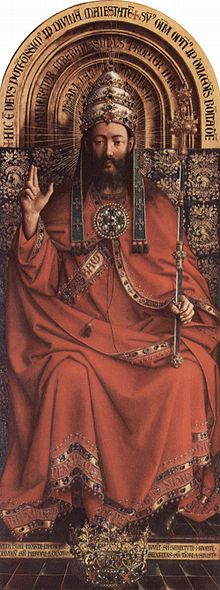
There are some rather good images of Christ the King, including the Van Eyck above, and indeed the rather more traditionally devotional image shown below (which I rather like).  However, we should not make the mistake of assuming that the feast is only about the time when the request expressed in the words of the Pater Noster "Thy kingdom come" have been fulfilled, even if Pope Paul VI's placing of the feast at the end of year points in that direction.


The feast is also about the ways in which Christ is already the Universal King.  In his Angelus address on the Feast of Christ the King in 2006, Pope Benedict XVI said that "The Cross is the 'throne' from which He demonstrated the sublime regality of God-love."  He went on to explain that Christ the King is not about human-style power, but about service and love, with the perfect example of acceptance of this being the life of the Virgin Mary. As a result of her fiat mihi, "God exalted her over all other creatures, and Christ crowned her Queen of heaven and earth."  

If you have trawled through the details of the right-hand sidebar of this blog, you might have spotted that the there is an embedded youtube video of Blessed John Henry Newman's Lead Kindly Light, sung by the late, great Irish tenor Frank Patterson.  Perhaps it is my Celtic blood, but I must confess a fondness for his performances of church music: so be warned, there will be more links in the future.  Frank Patterson was not only a talented tenor who sang for Popes and Presidents, but he was also a devout Catholic and indeed a Knight of Malta.  Having offered a brief prayer for the repose of his soul, we turn to his stirring performance of Hail Redeemer King Divine.


On a personal note, approaching the turn of the liturgical year gives pause for reflection.  This is not just in the way it always does, thinking of lost family and friends throughout the month of the Holy Souls, and of the Four Last Things in Advent, and indeed of the joy and hope to be brought by Christmas and a new year.  For members of all the Ordinariate groups, this is the end of the liturgical year in which we left our (yes we admit it) much loved Church of England in order to share, with much joy, the priority given by the Holy Father to Christ's fervent desire that all should be one.  Therefore, with sincere thanksgiving for our welcome in the Catholic Church through the Ordinariate, we also pause to pray for all those we have left behind in the Church of England, noting that we now for the first time enter a liturgical year without them. 

Coming from St Mary's Bourne St, the Feast of Christ the King is a particularly potent memory.  This was, and continues to be, marked in quite some style at St Mary's.  We send our friends there every good wish for tomorrow's event. 

For old time's sake, here is a photo taken from the organ gallery at St Mary's during the celebrations for Christ the King in 2009.  The author of this blogpost is acting as subdeacon, another member of Marylebone Ordinariate Group is on the far left at the altar rail, and it wouldn't surprise me if the third member of our group were also somewhere in the serving group. 

One Bourne St tradition at Christ the King that we can happily copy on this blog is the inclusion of the Hallelujah Chorus.  So, here it is.  A very happy Feast of the Christ the Universal King to you all, and please join your prayers with ours as we prepare to enter a new year.


Our Lady, pray for us, and may the souls of all the faithful departed rest in peace.

Friday, 18 November 2011

Petrine Works Old and New

Today is the Feast of the Dedication of the Basilicas of St Peter and of St Paul.  St Peter's must surely be the most well known church building in the world, and forms the heart of the Vatican City.  You might have noticed that we have modified the title design of the blog in honour of this great building.  In spite of being so well known, as mentioned in last week's post on the Basilica of St John Lateran, St Peter's is not, as is commonly assumed, a cathedral, and it is not where the cathedra of the Bishop of Rome is situated.

However, St Peter's is the obvious photo used whenever the Vatican or the Roman Church is mentioned, and as such it is an immensely powerful symbol of the Catholic Church, recognised outside the Church and by people with absolutely no interest in Catholicism, Christianity or religion.


The Basilica of St Paul outside the Walls (Basilica Papale di San Paolo fuori le Mura) is perhaps slightly less well known (apart from a brief burst of fame in 2008, when there was media speculation about its Abbot, Edmund Power, potentially having been in the running for the post of Archbishop of Westminster), but like St Peter's and like St John Lateran is one of the four ancient Papal Basilicas to be found in Rome.  The fourth is Santa Maria Maggiore, of which more some other time.


The sites of both Basilicas have been places of pilgrimage from very early, and indeed long before it became "safe" or "established religion" to perform such acts of devotion.  Henry Vollam Morton, the journalist and travel writer (perhaps best known for being the first to break the story, in the Daily Express, of Lord Caernarvon and Howard Carter's opening of the tomb of Tutankhamun) put it like this in his 1959 book This is Rome :
It is extraordinarily interesting that Roman pilgrimage began at an…early time. Pilgrims did not wait for the Peace of the Church [Constantine’s edict of toleration] before they visited the tombs of the Apostles. They went to Rome a century before there were any public churches and when the Church was confined to the tituli [private homes] and the catacombs. The two great pilgrimage sites were exactly as today—the tombs, or memorials, of St. Peter upon the Vatican Hill and the tomb of St. Paul off the Ostian Way.
People have oftened question whether the ancient relics in St Peter's and St Paul's are what they say they are. However, much investigation has been carried out on this.

Years of architectural work at St Peter's (exploring areas of the Basilica that had not been accessible since the 9th century) led to Pope Pius XII proclaiming in December 1950 that although we could not be absolutely certain at that time that the remains in St Peter's were indeed those of St Peter, certain convincing evidence had come to light that pointed in that direction, and that therefore it was believed that the tomb of St Peter had been found.  Tradition held that St Peter had been buried on the Vatican Hill, and that since that time, martyrs, popes and other Christians had been buried nearby : the architectural work certainly showed that the Vatican had been built over a cemetery that dated back to the right period.   At the lowest level of the various levels of burials, an aedicula containing bone fragments wrapped in tissue with gold decorations and precious murex purple : this would certainly indicate the burial of someone considered to be of great importance.

Further work, including the discovery of an inscription, and the testing of bones showing that they belonged to a man of 60-70 years of age, led to Pope Paul VI declaring in 1968 that the matter was now beyond doubt.

As to the remains of St Paul in the Basilica of St Paul outside the Walls, the formal confirmation of the discovery of the white marble sarcophagus of St Paul was made in 2006 (although a 19th century chronicle entry from the Benedictine abbey next to the Basilica comments briefly on the discovery of the sarcophagus). The sarcophagus was then analysed until 2009.  Carbon dating carried out during that process showed that the bone fragments found in the sarcophagus of St Paul did indeed date from the first century AD, and that grains of incense and pieces of purple linen had been found alongside the bone fragments. Pope Benedict XVI announced in December 2009 that this seemed to add convincing weight to the uninterrupted tradition that the remains of St Paul's are buried in the Basilica.

For some light relief before the next section of this post, which gets a little serious, here is a selection of photos of St Peter's accompanied by the Sanctus from Schubert's Mass in E flat.


The Holy Father begins his travels to Benin today, a country that, along with most of Africa, is seeing exponential growth of Catholicism (Benin has roughly 500,000 more Catholics than it did ten years ago).  This growth sits oddly with the crazed cries of much of the media whenever the Holy Father visits or talks of Africa, virtually accusing him of personal involvement with a deliberate campaign of mass murder.  The fuss when Pope Benedict visited Cameroon and Angola two years ago, when the media extracted one sentence from his in-flight pre-visit address to journalists and spoke of nothing else was utterly scandalous, yet absolutely predictable : no talk of the growth of the Church in Africa, no talk of Church schools, Church hospitals, Church activity to support and treat those with AIDS and other diseases, Church orphanages, Church aid to the poor, and of course no talk of anything even vaguely touching on the spiritual. 

I hope the point is not silly, but this is the precise opposite of the way the media treated the recent death of Sir Jimmy Saville.  There was much talk of his immense and unquestionably marvellous charitable deeds (for which he received a Papal Knighthood), which was very welcome publicity for doing good works : but there was no mention of him attending Mass on an almost daily basis.  There, no credit could be given to Sir Jimmy's Catholicism, but when there is anything for which it is believed (rightly or wrongly) that "blame" is "needed", then the media are very keen on blaming Catholicism as a whole, and indeed the Pope himself.

Let us hope and pray that the media are going to be slightly more balanced during this trip, but sadly it seems that the media are not only sex-obsessed but lazy : a quick search on the internet reveals that the same old blinkered nonsense is being rehashed, of course entirely removed from the full context of the discussion.  Nobody expects all journalists to agree with what the Pope says, nor to praise him, but it would be nice to have a proper, reasoned discussion, rather than just be witness to the de-contextualised slinging about of extreme accusations.

Anyway, the work of this modern Successor of St Peter is for the "common good", just as was the work of St Peter himself.  Let us wish the Holy Father well on his trip.


St Peter, St Paul, all Saints of Africa, pray for us.

Friday, 28 October 2011

The Holy Father hosts in Assisi

Very much in line with the theme of yesterday's blogpost, The Pope of Christian Unity, in Assisi yesterday the Holy Father hosted leaders of Orthodox and Protestant Christianity, as well as leaders of other religions, for an Interreligious meeting in Assisi, at which he and his guests renewed their commitment to peace.

This was the third such meeting.  The first took place 25 years ago, the second shortly after the events of 11 September 2011.  This time, the much discussed moment of common prayer was not included, rather leaders were each given an opportunity to make a contribution, and then separately each had time for prayer and reflection.  

The Holy Father's message was that there should be no more violence in the name of religion, that we as Christians have the shameful task of acknowledging that violence has in the past been used in the name of Christianity, and that the contributions of each religion in this life should be "Justice and Peace, Forgiveness and Life, Love"
As a Christian I want to say at this point: yes, it is true, in the course of history, force has also been used in the name of the Christian faith. We acknowledge it with great shame. But it is utterly clear that this was an abuse of the Christian faith, one that evidently contradicts its true nature. The God in whom we Christians believe is the Creator and Father of all, and from him all people are brothers and sisters and form one single family. For us the Cross of Christ is the sign of the God who put "suffering-with" (compassion) and "loving-with" in place of force. His name is "God of love and peace" (2 Cor 13:11). It is the task of all who bear responsibility for the Christian faith to purify the religion of Christians again and again from its very heart, so that it truly serves as an instrument of God’s peace in the world, despite the fallibility of humans


The Holy Father also included agnostics in the guest list, picking up on the theme of the homily preached last month in Germany, where he pointed out that agnostics who seek God are closer to the heart of God than those who are ostensibly believers but whose life in faith is lived solely through routine and convention.
In addition to the two phenomena of religion and anti-religion, a further basic orientation is found in the growing world of agnosticism: people to whom the gift of faith has not been given, but who are nevertheless on the lookout for truth, searching for God. Such people do not simply assert: "There is no God". They suffer from his absence and yet are inwardly making their way towards him, inasmuch as they seek truth and goodness. They are "pilgrims of truth, pilgrims of peace". They ask questions of both sides. They take away from militant atheists the false certainty by which these claim to know that there is no God and they invite them to leave polemics aside and to become seekers who do not give up hope in the existence of truth and in the possibility and necessity of living by it. But they also challenge the followers of religions not to consider God as their own property, as if he belonged to them, in such a way that they feel vindicated in using force against others.
It is important not to misunderstand the events of yesterday.  This was not (and neither were the previous Assisi meetings), a watering down of Catholicism, or even of Christianity in any sense, in order to have a 1960s style pow-wow.  In no way did yesterday contradict what many, including Blessed John Henry Newman, have said about relativism.  Rather, it was a meeting of all those who lead world religions, held with a view to dedicating themselves to peace.  Indeed, the Holy Father, when talking of agnostics, commented that each us must seek the truest sense of our faith :

Their inability to find God is partly the responsibility of believers with a limited or even falsified image of God. So all their struggling and questioning is in part an appeal to believers to purify their faith, so that God, the true God, becomes accessible.
This is entirely consistent with what he said in the first quotation above, that violence committed in the name of Christianity contradicts its very nature, and is based on incorrect and falsified understandings.

Regular readers of this blog with keen eyes will note that in some of the footage included above, the Porziuncola can be seen.  We have previously talked of the Porziuncola here  and here.

St Francis of Assisi, Blessed John Paul II, pray for us.

Thursday, 27 October 2011

The Pope of Christian Unity

The ancient churches of the east have long fascinated me.  I found that one of the most interesting parts of Diarmaid MacCulloch's BBC documentary A History of Christianity was his opening section on the east, not only the Syrian Orthodox Church, but also the very early progress of Christianity in China. 

On a more personal level, I had the good fortune to spend several months in Armenia in 1998, where, thanks to the insatiable appetite for knowledge and thirst for history of my French boss at the time, I visited and attended the liturgy at a number of ancient churches and monasteries, including of course Echmiadzin and the astonishing and beautiful Khor Virap, which sits right on the current Turkish border with spectacular views of Mt Ararat.  Khor Virap is where St Gregory the Illuminator was imprisoned in a cave for many years before finally being released and converting the King of Armenia, making Armenia the first country to declare itself formally Christian (in 301AD).


The reason for indulging myself in this trip down memory lane is that today is the Feast of St Frumentius, the Apostle to Ethiopia.  The Ethiopian Orthodox Church, like the Armenian Apostolic Church, is very ancient, and is an Oriental Orthodox church.  These churches split from the Western Church long before the Catholic/Orthodox divide that arose in the eleventh century.  The fundamental difference between these Oriental Orthodox churches and the Catholic and Orthodox Churches of the west is a disagreement that crystallised at the Council of Chalcedon in 451AD. 

In the west, we refer to the Oriental Orthodox Churches as Monophysite, meaning that they believe that Christ had one single nature, whereas western teaching is that Christ has two natures, being, as the Divine Praises say, "True God and True Man", being wholly divine and wholly human.  The Oriental Orthodox reject the label of Monophysite, preferring Miaphysite, meaning that their definition of one nature really means a union in one form of two different natures.  These differences, which in this short summary and even in their underlying origins, turn on very subtle interpretations and in some cases on differences in translations, have kept the Oriental Orthodox and the Western Churches apart for over 1500 years, and it is only in the most recent times that small steps towards greater understanding have been made. 

A high point in the move towards greater understanding and reconciliation was the visit of Coptic Patriarch Pope Shenouda III to the Vatican in 1973, where Pope Paul VI presented him with a relic of St Athanasius (of whom a little more below), which relic is now housed in the Coptic Cathedral of St Mark in Cairo.  We must hope and pray that our Holy Father, Pope Benedict XVI, the "Pope of Christian Unity" as he is being called, continues the good work that has been started.

St Frumentius, having found himself shipwrecked in Ethiopia, was eventually sent to Alexandria, where in 328AD he was ordained Bishop by St Athanasius, who for so long was credited as the author of the Quicumque Vult, a text that is not as well known any more as it should be ("Whosoever will be saved, before all things it is necessary that he hold the Catholic Faith....").  From Alexandria, Frumentius returned south as Abune ("father") of Ethiopia, thereby starting a tradition that endured until 1959 of the Coptic Pope naming an Egyptian Copt as Archbishop of Ethiopia.  Like St Gregory the Illuminator, he baptised the King, and converted the country.

No post on the Ethiopian Orthodox Church can be complete with something on Lalibela, the series of churches carved out of the rock, each being quite literally monolithic, ie one single stone.  Here is an extract from a documentary about these astonishing buildings.


For me, gaining more and more understanding about the ancient churches of the first millenium, and seeing that, even if very very slowly, efforts are being made to explore ways to bridge our gaps, is ever so slightly bittersweet.  It is of course wonderful that these things are being done, these are clear examples of work and prayer being put in with a view to finding ways to come closer to unity of Christians.  Who does not rejoice at seeing this photo of the Holy Father with Bartholomew the Ecumenical Patriarch, symbolising in one image small steps that, while still fraught with difficulty, were thought impossible within living memory?


Yet the label of bittersweet still applies, because it reminds us that our former home, the Church of England, is not moving in the same direction, but in the opposite, towards some sort of increasingly formal affiliation with the national protestant churches of Scandinavia, rejecting more and more the idea of unity with the ancient Church of East and West : some kinds of Anglicans, in saying something anti-Papal, forget that the Orthodox Churches view developments in their church no more positively than does the Catholic Church.

We must pray with Pope Benedict XVI, the Pope of Christian Unity, with St Gregory the Illuminator and St Frumentius for the unity of all Christians.  On a day when the Holy Father is gathering around him not only the leaders of other religions, but also the leaders of Orthodox and Protestant Christianity, this seems doubly appropriate.

Let us also offer a prayer for those in the Ethiopian Catholic Metropolitan Church, who are in communion with the Holy Father, and who follow an Ethiopic Rite, especially those in Eritrea, whose ecclesial structure became an Ordinariate in 1930, later being raised to an Exarchate and thence to an Eparchate under the Metropolitan See of Addis Ababa.