Showing posts with label Frank Patterson. Show all posts

Sunday, 10 June 2012

Contrasting Definitions

Time, indeed like an ever rolling stream, has appeared to go quickly since we became Catholics.  A year ago, we were in our final month at Bourne St, preparing to leave the Church of England and our status as Anglicans.  We were embarking upon a eucharistic fast that was to last several months, in preparation for our eventual reception into the Catholic Church in early September.  It was appropriate that one of the last services we attended as Anglicans was the Bourne Street Corpus Christi devotion, in which we could give thanks for all the grace that had been poured out upon us in our time there.  Bourne Street always marks the Sunday following Corpus Christi with the grandest of services, greenery and herbs strewn on the floor during a procession, and of course some very fine music.  We wish our friends there well for their celebrations tonight. 

At St James's we mark Corpus Christi today with a Procession of the Blessed Sacrament after Mass.  We look forward to welcoming Fr Christopher Pearson of the Ordinariate as guest preacher.


That Bourne Street service last year was the final occasion upon which I served as an Anglican, acting as MC at a service of Evensong, Procession and Benediction.  How apt that the first time that I should serve at the altar as a Catholic should also be for the same form of service and in the same capacity.  Below you will see a couple of pictures of the Catholic service at which I served, the Ordinariate Anniversary at St James's, followed by a couple of pictures from Bourne St. 


You will see why we for us the progression seems entirely natural and normal.  Very much a continuation of the same, but crucially, now in communion with the Successor of St Peter.  A couple of pictures from the Bourne St archive now follow, giving a further indication of the reverence with which Corpus Christi has been treated in Anglo-Catholicism.  The first picture is from 2011, the second from c1995.


Our memories of those happy days have not flown, forgotten as a dream, but are very much fresh (all these Isaac Watts quotations were not intended to link with the mention of St Anne in our previous post, but do so quite nicely).  While in many ways so much has happened over this year, some of which has been recounted on this blog, in other ways we consider that what has happened was nothing more than the natural outcome for us, given the way we had understood Anglo-Catholicism.  There was a predictability, perhaps even in some ways an inevitability about what has happened, even if not about the way it has been allowed to happen, through the graciousness of Anglicanorum coetibus

Now, more than ever, it has become very clear that there was no one definition of what people understood by Anglo-Catholicism.  There had always been a wide range of sub-groups, that themselves could either be virtually entirely in line with the teachings of the Catholic Church, or in reality quite far from them in some important ways.  High Church Anglicanism and Anglo-Papalism are but two of the most long-established terms, but even there the difference is clear.

Over the past 20-30 years, the picture has become even more confused.  Movements such as Affirming Catholicism have sprung up, which happily absorb much of the liturgical and sartorial practice of the Catholic Church, while adopting an approach to moral teaching that is not based on the Catechism but on what people feel - quite genuinely - to be right and good.  It's the same old debate about there being a Truth that has been revealed, and is interpreted afresh in each generation, or there being an ongoing series of revelations in which the Truth today is not the same as the Truth yesterday (and indeed even today there can be multiple Truths, some of which can contradict each other).  We touched on this topic in this recent and widely-read post.  Anglo-Catholics of a more traditional outlook were sometimes prone to using the odd slightly unkind nickname for Affirming Catholics, the more printable of which include AffCaths and indeed De-Caffs.  However, the same naughtiness was shown in return, with Forward in Faith and its quasi-predecessor Cost of Conscience having been unkindly labelled Backwards in Bitterness and Price of Prejudice respectively.

That debate continues with Anglo-Catholicism.  With the departure of many to the Ordinariate, and the seeming acceptance of the changes likely to emerge from this summer's General Synod, the overall theme of Anglo-Catholicism seems to be shifting.  The debates on the approach to moral teaching will remain, but there now seems to be a view that the primary object of Anglo-Catholicism is not [to act]..in defence of Catholic Truth and...[to labour for]...the Reunion of Christendom, (as the words on the memorial to Lord Halifax say, see the photo in this post) but rather to be one of a number of contrasting strands of Christianity that should co-exist within the Church of England, even if the teachings of those strands are in some very signficant ways utterly incompatible.  The new Anglo-Catholicism now seems to be moving towards saying that if corporate reunion with the Roman Church were to come along, that would be lovely, but only if Rome moves on a number of significant matters, because Rome cannot expect to dictate to the Church of England the terms on which any such corporate reunion would take place. 

Perhaps this was obviously going to be the case.    The people who felt more of a draw to Rome and the Catholic Church have left or are very seriously considering leaving: yet this is not a new trend.  Yes, there have the departures since the 1990s, and indeed since the Ordinariate, but ever since Anglo-Catholicism began (in the sense we understand it arising from the Oxford Movement), there has always been a steady flow over the Tiber, even before the moment that Blessed John Henry Newman concluded that his eloquent and impressive arguments about the catholic nature of the Church of England, written while still an Anglican, did not stand up to the reality of the day (see here for details of where Newman drew his line in the sand, it being, to mix metaphors, a final straw at the end of a long process).

Newman's Tract 90, in which he argued that the 39 Articles of the Book of Common Prayer were not an attack on Catholic theology but rather an attempt to limit excesses, caused a great stir.  In response to protests from (Anglican clerics who were) senior in the University of Oxford (including Archibald Campbell Tait, mentioned so prominently in our most popular ever post) the Anglican Bishop of Oxford requested that there not be a Tract 91, and neither there was.  Tract 90 was published in 1841, just before Newman's withdrawal to Littlemore in 1842, from where he was received into the Catholic Church by Blessed Dominic Barbieri in October 1845.

Anglo-Catholics still cite Tract 90 today in defence of the great Anglo-Catholic vision of old, but given what is happening around them, one wonders if they can really continue to do so for much longer, at least in respect of the Church of England as it is today.  The drive of the Tracts for the Times, particularly Tract 90, was to show the Church of England as ecclesiastically catholic rather than protestant, ie that it was in tune with the teachings of the Catholic Faith.  As we mentioned a week or two ago, Geoffrey Fisher, a recent Archbishop of Canterbury summed this view up in the following way, just after the second world war.
The Church of England has no doctrine of its own, save that of the one Holy, Catholic, Apostolic Church.
When we quoted this recently, a comment on that blogpost was picked up upon by the excellent Let Nothing You Dismay blog.  There, the author pointed out
Although the idea of a synodical structure which would allow the laity, clergy and episcopate an opportunity to deliberate together on the issues facing the contemporary Church is (in theory) a laudable one, it has proved disastrous in practice. And this has been, not only because of the adoption of a quasi-parliamentary 'democratic model which has given the politicisation of church life a focus and an official platform, but because within Anglicanism there is no consensus as to what constitutes the authentic tradition.

Archbishop Fisher's comments about the Church of England having no doctrine which is not that of the catholic church are often seized upon by people like me, but the truth is that, however authoritatively they were expressed, they remain just the views of one Archbishop of Canterbury among many; they may have been an accurate snapshot of the consensus at the time within the Church, but are they any more than that? It's instructive that his comment was made just before the then established consensus (perhaps the high water mark of Tractarian influence within Anglicanism, going far beyond those who would identify themselves as 'Catholics') was about to fall apart.
As usual, the LNYD blog is spot on.  You cannot argue for the catholicity of the Church of England now (I make no comment about the past, nor do I make any comment about orders, which is an entirely different point) without addressing the issue of the change of direction.  You cannot logically argue using Tract 90 without volunteering to write a Tract 91, arguing the impossible, that everything that is now happening in the Church of England will not change the catholic vs protestant analysis that so obsessed the Tractarians who gave rise to what we call Anglo-Catholicism.

So in the CofE for those Anglo-Catholics who stay, change is required.  You can see this even from the wording of the statement issued by the Forward in Faith bishops last week. 
.....we must say something about diversity. At the heart of our theological tradition is an acceptance that the Church of England is enriched by the range of viewpoints within its spectrum. We are committed to the recognition of this diversity and to the liberty that protects it. Of course, the defence of liberty is one of the functions of justice and law, of which the monarch is guardian and symbol.
Really?  Diversity, with mutually incompatible theologies, is that a good thing?   Of course, this phenomenon is not new in the Church of England, but it has not always been seen as a strength of Anglicanism.  It seems there is no longer the attempt to catholicise or re-catholicise the Church of England, but that diversity of opinion,  Anglo-Catholic (of whatever hue) and protestant is good.  Well, here we come back to what we think we mean by saying "the Church", or even "the Catholic Church".  

The Forward in Faith bishops go on to say:
.....our search for unity will commit us to continuing engagement with the ARCIC process and dialogue with the Orthodox Churches.
So there you have it.  Anglicanorum coetibus is not on the agenda, the outcome of July's General Synod is irrelevant.  Christian Unity for the Forward in Faith bishops is the ARCIC process and the Orthodox (who, as we have noted before, do not think in the least bit favourably of the current Anglican changes).  That means it is not a high priority for them.  In the words of the Anglican Archbishop of New Zealand after the end of the recent ARCIC talks in Hong Kong:
There seem to be many obstacles from a human point of view, and it does not seem likely to have fully visible unity in the near future
Diversity constituted by incompatible theologies, and what risks appearing as institutional loyalty (however much any of us love our view of what the CofE is or has been) at the expense of a clear impetus towards unity, those are not goals for which any of us in the Marylebone group could have ignored this gracious call to Unity issued by Pope Benedict.

For us, it is sad to note this seemingly different approach.  However, we must acknowledge that it is only sad because it relates to our vision of what Anglo-Catholicism was all about.  We had always seen the Church of England as being part of the Church, but being in impaired communion, we had viewed the Catholic Church as being the rock from which....[the Church of England was]...hewn, we had seen ourselves as being separated by accident of history.  We had never seen the Church of England as a standalone entity in which we could seek to maintain a strand of catholicism.

So while it may all be rather sad for us, the changes may be positive and welcome for others.  The word Anglo-Catholicism has never meant just one thing, and the Anglo-Catholic movement has never had one single goal upon which all its adherents agreed.

Let us move back to Corpus Christi. Here are two contrasting pieces of music to prepare us for today.  First, some Tallis, and then another appearance from Frank Patterson.


Thursday, 31 May 2012

The Incarnation is not only for Christmas

The Feast of the Visitation has been, historically, a slightly odd one for those who have had an association with St Mary's Bourne St.  The month of May was never seen out with any great festivity, which you would at first think was unusual for a church in the highest of Anglo-Catholic traditions, dedicated to Our Lady, indeed thus dedicated on the Feast of the Visitation in 1874.  In fact there is a very good explanation.


Unlike so many of the apparently unusual traditions of individual parishes around the world, there was no secret behind this, there had been no loss of the rationale for this seemingly strange omission (although it must be admitted that the number of people "in the know" is not high).  The church was dedicated on the Feast of the Visitation according to the pre-1969 calendar, when this fell on 2 July, hence it always seemed slightly superfluous to hold another grand service on the 31 May.  Therefore, it had been practice since shortly after the calendar changes to observe the Visitation in a slightly low key way, given the bonanza to follow later in the year. 

Indeed, even although our friends at Bourne St now do mark the Visitation on 31 May in more style than in our time (and, on that note, we take the opportunity to wish the vicar a very happy birthday), the first weekend in July is still a time of great festivities there: founders and benefactors are commemorated on the Saturday, and a great procession around the parish accompanies the usual Sunday morning rituals. 

Whether the day is marked today and/or according to an older calendar, it is indeed a cause for great joy. Even if circumstances mean that we no longer agree on everything and are sadly no longer in communion, we have no difficulty at all in saying that our friends at Bourne St will be entirely right to include a Marian procession through the streets in their plans for early July.   The day should be marked with celebration and happiness.

Indeed, the first weekend of July holds a particular significance for us, as it was the occasion of our own parting of friends last year.....but we will say much more on that in around a month.

All that ecumenical introduction serves as explanatory background to the fact that we are not yet used to marking the Visitation at the end of May.  In this instance, we cannot attribute the lack of familiarity to strange Catholic practices, nor to clinging on to Anglican habits: the root cause lies in the parochial traditions of our former home.

The Visitation is a time of great rejoicing, commemorating not only the joyful leap of St John the Baptist in his mother's womb, but also the incarnation itself.  It is very easy to make the mistake of thinking that we celebrate the incarnation at Midnight Mass, and that that's enough : we do indeed celebrate the incarnation then, but the incarnation is not only about a signficant date of birth, but as the greatest of acts (all the more so for being an act of humbling abasement), it is rightly marked through the Annunciation, through the Visitation and all throughout the Church's year.

Without the incarnation there would have been no Holy Week and Easter, indeed even Pentecost, which we marked last week, would have been rather different.  The incarnation is a wonder that affects every day in the calendar, pre or post 1969, and it is absolutely correct to give thanks for it at all times.   

I mentioned above the celebrations of the Visitation in July (even if technically the event is now a commemoration of the anniversary of the dedication of a church).  Well, to make my point about the need to mark the incarnation throughout the year, I want to (appear to) be even more unseasonal and include Betjeman's well-known poem Christmas, another example of Anglican Patrimony.  The poem talks about all the ways in which Christmas is celebrated, and the things that people fixate upon, and concludes by noting that really what counts is miraculous yet rather simple.  The same can be said at any time of year, there is this single Truth that underpins so much of the Truth that the Church is blessed to proclaim.
The bells of waiting Advent ring,
The Tortoise stove is lit again
And lamp-oil light across the night
Has caught the streaks of winter rain
In many a stained-glass window sheen
From Crimson Lake to Hookers Green.

The holly in the windy hedge
And round the Manor House the yew
Will soon be stripped to deck the ledge,
The altar, font and arch and pew,
So that the villagers can say
'The church looks nice' on Christmas Day.

Provincial Public Houses blaze,
Corporation tramcars clang,
On lighted tenements I gaze,
Where paper decorations hang,
And bunting in the red Town Hall
Says 'Merry Christmas to you all'.

And London shops on Christmas Eve
Are strung with silver bells and flowers
As hurrying clerks the City leave
To pigeon-haunted classic towers,
And marbled clouds go scudding by
The many-steepled London sky.

And girls in slacks remember Dad,
And oafish louts remember Mum,
And sleepless children's hearts are glad.
And Christmas-morning bells say 'Come!'
Even to shining ones who dwell
Safe in the Dorchester Hotel.

And is it true,
This most tremendous tale of all,
Seen in a stained-glass window's hue,
A Baby in an ox's stall ?
The Maker of the stars and sea
Become a Child on earth for me ?

And is it true ? For if it is,
No loving fingers tying strings
Around those tissued fripperies,
The sweet and silly Christmas things,
Bath salts and inexpensive scent
And hideous tie so kindly meant,

No love that in a family dwells,
No carolling in frosty air,
Nor all the steeple-shaking bells
Can with this single Truth compare -
That God was man in Palestine
And lives today in Bread and Wine.
The Gospels all flow from that single Truth, and we do well at all times and in all places to ensure that we ponder it in our hearts all year round, not just when the London shops are strung with silver bells and flowers.

The Visitation is a timely feast in its current position because it gives us one more chance to honour Our Lady in this her special month of May - not, of course, that we should desist from honouring her outside of May.  Time then for two pieces of music.  The first, a piece of Anglican Patrimony, the Magnificat, today's song, as set by Stanford in his Evening Service in C, and as sung at the Ordinariate's first anniversary celebrations at St James's in January this year.  The second: I just couldn't resist one last outing this year for Frank Patterson and Bring Flowers of the Rarest, a true May hymn. 

Tomorrow, our devotions turn towards the Sacred Heart of Jesus, the burning love of the incarnate one.  For tonight though, let us rejoice with Our Lady, and give thanks for her role in the incarnation.


Monday, 30 April 2012

Look Down in Mercy Upon England thy Dowry

Former Anglo-Catholics now in the communion of the Catholic Church are no strangers to Marian devotion.  What has changed is that this practice, which in our Anglican days was felt to be extreme, and was seen as something indulged in by a minority group, is now conducted in union with the whole Church, as part of the mainstream.


That is in no way to denigrate the devotion to Our Lady which existed, and in many circles still does exist, in the Church of England.  One year ago, the Facebook group page of our former Anglican parish contained a link to exactly the same youtube video as we now include below (you may have noted on this blog a weakness for Frank Patterson's performances of Catholic hymns, for example here, co-incidentally the hymn sung after Mass at St James's last Sunday).  All people have recourse to Our Lady and to the power of her intercession on our behalf, and is that not indeed one of the most wonderful things about her.


Yet in those days, it was something that we knew was not widespread in our ecclesial environment.  Other parishes and other clergy would view the May Procession at Bourne St as something eccentric, as something unfamiliar and exotic.  In all honesty, it must be admitted that some of the congregation were rather bewildered by it too: although there, all credit must be given to those who were, and are, so determined to carry on with this longstanding tradition, something which tells so powerfully, so visually and so audibly of the solid Catholic tradition of devotion to Our Lady.

One of the first large scale public events to occur involving the Ordinariate after our reception into the Catholic Church was the annual Rosary Crusade of Reparation.  If anything showed our new place in the order of things, and the solidity of the welcome given to us in the Catholic Church as Ordinariate members, that early event did, with Monsignor Newton leading the long procession from Westminster Cathedral to the London Oratory.  Photos of that great day can be seen here on our group's Flickr site and here on the Flickr site of the Ordinariate itself.  We are no longer at the edge of things, we are very much part of the core.

Much credit has been given to the Holy Father for his vision in bringing about the Ordinariates now springing up around the world.  We must give thanks not only for this, but also for the intercession of Blessed John Henry Newman and of Our Most Blessed Lady, since Anglicanorum Coetibus has allowed us and well over a thousand like us in England alone, to work together in Unity

We have said before that Ordinariate members should take Cardinal Nicholas Wiseman to their hearts, a wise Prince of the Church who showed great favour to Anglicans joining the Catholic Church.  We have also exhausted the airwaves by posting his hymn Full in the Panting Heart of Rome more than a few times.   On this the eve of Mary's month of May, perhaps his prayer for the Conversion of England is the most suitable way to conclude the opening blogpost of this special month.

O BLESSED VIRGIN MARY,
Mother of God and our most gentle Queen and Mother,
look down in mercy upon England thy "Dowry"
and upon us all who greatly hope and trust in thee.
By thee it was that Jesus our Saviour and our hope was given unto the world;
and He has given thee to us that we might hope still more.
Plead for us thy children,
whom thou didst receive and accept at the foot of the Cross,
O sorrowful Mother.
Intercede for our separated brethren,
that with us in the one true fold
they may be united to the supreme Shepherd, the Vicar of thy Son.
Pray for us all, dear Mother,
that by faith fruitful in good works
we may all deserve to see and praise God,
together with thee, in our heavenly home. Amen. 

Saturday, 19 November 2011

Christ the King

We now approach the final days of the Church's year.   There is one more great feast day to come before we move into a new year, and into the penitential and preparational season of Advent.  In the modern calendar, the last Sunday of the liturgical year (ie tomorrow) is the Solemnity of Our Lord Jesus Christ King of the Universe.  Pope Paul VI moved the date of this feast in 1969, previously it had been celebrated on the last Sunday before All Saints' Day (and still is when the Extraordinary Form is used), which was the date set in the encyclical letter Quas Primas of Pope Pius XI, promulgated on 11 December 1925.


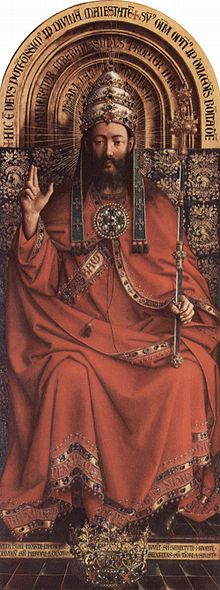
There are some rather good images of Christ the King, including the Van Eyck above, and indeed the rather more traditionally devotional image shown below (which I rather like).  However, we should not make the mistake of assuming that the feast is only about the time when the request expressed in the words of the Pater Noster "Thy kingdom come" have been fulfilled, even if Pope Paul VI's placing of the feast at the end of year points in that direction.


The feast is also about the ways in which Christ is already the Universal King.  In his Angelus address on the Feast of Christ the King in 2006, Pope Benedict XVI said that "The Cross is the 'throne' from which He demonstrated the sublime regality of God-love."  He went on to explain that Christ the King is not about human-style power, but about service and love, with the perfect example of acceptance of this being the life of the Virgin Mary. As a result of her fiat mihi, "God exalted her over all other creatures, and Christ crowned her Queen of heaven and earth."  

If you have trawled through the details of the right-hand sidebar of this blog, you might have spotted that the there is an embedded youtube video of Blessed John Henry Newman's Lead Kindly Light, sung by the late, great Irish tenor Frank Patterson.  Perhaps it is my Celtic blood, but I must confess a fondness for his performances of church music: so be warned, there will be more links in the future.  Frank Patterson was not only a talented tenor who sang for Popes and Presidents, but he was also a devout Catholic and indeed a Knight of Malta.  Having offered a brief prayer for the repose of his soul, we turn to his stirring performance of Hail Redeemer King Divine.


On a personal note, approaching the turn of the liturgical year gives pause for reflection.  This is not just in the way it always does, thinking of lost family and friends throughout the month of the Holy Souls, and of the Four Last Things in Advent, and indeed of the joy and hope to be brought by Christmas and a new year.  For members of all the Ordinariate groups, this is the end of the liturgical year in which we left our (yes we admit it) much loved Church of England in order to share, with much joy, the priority given by the Holy Father to Christ's fervent desire that all should be one.  Therefore, with sincere thanksgiving for our welcome in the Catholic Church through the Ordinariate, we also pause to pray for all those we have left behind in the Church of England, noting that we now for the first time enter a liturgical year without them. 

Coming from St Mary's Bourne St, the Feast of Christ the King is a particularly potent memory.  This was, and continues to be, marked in quite some style at St Mary's.  We send our friends there every good wish for tomorrow's event. 

For old time's sake, here is a photo taken from the organ gallery at St Mary's during the celebrations for Christ the King in 2009.  The author of this blogpost is acting as subdeacon, another member of Marylebone Ordinariate Group is on the far left at the altar rail, and it wouldn't surprise me if the third member of our group were also somewhere in the serving group. 

One Bourne St tradition at Christ the King that we can happily copy on this blog is the inclusion of the Hallelujah Chorus.  So, here it is.  A very happy Feast of the Christ the Universal King to you all, and please join your prayers with ours as we prepare to enter a new year.


Our Lady, pray for us, and may the souls of all the faithful departed rest in peace.