Showing posts with label Pope Paul VI. Show all posts

Thursday, 2 August 2012

Monsignor Newton on The Future of Ecumenism

A video recording of Mgr Newton's address given at the Church of St Mary Magdalen in Brighton has been in circulation for some time, but it is only now that the quiet days of August allow the members of the Marylebone group to view it and to provide a few personal thoughts on it.


It can come as no surprise that we find ourselves wholeheartedly in agreement with what Mgr Newton says (and no, we are not saying that simply because he is our Ordinary).

To prove that, do please note that we have often referred (for example here and here) on this blog to our sadness that the warnings given by many, including by Cardinal Kaspar in 2006 (to the Church of England's House of Bishops) and in 2008 (to the Lambeth Conference) have not been taken into account.  His 2006 speech called for the Church of England not to erect new impediments to unity.  Cardinal Kaspar's 2008 text included the following as part of his longer address :
We would see the Anglican Communion as moving a considerable distance closer to the side of the Protestant churches of the 16th century, and to a position they adopted only during the second half of the 20th century.
The 1966 Common Declaration signed by Pope Paul VI and Archbishop Michael Ramsey called for a dialogue that would “lead to that unity in truth, for which Christ prayed”, and spoke of “a restoration of complete communion of faith and sacramental life”. It now seems that full visible communion as the aim of our dialogue has receded further, and that our dialogue will have less ultimate goals and therefore will be altered in its character. While such a dialogue could still lead to good results, it would not be sustained by the dynamism which arises from the realistic possibility of the unity Christ asks of us, or the shared partaking of the one Lord’s table, for which we so earnestly long.
The advice of those such as Cardinal Kaspar has been ignored even although senior clergy from the Orthodox Church have addressed leading Anglicans on the same point (certain kinds of Anglicans like to turn a deaf ear to Rome, fondly but vainly imagining that Constantinople or Moscow will say something rather more to their liking).  At a 2010 address to the Nicaea Club at Lambeth Palace, Metropolitan Hilarion, of the Russian Orthodox Church, after recalling the warm history of co-operation between Anglicanism and the Orthodox, and having taken several none-too-subtle swipes at the über-liberal practices of certain parts of the Anglican Communion, went on to comment that the Church of England's approach on certain issues was not conducive to Christian Unity.
We have studied the preparatory documents for the decision on female episcopate and were struck by the conviction expressed in them that even if the female episcopate were introduced, ecumenical contacts with the Roman Catholic and the Orthodox Churches would not come to an end. What made the authors of these documents so certain?
The effect of what is now happening is that the underlying raison d'être for the no doubt friendly and sincere ecumenical dialogue that carries on is fundamentally different from that envisaged by the 1966 Common Declaration.  No longer does even the most Panglossian optimist think that any kind of corporate unity is likely in the lifetime of anyone living today.  The unquestionably warm friendships and contacts at the parish and personal level continue, but the true Unity for which Christ prayed is further away than it was.  The conclusions of ARCIC I and the zenith of hope for reunion that was attained when Blessed John Paul II knelt in prayer beside Archbishop Robert Runcie in Canterbury Cathedral seem so very far distant now.

Well, that's all old ground, you might say.  Cardinal Kaspar and Monsignor Newton have said it all rather better than you, and indeed you have written of this in the past.  All true.  We'll leave it there.
 
However, what we would want to do is to pick up on something else that Monsignor Newton mentioned.  He talked of an address given by the Archbishop of Canterbury to a symposium at the Gregorian University in Rome in 2009, marking the centenary of the birth of Cardinal Willebrands, the first president of the Pontifical Council for the Promotion of Christian Unity.

Dr Williams talked of the many things upon which Catholics and Anglicans agree being first order issues (by which he meant important points), and of those upon which we did not agree being second order issues (by which he meant less significant matters that ought not to get in the way of the bigger points).  He also talked of how the way that the Anglican Communion handles differences might be a potential model for Catholic-Anglican discussions, but we shall make no comment upon that, sticking rather to his differentiation in significance of topics.

When reading of Dr Williams's talk at the time, my reaction to the first order and second order analysis was  that I wanted to apply it rather differently.  If these points really are second order (in an Anglican understanding thereof), why then (of relevance to Anglicans) does General Synod not only spend seemingly all of its time discussing them, but also (of relevance to Catholics too) place such a high value on them that they are allowed to wound shared understandings of first order issues?

Whatever we might think of any of these "second order issues", do any of them really trump the following:
Ut omnes unum sint, sicut tu Pater in me, et ego in te, ut et ipsi in nobis unum sint, ut credat mundus, quia tu me misisti.

That they all may be one; as thou, Father, art in me, and I in thee, that they also may be one in us; that the world may believe that thou hast sent me.
In this context, Anglicanorum coetibus can indeed be seen very clearly as a practical ecumenical gesture, as Monsignor Newton rightly said.  To Anglo-Catholics who didn't wish their response to the Gospel call to Unity to be subject to second order issues, it was indeed the perfect ecumenical gesture.


Let us conclude with two musical settings of the words of Psalm 132 (or Psalm 133, depending on which counting system you follow....).  The first version is very definitely Anglican Patrimony, it is Anglican chant sung by the choir of King's College, Cambridge.  The second is a setting that has featured previously on this blog, written by Fernando de las Infantas in 1570 to commemorate the founding the Holy League, the alliance of Catholic Nations that in 1571, under Don John of Austria, would emerge victorious from the Battle of Lepanto, as Fr Hunwicke evoked so clearly for us at St Mary's Bourne St in 2010.
Ecce quam bonum et quam iucundum, habitare fratres in unum.  Sicut unguentum in capite, quod descendit in barbam, barbam Aaron.  Quod descendit in oram vestimenti eius, sicut ros Hermon, qui descendit in montem Sion.  Quoniam illic mandavit Dominus benedictionem, et vitam usque in saeculum.

Behold how good and joyful a thing it is, brethren, to dwell together in unity.  It is like the precious ointment upon the head, that ran down unto the beard, even unto Aaron's beard.  And went down to the skirts of his clothing, like as the dew of Hermon, which fell upon the hill of Sion.  For there the Lord promised his blessing and life for evermore.


Saturday, 19 November 2011

Christ the King

We now approach the final days of the Church's year.   There is one more great feast day to come before we move into a new year, and into the penitential and preparational season of Advent.  In the modern calendar, the last Sunday of the liturgical year (ie tomorrow) is the Solemnity of Our Lord Jesus Christ King of the Universe.  Pope Paul VI moved the date of this feast in 1969, previously it had been celebrated on the last Sunday before All Saints' Day (and still is when the Extraordinary Form is used), which was the date set in the encyclical letter Quas Primas of Pope Pius XI, promulgated on 11 December 1925.


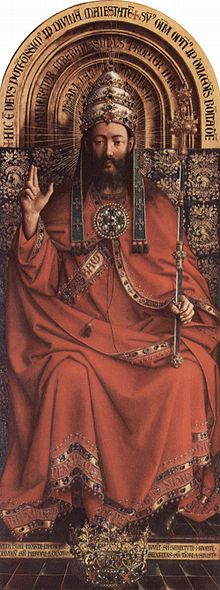
There are some rather good images of Christ the King, including the Van Eyck above, and indeed the rather more traditionally devotional image shown below (which I rather like).  However, we should not make the mistake of assuming that the feast is only about the time when the request expressed in the words of the Pater Noster "Thy kingdom come" have been fulfilled, even if Pope Paul VI's placing of the feast at the end of year points in that direction.


The feast is also about the ways in which Christ is already the Universal King.  In his Angelus address on the Feast of Christ the King in 2006, Pope Benedict XVI said that "The Cross is the 'throne' from which He demonstrated the sublime regality of God-love."  He went on to explain that Christ the King is not about human-style power, but about service and love, with the perfect example of acceptance of this being the life of the Virgin Mary. As a result of her fiat mihi, "God exalted her over all other creatures, and Christ crowned her Queen of heaven and earth."  

If you have trawled through the details of the right-hand sidebar of this blog, you might have spotted that the there is an embedded youtube video of Blessed John Henry Newman's Lead Kindly Light, sung by the late, great Irish tenor Frank Patterson.  Perhaps it is my Celtic blood, but I must confess a fondness for his performances of church music: so be warned, there will be more links in the future.  Frank Patterson was not only a talented tenor who sang for Popes and Presidents, but he was also a devout Catholic and indeed a Knight of Malta.  Having offered a brief prayer for the repose of his soul, we turn to his stirring performance of Hail Redeemer King Divine.


On a personal note, approaching the turn of the liturgical year gives pause for reflection.  This is not just in the way it always does, thinking of lost family and friends throughout the month of the Holy Souls, and of the Four Last Things in Advent, and indeed of the joy and hope to be brought by Christmas and a new year.  For members of all the Ordinariate groups, this is the end of the liturgical year in which we left our (yes we admit it) much loved Church of England in order to share, with much joy, the priority given by the Holy Father to Christ's fervent desire that all should be one.  Therefore, with sincere thanksgiving for our welcome in the Catholic Church through the Ordinariate, we also pause to pray for all those we have left behind in the Church of England, noting that we now for the first time enter a liturgical year without them. 

Coming from St Mary's Bourne St, the Feast of Christ the King is a particularly potent memory.  This was, and continues to be, marked in quite some style at St Mary's.  We send our friends there every good wish for tomorrow's event. 

For old time's sake, here is a photo taken from the organ gallery at St Mary's during the celebrations for Christ the King in 2009.  The author of this blogpost is acting as subdeacon, another member of Marylebone Ordinariate Group is on the far left at the altar rail, and it wouldn't surprise me if the third member of our group were also somewhere in the serving group. 

One Bourne St tradition at Christ the King that we can happily copy on this blog is the inclusion of the Hallelujah Chorus.  So, here it is.  A very happy Feast of the Christ the Universal King to you all, and please join your prayers with ours as we prepare to enter a new year.


Our Lady, pray for us, and may the souls of all the faithful departed rest in peace.

Friday, 18 November 2011

Petrine Works Old and New

Today is the Feast of the Dedication of the Basilicas of St Peter and of St Paul.  St Peter's must surely be the most well known church building in the world, and forms the heart of the Vatican City.  You might have noticed that we have modified the title design of the blog in honour of this great building.  In spite of being so well known, as mentioned in last week's post on the Basilica of St John Lateran, St Peter's is not, as is commonly assumed, a cathedral, and it is not where the cathedra of the Bishop of Rome is situated.

However, St Peter's is the obvious photo used whenever the Vatican or the Roman Church is mentioned, and as such it is an immensely powerful symbol of the Catholic Church, recognised outside the Church and by people with absolutely no interest in Catholicism, Christianity or religion.


The Basilica of St Paul outside the Walls (Basilica Papale di San Paolo fuori le Mura) is perhaps slightly less well known (apart from a brief burst of fame in 2008, when there was media speculation about its Abbot, Edmund Power, potentially having been in the running for the post of Archbishop of Westminster), but like St Peter's and like St John Lateran is one of the four ancient Papal Basilicas to be found in Rome.  The fourth is Santa Maria Maggiore, of which more some other time.


The sites of both Basilicas have been places of pilgrimage from very early, and indeed long before it became "safe" or "established religion" to perform such acts of devotion.  Henry Vollam Morton, the journalist and travel writer (perhaps best known for being the first to break the story, in the Daily Express, of Lord Caernarvon and Howard Carter's opening of the tomb of Tutankhamun) put it like this in his 1959 book This is Rome :
It is extraordinarily interesting that Roman pilgrimage began at an…early time. Pilgrims did not wait for the Peace of the Church [Constantine’s edict of toleration] before they visited the tombs of the Apostles. They went to Rome a century before there were any public churches and when the Church was confined to the tituli [private homes] and the catacombs. The two great pilgrimage sites were exactly as today—the tombs, or memorials, of St. Peter upon the Vatican Hill and the tomb of St. Paul off the Ostian Way.
People have oftened question whether the ancient relics in St Peter's and St Paul's are what they say they are. However, much investigation has been carried out on this.

Years of architectural work at St Peter's (exploring areas of the Basilica that had not been accessible since the 9th century) led to Pope Pius XII proclaiming in December 1950 that although we could not be absolutely certain at that time that the remains in St Peter's were indeed those of St Peter, certain convincing evidence had come to light that pointed in that direction, and that therefore it was believed that the tomb of St Peter had been found.  Tradition held that St Peter had been buried on the Vatican Hill, and that since that time, martyrs, popes and other Christians had been buried nearby : the architectural work certainly showed that the Vatican had been built over a cemetery that dated back to the right period.   At the lowest level of the various levels of burials, an aedicula containing bone fragments wrapped in tissue with gold decorations and precious murex purple : this would certainly indicate the burial of someone considered to be of great importance.

Further work, including the discovery of an inscription, and the testing of bones showing that they belonged to a man of 60-70 years of age, led to Pope Paul VI declaring in 1968 that the matter was now beyond doubt.

As to the remains of St Paul in the Basilica of St Paul outside the Walls, the formal confirmation of the discovery of the white marble sarcophagus of St Paul was made in 2006 (although a 19th century chronicle entry from the Benedictine abbey next to the Basilica comments briefly on the discovery of the sarcophagus). The sarcophagus was then analysed until 2009.  Carbon dating carried out during that process showed that the bone fragments found in the sarcophagus of St Paul did indeed date from the first century AD, and that grains of incense and pieces of purple linen had been found alongside the bone fragments. Pope Benedict XVI announced in December 2009 that this seemed to add convincing weight to the uninterrupted tradition that the remains of St Paul's are buried in the Basilica.

For some light relief before the next section of this post, which gets a little serious, here is a selection of photos of St Peter's accompanied by the Sanctus from Schubert's Mass in E flat.


The Holy Father begins his travels to Benin today, a country that, along with most of Africa, is seeing exponential growth of Catholicism (Benin has roughly 500,000 more Catholics than it did ten years ago).  This growth sits oddly with the crazed cries of much of the media whenever the Holy Father visits or talks of Africa, virtually accusing him of personal involvement with a deliberate campaign of mass murder.  The fuss when Pope Benedict visited Cameroon and Angola two years ago, when the media extracted one sentence from his in-flight pre-visit address to journalists and spoke of nothing else was utterly scandalous, yet absolutely predictable : no talk of the growth of the Church in Africa, no talk of Church schools, Church hospitals, Church activity to support and treat those with AIDS and other diseases, Church orphanages, Church aid to the poor, and of course no talk of anything even vaguely touching on the spiritual. 

I hope the point is not silly, but this is the precise opposite of the way the media treated the recent death of Sir Jimmy Saville.  There was much talk of his immense and unquestionably marvellous charitable deeds (for which he received a Papal Knighthood), which was very welcome publicity for doing good works : but there was no mention of him attending Mass on an almost daily basis.  There, no credit could be given to Sir Jimmy's Catholicism, but when there is anything for which it is believed (rightly or wrongly) that "blame" is "needed", then the media are very keen on blaming Catholicism as a whole, and indeed the Pope himself.

Let us hope and pray that the media are going to be slightly more balanced during this trip, but sadly it seems that the media are not only sex-obsessed but lazy : a quick search on the internet reveals that the same old blinkered nonsense is being rehashed, of course entirely removed from the full context of the discussion.  Nobody expects all journalists to agree with what the Pope says, nor to praise him, but it would be nice to have a proper, reasoned discussion, rather than just be witness to the de-contextualised slinging about of extreme accusations.

Anyway, the work of this modern Successor of St Peter is for the "common good", just as was the work of St Peter himself.  Let us wish the Holy Father well on his trip.


St Peter, St Paul, all Saints of Africa, pray for us.

Thursday, 27 October 2011

The Pope of Christian Unity

The ancient churches of the east have long fascinated me.  I found that one of the most interesting parts of Diarmaid MacCulloch's BBC documentary A History of Christianity was his opening section on the east, not only the Syrian Orthodox Church, but also the very early progress of Christianity in China. 

On a more personal level, I had the good fortune to spend several months in Armenia in 1998, where, thanks to the insatiable appetite for knowledge and thirst for history of my French boss at the time, I visited and attended the liturgy at a number of ancient churches and monasteries, including of course Echmiadzin and the astonishing and beautiful Khor Virap, which sits right on the current Turkish border with spectacular views of Mt Ararat.  Khor Virap is where St Gregory the Illuminator was imprisoned in a cave for many years before finally being released and converting the King of Armenia, making Armenia the first country to declare itself formally Christian (in 301AD).


The reason for indulging myself in this trip down memory lane is that today is the Feast of St Frumentius, the Apostle to Ethiopia.  The Ethiopian Orthodox Church, like the Armenian Apostolic Church, is very ancient, and is an Oriental Orthodox church.  These churches split from the Western Church long before the Catholic/Orthodox divide that arose in the eleventh century.  The fundamental difference between these Oriental Orthodox churches and the Catholic and Orthodox Churches of the west is a disagreement that crystallised at the Council of Chalcedon in 451AD. 

In the west, we refer to the Oriental Orthodox Churches as Monophysite, meaning that they believe that Christ had one single nature, whereas western teaching is that Christ has two natures, being, as the Divine Praises say, "True God and True Man", being wholly divine and wholly human.  The Oriental Orthodox reject the label of Monophysite, preferring Miaphysite, meaning that their definition of one nature really means a union in one form of two different natures.  These differences, which in this short summary and even in their underlying origins, turn on very subtle interpretations and in some cases on differences in translations, have kept the Oriental Orthodox and the Western Churches apart for over 1500 years, and it is only in the most recent times that small steps towards greater understanding have been made. 

A high point in the move towards greater understanding and reconciliation was the visit of Coptic Patriarch Pope Shenouda III to the Vatican in 1973, where Pope Paul VI presented him with a relic of St Athanasius (of whom a little more below), which relic is now housed in the Coptic Cathedral of St Mark in Cairo.  We must hope and pray that our Holy Father, Pope Benedict XVI, the "Pope of Christian Unity" as he is being called, continues the good work that has been started.

St Frumentius, having found himself shipwrecked in Ethiopia, was eventually sent to Alexandria, where in 328AD he was ordained Bishop by St Athanasius, who for so long was credited as the author of the Quicumque Vult, a text that is not as well known any more as it should be ("Whosoever will be saved, before all things it is necessary that he hold the Catholic Faith....").  From Alexandria, Frumentius returned south as Abune ("father") of Ethiopia, thereby starting a tradition that endured until 1959 of the Coptic Pope naming an Egyptian Copt as Archbishop of Ethiopia.  Like St Gregory the Illuminator, he baptised the King, and converted the country.

No post on the Ethiopian Orthodox Church can be complete with something on Lalibela, the series of churches carved out of the rock, each being quite literally monolithic, ie one single stone.  Here is an extract from a documentary about these astonishing buildings.


For me, gaining more and more understanding about the ancient churches of the first millenium, and seeing that, even if very very slowly, efforts are being made to explore ways to bridge our gaps, is ever so slightly bittersweet.  It is of course wonderful that these things are being done, these are clear examples of work and prayer being put in with a view to finding ways to come closer to unity of Christians.  Who does not rejoice at seeing this photo of the Holy Father with Bartholomew the Ecumenical Patriarch, symbolising in one image small steps that, while still fraught with difficulty, were thought impossible within living memory?


Yet the label of bittersweet still applies, because it reminds us that our former home, the Church of England, is not moving in the same direction, but in the opposite, towards some sort of increasingly formal affiliation with the national protestant churches of Scandinavia, rejecting more and more the idea of unity with the ancient Church of East and West : some kinds of Anglicans, in saying something anti-Papal, forget that the Orthodox Churches view developments in their church no more positively than does the Catholic Church.

We must pray with Pope Benedict XVI, the Pope of Christian Unity, with St Gregory the Illuminator and St Frumentius for the unity of all Christians.  On a day when the Holy Father is gathering around him not only the leaders of other religions, but also the leaders of Orthodox and Protestant Christianity, this seems doubly appropriate.

Let us also offer a prayer for those in the Ethiopian Catholic Metropolitan Church, who are in communion with the Holy Father, and who follow an Ethiopic Rite, especially those in Eritrea, whose ecclesial structure became an Ordinariate in 1930, later being raised to an Exarchate and thence to an Eparchate under the Metropolitan See of Addis Ababa.