Showing posts with label Cardinal Keith O'Brien. Show all posts

Friday, 16 March 2012

Here We Go Again

Old issues keep cropping up, time and again.  Although in some places a constructive and engaged dialogue continues, in other places there is merely shouting (or as the French, in their unashamedly un-pc way, say un dialogue de sourds).  Currently, there are two very different examples of this phenomenon that are floating around the public consciousness (one rather more than the other), although there was a third example, to my mind in no way less important, which has been obliterated from the forum.


The first topic is the one that is all over the UK media, being the question of same-sex marriage and its near certain introduction into the English legal system (indeed the government now tells us that it doesn't matter how many people say they are for or against it, it is going to happen, come what may).  I am not going to dig a hole for myself by getting involved in that debate (and so it is unlikely that any comments will be published) : there are already plenty, far more eloquent and informed than I could ever be, on both sides of the discussion, who have made their case, just as there are those on both sides of the debate who have merely shouted at each other.  However, I will say a couple of things, writing purely in a personal capacity.

It is to be hoped that people on both sides of the debate understand that people on the other side do genuinely feel strongly about their position.  They each very honestly believe that they are putting forward a case that is robust, just, and in many ways, they feel, so obvious that it barely need be spoken.  That last part being the reason why the debate often gets so heated.  Some express themselves better than others, some show a deeper awareness of the contrary arguments than others, the words of all of them alike are twisted into grotesque (yes, I know the reference I am making, and no, read the original, Cardinal O'Brien did not say that anyone was grotesque) soundbites by the media, but underneath it all, they know that they sincerely hold the views they express and they know that their debating partners are no less sincere in their belief.

There are times when this slips and the situation turns unpleasant, though I won't name names : we can all think of examples on both sides. 

It should be emphasised that whatever else it is doing, and whatever else it may be perceived to be doing, the Catholic Church is not throwing itself into an attack on any particular group in this debate.  Those who like to deride the Catholic Church sometimes talk about its "unhealthy" obsession with sin, and how it imbues an enduring sense of "Catholic guilt" in its members : well, that in itself is an old debate, but in this context I would answer the "charge" by saying that all Catholics are indeed taught that they all sin, every one of them, each in their own ways, that none of them should feel superior to anyone else in this regard, and most importantly that they can all, if they want, receive God's forgiveness.  In support of this assertion, I could cite a familiar Bible text about motes, but in addition I would draw your attention to this recent homily given by the Holy Father.

The Catholic Church is defending something, not attacking something.  The letter from the Archbishop of Westminster and the Archbishop of Southwark read out in parishes last Sunday morning was a reasoned and calm, but very clear, defence of the traditional understanding of the institution of marriage. 

One big fear - and you don't have to agree with the Catholic Church's understanding of marriage to see this - is that the government just hasn't thought this through in detail.  The implications are not insignificant (for example, an interesting debate recently about something as basic as vocabulary, will the words husband, wife and even mother and father become politically incorrect?).  There is a special concern in the Church of England, whose statement yesterday points out the naivety of imagining that the dividing line between civil and religious marriage is quite as neat and tidy as seems to be assumed in the case of the established church, whose clergy are licensed to perform marriages.   

If the change is brought in, and it must be said that it seems very likely that it will be, it will probably be manageable for the Catholic Church to find a way to work with the new realities.  It will be messy, it will be difficult, but it will somehow be achievable.  There is after all the precedent of the mariage civil  and the mariage réligieux, as well as similar precedents from a few other countries, even if those do not quite replicate the context we will find here.  The time will surely come when even this will not be acceptable, and one can foresee the day when the government demands that any organisation that conducts marriages should do so for any who ask, regardless of how the request fits the organisation's own criteria for marriage. When that day comes, it might be necessary, as was suggested on the Valle Adurni blog a few weeks ago, for the Catholic Church simply to stop conducting any marriage ceremonies at all in order not to be in a position where it breaks the law where it "supplies services" to some but not to others.

The poor old CofE will have a tougher time, partly on account of its established status, but also on account of its rapidly growing body of evangelicals, who will struggle to come to an accommodation on this with the liberal wing, many of  whom would have no issue at all with conducting same-sex marriage ceremonies.

It must be conceded that those who have no religious belief must find it immensely frustrating that a group of people, however large, and based on whatever history and tradition, is perceived as trying to restrict some of those who have no interest in them. It behoves those advocating a traditional understanding of marriage to bear that in mind, just as we would ask those looking to bring same-sex marriage into existence to take account of the genuine reasons why people do not agree with them, rather than just lazily assuming that it must be down to one kind of prejudice or another.

A Stonewall lobbyist remarked that Catholics who are not in favour of same sex marriage should simply be careful to ensure that they don't enter into such an arrangement.  Some people found that flippant, but I must admit that I found it quite funny.  In return, a mildly amusing anecdote about the famous Labour MP Tom Driberg, later Lord Bradwell (immortalised in a rather unkind, if funny, 1977 Derek and Clive sketch about an exchange between taxi drivers that is definitely not for the faint of heart). 

Driberg, despite never making a secret of his homosexuality, decided to get married in 1951.  In a ceremony at St Mary's Bourne St in June that year (described as "outrageously ornate" by his biographer), at which his bride was first baptised and then entered church to the accompaniment of an organ arrangement of The Red Flag, Driberg made vows that he didn't end up keeping in front of a full house.  Among those present, so (possibly apocryphal) Bourne St legend relates, was Winston Churchill, who is said to have remarked unkindly of the bride's looks "Well, buggers can't be choosers."

On a more serious note, Driberg left instructions for the sermon to be given at his funeral.  It wasn't at all a celebration of how wonderful he was, of what a joyous and exuberant life he had led.  It was a powerful address, given by the Revd Gerald Irvine, on how Driberg had fallen short in his life, how he (exactly like everyone else, no better, no worse) was a sinner, which of the Seven Deadly Sins had plagued him most.  All of us can learn a lesson from Driberg in that respect, an awareness that no matter what our own little cocktail of pecadilloes might be, we all fall short, every one of us.

Interestingly, although Driberg maintained his lifelong Anglo-Catholicism (Lancing to Pusey House to St Mary's Bourne Street and onwards), he was supportive of someone whose life's path crossed his own on many occasions but who left Anglo-Catholicism.  Evelyn Waugh did what in 1930 was, even if not criminal, barely less scandalous socially than were Driberg's pastimes - he became a Catholic.  Did Driberg reject him as a bigot?  No - Driberg was Waugh's only guest upon his reception into the Catholic Church, and Driberg gave Waugh column space in the Daily Express subsequently to defend himself against charges of blasphemy from The Tablet (now doesn't that sound strange to the modern ear).

************

Another old issue that crops up again and again is the path to reunion between the Church of England and the Catholic Church.  Everyone with even the slightest interest in Christian Unity rejoices that the Archbishop of Canterbury and Holy Father jointly attended Vespers in Rome, and that together they gave thanks for the mission begun by St Gregory the Great of sending St Augustine of Canterbury to increase the spread of Christendom in the British Isles and to strengthen the links between the Church in England and Rome.  That Rowan Williams goes to Rome so often, and continues to be invited back, is a very good thing.  Christian Unity is a Gospel imperative, and however distant it seems, we must all seek it.

Still, there are those who see this as proof that everything can carry on exactly as before, that there are no new impediments to Christian Unity being gleefully erected by parts of the Anglican Communion.  I regret that those people would seem to be in Egyptian mode.  A strange comment on this was made by the American Episcopal Church's Pierre Whalon, who took the opportunity to have a little go at the Ordinariates formed under Anglicanorum Coetibus, declaring that they had no ecclesiological basis and that as pastoral measures would only last a decade or two.  Well, as an American he ought to know that the US Pastoral Provision, creating the Anglican Use in the Catholic Church in the USA was brought in 32 years ago. Furthermore, as the head of ECUSA's European branch, which overlaps with the Church of England's Diocese in Europe, he ought to know something about the endurance and ecclesiology of multiple jurisdictions of the same denomination co-existing in the same geographic territory.

This film of the event by Rome Reports shows the clear and genuine affection and respect that exists between the Holy Father and the Archbishop of Canterbury.  However, even though Pope Benedict XVI is most definitely the Pope of Christian Unity, the debate has moved on and there can be few who seriously believe that any kind of corporate reunion is possible in their lifetime (even if there were many who believed precisely that even twenty or thirty years ago).


************

Finally, the third old story that came briefly to public attention, yet has quickly been displaced by the two old stories above, particularly the first one, is abortion.  That, in itself, is sad.

However, the saddest thing is that those academic ethicists who argued (even if in the context of academia) that infanticide (or if you prefer, post natal abortion) could be justified did not expect the reaction they got.

We all know the difficult cases where there are heart-rending tales used to argue in favour of and against abortion.  The victim of rape who can't bear the thought of a permanent reminder of the awful crime that befell her.  The mother of several children who cannot see how she could possibly cope with more children without causing severe difficulties for her existing children.  The adult who might so nearly have been aborted when in the womb but wasn't.  The disabled child who brought joy to their parents.  We all understand the difficulties here, all of us know that glib answers just won't do, and we all know that you can find people for and against any such cases (even when Church teaching is very clear). 

However, is the world really such a horrible place that shock and revulsion at the very idea of infanticide come as a surprise to some?

Wednesday, 30 November 2011

St Andrew and St Andrews

Regular readers of this blog will have noticed a Scottish connection.  Two of the three members of the Marylebone Ordinariate Group were brought up in Scotland, and this has had some influence on a number of the posts put up on this site.

For example, for vintage footage of proceedings at the 1948 Restoration Mass at Pluscarden Abbey, you might want to read our blogpost Scottish Restorations.  Alternatively, our blogpost on St Margaret of Scotland includes a lightning tour of Dunfermline Abbey, some photos of that fine building as well of Cardinal Keith O'Brien, the Lord Lyon King of Arms and the tomb of St Margaret.  There is also film of a recent celebration by FSSP clergy of a Solemn High Mass in St Mary's Catholic Cathedral in Edinburgh.  Finally, one of our earliest posts, Saint Ninian, pray for us, included footage of the Holy Father's visit to Scotland in 2010, and talked of the life of St Ninian, that key figure in the history of the Church in Scotland.

With this background knowledge in mind, it can come as no surprise that we are posting on St Andrew, whose feast day falls today.  We include information on the saint himself, and on the town in Scotland that bears his name, and conclude with a very very fine hymn in his honour.
 

The first apostle (a former follower of St John the Baptist, he was the first to recognise Our Lord as the Messiah and to follow him), and the brother of St Peter (St Andrew brought St Peter to meet our Lord, whereupon they both received the call to become fishers of men), St Andrew is a prominent figure in Bible (as the disciple who brought the little boy with his loaves and fishes to Our Lord, for example), and also in the establishment of the Metropolitan See of Constantinople and in the founding of churches around the Black Sea.  The first bishop to serve in Byzantium, his influence in the region is enormous.

That he preached around the Black Sea is not in doubt, but it must be admitted that some of the specific connections he is traditionally said to have had are harder to prove.  It may be that in some cases, his undoubted travels around that area have led to the appropriation of his story to boost the credentials of certain of the Orthodox and Oriental Orthodox churches in the region, but that's a story for another day, when this blog returns to rambling around Eastern Europe, as it did in our previous post on The Pope of Christian Unity.

Picking up on the topic of the relics of St Athanasius as mentioned in The Pope of Christian Unity, relics of St Andrew that were housed for many centuries inside the Vatican (including some inside one of the main pillars of St Peter's Basilica) were given to the Greek Orthodox Church by Pope Paul VI in 1964.  They are now housed in Patras, the site of the martyrdom of St Andrew.

In 1969, Pope Paul VI gave a further relic of St Andrew to Cardinal Gordon Gray, then Archbishop of St Andrews and Edinburgh, greeting the Scottish bishop with the words "Peter greets his brother Andrew."  The relic is now housed in the St Andrew's altar in St Mary's Catholic Cathedral in Edinburgh, along with another relic of St Andrew, given by the Archbishop of Amalfi in the nineteenth century.

The way in which St Andrew is said to have met his death is by having been crucified on a cross in the shape of the X we now see in the Scottish flag, and from there in the Union Jack and multiple flags of Commonwealth countries and Crown Territories.  He is said to have been crucified in this way as he did not feel himself worthy to be crucified in the same way as Our Lord (echoing the upside-down crucifixion of St Peter for the same reasons).


So now indeed to Scotland, one of several countries to have St Andrew as its patron saint.  More specifically, to St Andrews, a beautiful town in the far east of the ancient kingdom of Fife.  St Andrews may very well now be famous for its association with the Duke of Cambridge and with golf, but for me it is associated with childhood visits, and later multiple visits with visiting friends and family (including now my wife and children) from England, to the ruins of the castle and of the cathedral. 

The castle is wonderful.  The best part, as far as I have been concerned as from the age of about five, is that you can still climb down into the mine and countermine that were built during the siege of St Andrew's Castle.  Once you have resurfaced and exited the castle, the game is to find, out in the street that runs outside the castle, the drain cover that sits over the end of the tunnel. 


As you might imagine, the history of the castle is very complicated.  The most famous episode followed the strong opposition of Cardinal David Beaton to the proposed marriage of Mary, Queen of Scots to the young Prince Edward (later King Edward VI) of England.  The fallout from this involved the burning at the stake of a protestant martyr (protestants were felt to have been in league with the English), the reprisal murder of Cardinal David Beaton and the hanging of his dead body from a castle window, and finally a siege of the protestants that then held the castle that lasted around a year. 

Until the Reformation, St Andrews had been the ecclesiastical capital of Scotland (even now, Cardinal Keith O'Brien is the Archbishop of St Andrews and Edinburgh), and the castle had been the home of the bishops and then archbishops of St Andrews.  After the Reformation, there were great and very lengthy struggles in Scotland between those favouring maintaining the episcopal office, and those of a more hardline presbyterian nature.  Upon the arrival in 1689 of the usurper, the office of bishop was abolished in Scotland, and the castle slowly fell into terrible disrepair.

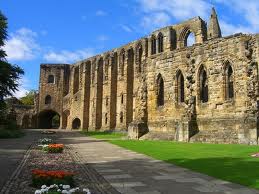
The neighbouring ruins of St Andrew's Cathedral are no less spectacular.  The setting of the cathedral, at the edge of the land, looking out over the North Sea, merits the trip on its own, especially the view thereof if you approach St Andrews from the hillier south (ie from the direction of Anstruther). 


The site had been a centre of Christian worship for centuries when the work began on the new Cathedral in 1158.  It took well over another century for the 350-foot long building to be completed, with a dedication rite taking place in the presence of King Robert the Bruce in 1318.  The King placed a parchment expressing the nation's thanks to its Patron on the new High Altar.  Fire, repairs, expansion and enhancement marked its history, along with the appearance of several religious orders in this small town.  However, its altars were stripped in 1559, its images removed, the reliquary destroyed, and then over the next decades neglect and the collapse of one of its many towers began a long decline into ruin.

There are many places of worship under the patronage of St Andrew of course, particularly in places where there has been a large Scottish diaspora (though far fewer than you might expect in Scotland itself).  For example, the Catholic Cathedral in Glasgow, the Catholic Cathedral in Dundee, the Scottish Episcopalian Cathedral in Aberdeen, the Anglican Cathedral in Singapore, the Anglican (or rather Sydney Anglican) Cathedral in Sydney, and the Catholic Cathedral in Victoria, British Columbia. 

No-one seems to be entirely sure why Scotland developed such a strong cult of St Andrew, which it seems to have done long before the formal proclamation of St Andrew as the Patron Saint of Scotland, and even before the arrival of the relics of St Andrew in Scotland in the eighth or ninth century.  It is true that more prestigious patrons would be hard to find, the First Apostle, the brother of St Peter, certainly carrying some stature.

Prayers to St Andrew were famously made before the Battle of Bannockburn in 1314, when Scottish soldiers wore the Cross of St Andrew on their tunics. 

The famous Declaration of Arbroath, considered a formal Scottish declaration of independence and single nationhood, took the form of a letter to Pope John XXII, in which Scottish nobles rejected the claim of the English that Scotland came under the jurisdiction of the Archbishop of York.  The Declaration describes how Scots constituted a separate nation, with its own particular devotion to St Andrew, "Our Patron and Protector."

In any event, there was not the geographic connection that made St Andrew such an obvious choice for Patron Saint of the Ukraine, Russia, Greece and Romania (amongst other places).  It remains one of those unanswered questions.

Today's blogpost ends with the Hymn to St Andrew, by E M Barrett.  You can listen to the tune and find the sheet music here.   All the verses are very good, but the third and fourth particularly so, with echoes of Walsingham hymns and their twin themes of restoring the damage done at the Reformation and the conversion of the country. 


When Christ our Lord to Andrew cried:
"Come, thou, and follow me,"
the fisher left his net beside the Sea of Galilee.
To teach the truth the Master taught,
to tread the path he trod
was all his will and thus he brought
unnumbered souls to God.

When Andrew’s hour had come, and he
was doomed, like Christ to die,
he kissed his cross exultingly,
and this his noble cry:
“O noble cross! O precious wood!
I long have yearned for thee;
uplift me to my only good
who died on thee for me.”

The faith that Andrew taught once shone
o’er all this kingdom fair;
the cross that Jesus died upon
was honoured everywhere.
But times once changed and Andrew’s name
was for a while forgot;
the cross, though set in kingly crown,
became a sign of shame.

St Andrew now in bliss above,
thy fervent prayers renew
that Scotland yet again may love
the faith, entire and true;
that I the cross allotted me
may bear with patient love! ‘
Twill lift me, as it lifted thee,
to reign with Christ above.


Wednesday, 16 November 2011

St Margaret of Scotland

November 16th is, in the modern calendar, the Feast of St Margaret of Scotland.  Another occasion to talk about Scottish pre-reformation church buildings, as well as the Saint of the day.  In a recent post, we talked about Pluscarden Abbey, Dunblane Cathedral and Dunkeld Cathedral, this time the focus must be on Dunfermline Abbey.


Born in Hungary around 1045, granddaughter of the exiled King of England, Margaret grew up in the pious atmosphere of the Hungarian Royal Court of "King Andrew the Catholic".  Her family returned to England for a few years, and then fled north to Northumbria after the Norman invasion.  Legend has it that the family was attempting to return to Europe when a storm blew their boat north and brought them to land in what is now the town of North Queensferry (a place I remember well from my childhood).  A few years later, Margaret married King Malcolm III of Scotland and became one of the most well known of those who have held the title Queen of Scots.


She is remarkable for several reasons.  First as a mother of eight children : three of her sons became Kings of Scotland, one of her daughters married King Henry I of England, another married the Count of Boulogne (the elder brother of King Baldwin I of Jerusalem), and yet another son became Abbot of Dunkeld.  She is also well known for her works of charity, indeed the towns of North and South Queensferry are so named because she provided for there to be ferry services there for pilgrims to cross the River Forth from Edinburgh to St Andrews in Fife.  Another reason for her influence being so strong is that, like St Cedd, St Wilfred and St Hilda, she was a key mover in ensuring that the practices of the local church conformed to the practices of the Church as a whole. 

In 1072, King Malcolm and Queen Margaret invited the Benedictines to send some of their number from Canterbury to turn Dunfermline Abbey (which had started life in the ninth century) into a Benedictine Priory Church.  The Abbey was properly founded, with Geoffrey of Canterbury as its first Abbot, in the reign of King David I (not, as was subsequently claimed for the purposes of increasing the cult of St Margaret, under King Malcolm and Queen Margaret).

Dunfermline Abbey itself holds a remarkable place in Scottish religious history.  Turned over to the crown after the Reformation, during which it was sacked, the Abbey was caught up in the Episcopalian vs Presbyterian difficulties of the 17th century, at one time having both an Episcopalian Bishop and a Presbyterian minister running parts of the building.  At the time of the early 19th century splits in the Church of Scotland, its minister first decided to join the Free Church of Scotland, then returned to the Church of Scotland. 


The Abbey is also a potent symbol of Scottish nationhood, not only on account of its royal foundation by Malcolm and Margaret.  Legend says that the mother of William Wallace is buried there, and it is known that King Robert the Bruce is buried there (Dunfermline became the burial place of Scottish kings after the Norwegian occupation of Iona, and has received more Scottish royal dead than any other place other than Iona).  The Bruce's remains were exhumed in the early 19th century, when extensive reconstruction work was needed following the collapse of the Abbey's tower, and he was subsequently reburied in the fervent atmosphere of 19th century romanticist Scottish fantasy (it's OK, I can say that, I'm Scottish....).

The tomb of St Margaret herself, within the ruins of the Lady Chapel, was restored and enclosed on the orders of Queen Victoria.


More recently, the Abbey has shown itself to be very open to recognising its complicated but stunning religious history, and in 2005 invited Cardinal Keith O'Brien, the Archbishop of St Andrews and Edinburgh, to preach, the first Catholic to preach in Dunfermline Abbey since the Reformation.  That same day, the Lord Lyon King of Arms formally presented new armorial bearings to the Abbey in the person of its minister.  The Lord Lieutenant of Fife and the Earl and Countess of Elgin were in attendance.


In order to provide some relevant music, I tried to find a youtube link to some Robert Carver, a Scottish renaissance composer of some rather good polyphony, but could find none.  I recommend the recordings made by Andrew Carwood of Carver's works.  Instead, maintaining the theme of the Scottish hierarchy, here is a video of Cardinal O'Brien assisting at an FSSP Solemn High Mass in St Mary's Catholic Cathedral in Edinburgh. 


St Margaret of Scotland, pray for us.