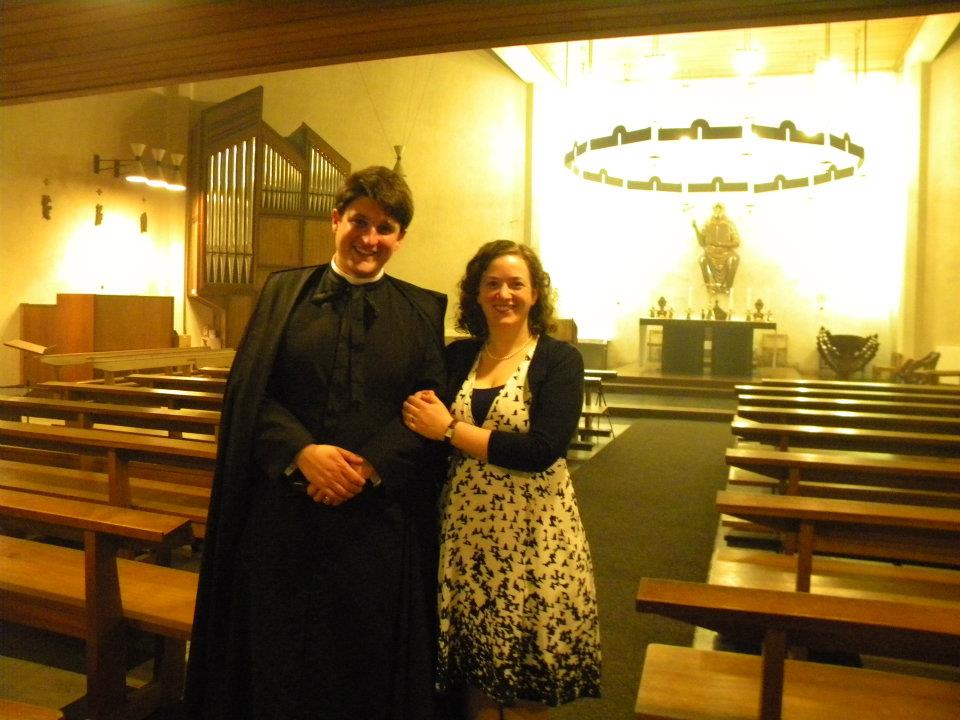
As previously posted, we are now expectantly looking forward to the coming ordination of Deacon John Hunwicke to the Priesthood at the Oxford Oratory on Wednesday 27th June at 19:00. And with even greater joy and gladness we are able to relay news that Fr Hunwicke's First Mass will be celebrated according to the Extraordinary Form at the London Oratory the following day at 11:30.
Those familiar with Fr Hunwicke during his time in the Church of England, not least the many many devoted fans of his wonderful and informative blog (which has helped more than a few Ordinariate members, both laity and clergy, to find their way to Holy Mother Church), will recall his ardent devotion to the liturgy, particularly in its most traditional forms, and as such it comes as little surprise that he will celebrate his First Mass according to the Extraordinary Form of the Roman Rite, a form regarded by the Holy Father himself as an 'venerable and ancient usage'.
Yet again, the Ordinariate continues to show itself as fiercely loyal not only to the patrimony of centuries of separated yet worthy practice and belief developed during its members' former days, but also to the inheritance of the wider Latin Church. That which countless generations before have held as sacred continues to be proclaimed by those individuals who, through the generosity and grace of the Holy Father, find themselves as heirs to that age-old tradition.
The wonderful diversity of the Church Catholic, even in the Latin Rite, is proclaimed by Fr Hunwicke celebrating his second Mass in the Ordinary Form of that same Rite, at the Church of the Holy Rood in Oxford. He is scheduled to celebrate that Mass as the Ordinariate Group in Oxford's usual Saturday evening Mass at 18:00 on 30th June, when the setting of the ordinary of the mass will be Palestrina's Missa Papae Marcelli.
Certainly members of the Marylebone Group (having good reason to be particular fans of Fr Hunwicke) will be in attendance at these wonderful occasions to which all are invited, and reports on this 'blog will follow in due course. What is about to unfold is something for which Ordinariate members have been praying ardently, and we rejoice that our prayers have been answered.
In these days leading up to this most significant week in the life of the Ordinariate and the Church in England, we renew our commitment of prayer for Fr Hunwicke as he prepares for ordination to Christ's Priesthood, and ask the intercession of Our Lady of Walsingham and Blessed John Henry Newman, but also of S. John Vianney that his fidelity and love for the Sacred Heart of Our Lord may be all the more imprinted on our ordinand too.
Showing posts with label Oxford Ordinariate. Show all posts
Friday, 22 June 2012
Wednesday, 9 May 2012
Tidings of Joy
This morning, the Ordinariate announced its list of candidates for Ordination to the Sacred Priesthood. Congratulations to all on the list: our prayers are with you, and we share your great joy and thankfulness that the shared journey we have made together into the full communion of the Catholic Church is now leading you onwards on the long and challenging road towards priestly service.
There is one name in particular on that list that causes us to rejoice. It is, of course: Hunwicke, John William. It is wonderful news that this learned, holy and charming gentleman is moving forward in the process towards being ordained as a priest in the Catholic Church. What has happened is not official confirmation or agreement of Ordination, it is simply the publication of a list of candidates, but even so, even if it is no more than a small step forward as part of continuing deliberations, it is to be wholeheartedly welcomed.
Many of us in the Ordinariate owe a lot to the learning that Fr Hunwicke's Liturgical Notes has given us. Those of us who have met him, even if on only a few occasions, are even more in his debt. He is a scholar with an in-depth knowledge of all the best of Anglican Patrimony (and of so much more), who has an unswerving loyalty and devotion to, and love for, Holy Mother Church. He is also a truly lovely man, who has made sacrifices to play his part in answering Our Lord's call to Christian Unity, and who has continued to wait patiently on the Lord while the wheels of process turn.
Fr Hunwicke has featured on this blog before, indeed in one of our most popular ever blogposts. He very kindly agreed to give us permission to reproduce in full a sermon he gave in October 2010 at St Mary's Bourne St. It is an extremely inspiring sermon, on the topic of Our Lady of Victories and the Battle of Lepanto, full of details and wisdom, but entirely accessible even to those less familiar with the subjects covered. Do take the time to read it.
The day after his visit to Bourne St, he posted a very favourable report of his trip to London on his own blog, the comments on which include a few interesting points from Bourne St regulars, on the origins of the sung Angelus in particular (now there's Patrimony for you). His report charmed all of those at Bourne St who read it, indeed my wife and daughters were among those most thrilled to have been mentioned in such a kind way in so elevated a forum.
It was only a couple of weeks ago that we posted an article on the First Mass of Fr Daniel Lloyd of the Oxford Ordinariate Group. The eagle-eyed among you might even have spotted a photo of Fr Hunwicke reading the Prayers of the Faithful that day. Since that group might one day soon, Deo volente, have another priest, as our newest member (a former member of the Oxford group) jokingly notes, it could soon be on its way to being fully resourced for a Pontifical High Mass.
We concluded the blogpost on Fr Lloyd's First Mass with the Haydn Te Deum. Time to post it again, in joy and thanksgiving for this wondrous news. Small steps forward in a positive direction. Prayers for, and congratulations to, all the Ordinariate's candidates for Ordination. What a tremendous sign of encouragement, development and growth that there is a list, let along such a long one. Let us hope, as the process continues, that all these candidates proceed to Ordination, and that the Lord will send us many more priests to serve in His Holy Catholic Church.
Deo gratias!
There is one name in particular on that list that causes us to rejoice. It is, of course: Hunwicke, John William. It is wonderful news that this learned, holy and charming gentleman is moving forward in the process towards being ordained as a priest in the Catholic Church. What has happened is not official confirmation or agreement of Ordination, it is simply the publication of a list of candidates, but even so, even if it is no more than a small step forward as part of continuing deliberations, it is to be wholeheartedly welcomed.
Many of us in the Ordinariate owe a lot to the learning that Fr Hunwicke's Liturgical Notes has given us. Those of us who have met him, even if on only a few occasions, are even more in his debt. He is a scholar with an in-depth knowledge of all the best of Anglican Patrimony (and of so much more), who has an unswerving loyalty and devotion to, and love for, Holy Mother Church. He is also a truly lovely man, who has made sacrifices to play his part in answering Our Lord's call to Christian Unity, and who has continued to wait patiently on the Lord while the wheels of process turn.
Fr Hunwicke has featured on this blog before, indeed in one of our most popular ever blogposts. He very kindly agreed to give us permission to reproduce in full a sermon he gave in October 2010 at St Mary's Bourne St. It is an extremely inspiring sermon, on the topic of Our Lady of Victories and the Battle of Lepanto, full of details and wisdom, but entirely accessible even to those less familiar with the subjects covered. Do take the time to read it.
The day after his visit to Bourne St, he posted a very favourable report of his trip to London on his own blog, the comments on which include a few interesting points from Bourne St regulars, on the origins of the sung Angelus in particular (now there's Patrimony for you). His report charmed all of those at Bourne St who read it, indeed my wife and daughters were among those most thrilled to have been mentioned in such a kind way in so elevated a forum.
It was only a couple of weeks ago that we posted an article on the First Mass of Fr Daniel Lloyd of the Oxford Ordinariate Group. The eagle-eyed among you might even have spotted a photo of Fr Hunwicke reading the Prayers of the Faithful that day. Since that group might one day soon, Deo volente, have another priest, as our newest member (a former member of the Oxford group) jokingly notes, it could soon be on its way to being fully resourced for a Pontifical High Mass.
We concluded the blogpost on Fr Lloyd's First Mass with the Haydn Te Deum. Time to post it again, in joy and thanksgiving for this wondrous news. Small steps forward in a positive direction. Prayers for, and congratulations to, all the Ordinariate's candidates for Ordination. What a tremendous sign of encouragement, development and growth that there is a list, let along such a long one. Let us hope, as the process continues, that all these candidates proceed to Ordination, and that the Lord will send us many more priests to serve in His Holy Catholic Church.
Deo gratias!
Wednesday, 25 April 2012
Another First Mass in the Ordinariate
We reported earlier this week from the Ordinations of Fr James Bradley and Fr Daniel Lloyd at St Patrick's Soho Square, and from the First Mass of Fr Bradley at Holy Ghost Balham. After the offering of Fr Bradley on Sunday morning, members of the Marylebone Ordinariate Group journeyed north to Oxford, the City of Dreaming Spires, to assist at Fr Daniel Lloyd’s first celebration of the Sacrifice of Calvary.
The setting could hardly have been more different. The Church of the Holy Rood, a title so appropriate for the First Mass of an Ordinariate Priest, is in many ways a product of the great iconoclasm of the last century, yet at a second glance retains and rejoices in many of the traditional marks of the Catholic Faith. As such, Mass was celebrated towards the East, as is to be favoured according to the Ordinariate’s liturgical patrimony: priest and people together in awful anticipation of Christ the High Priest’s return.
In recognition of the universality of the Catholic Church, into which Fr Lloyd has now been ordained as priest forever, the Newman Consort sang the Introit and other Propers in Latin plainsong, the language of generations before. The setting of the Mass, Missa Euge Bone, composed by Christopher Tye, echoed that fateful era of the Henrician Schism when, as the Assistant Priest Mgr Andrew Burnham pointed out, the musical jewel of English Catholicism was buried, divorced from centuries of tradition. How moving it was, then, to witness this humble new priest offering the same sacrifice using a “set of texts which has not changed by more than a few syllables since Augustine used those very words at Canterbury on the Third Sunday of Easter in the summer after he landed”.
Fr John Saward of Ss. Gregory and Augustine in Oxford, himself a former minister in the Church of England, preached the homily. He drew our attention to the life of Bl Karl Leisner, a holy priest held in Dachau concentration camp, who died of tuberculosis shortly after being liberated by the Allied Forces. He was captured a deacon, and whilst imprisoned was ordained to the priesthood by a bishop and fellow inmate. Due to his illness he had only the strength to offer the Mass but once.
Fr Saward noted the natural response of the secular world to such a situation; how great a waste of a life and futile an exercise to ordain a priest who had no opportunity to help the sick or console the dying. We were put in mind of the words of the Blessed Apostle Paul, of the crucified Christ Himself, “unto the Jews a stumbling block, and unto the Greeks foolishness; but unto them which are called, both Jews and Greeks, Christ the power of God, and the wisdom of God.” Fr Lloyd was exhorted to remain faithful to the celebration of the Mass, and reminded of the infinite grace outpoured at a single offering in union with Christ and His Church.
The Prayers of the Faithful echoed words which remain imprinted on the hearts of the Marylebone Ordinariate Group, those of the Prayer for the Church Militant here in Earth, amended to intercede on behalf of our Holy Father the Pope, along with the Ordinary, before also beseeching God’s protection of His servant Elizabeth our Queen and her Government. Patrimony received, purified, and proclaimed by the Church in the fullness of truth.
The joyful beauty of the Mass reached a crescendo at the Benedictus and culminated in the Agnus Dei, the Newman Consort truly excelling and raising hearts on high in the sight of the Divine Majesty. Such unspeakable wickedness to silence the song of Christ’s Faithful in the name of reformation.
An altogether different song of gladness concluded the Mass. A resounding ‘We praise thee, O God’ from our new priest gave way to the exuberance of Haydn’s Te Deum, echoing the great joy of the Church Militant and Triumphant at this first offering of the Holy Sacrifice. Those present could not but cast their minds back to the Beatification Mass of Blessed John Henry Newman, when our Holy Father concluded his offering with that same great expression of praise. Not confounded by this monolith of Austrian faith, English devotion to the Ordinariate’s heavenly mother could not but assert its place, with all in typically enthusiastic chorus singing ‘Joy to thee, O Queen of Heaven…’.
The celebration of a priest’s First Mass is one which draws together the Body of Christ in love for the new priest. Yet such an occasion is inevitably deeply personal and intimate for the man conformed to Christ Himself. In grateful thanksgiving, Fr Lloyd offered his mother and wife posies of flowers which had previously adorned the altar, before imparting his first blessing on them and all present.
How can we not, on such occasions, pray all the more earnestly for vocations, for mothers and fathers to offer their sons to the Lord who is ever-faithful? Lovingly reverencing the anointed hands of the new priest, by whose words and actions the grace of Christ is made present to his flock, we pray that His grace may extend to wanderers from the fold so that they might be one with the saints in one unbroken peace, one unbounded love.
Praise we Him, Whose love divineThanks be to God for sending His Church these two new priests.
Gives the guests His blood for wine,
Gives His body for the feast,
Love the victim, Love the priest.
Monday, 12 December 2011
A Principal Church for the Ordinariate
It was after coming home last night from having attended the 5.30pm Sung Mass at Westminster Cathedral, the "mother church" of the diocese in which our Ordinariate Group is based, that I happened upon the Ordinariate Portal's news update on Facebook that some comments by Archbishop Vincent Nichols on the subject of the Ordinariate and a possible "principal church" for it had been reported on the Ordinariate Portal's website.
The Mass itself had been very good. The usual dignified style, a stirring hymn to kick things off (Hail to the Lord's Anointed, the same Advent hymn discussed by Monsignor Andrew Burnham on the Oxford Ordinariate blog), the plainsong to Mass XVIII sung congregationally, and a good homily on happiness (we are all obsessed by trying to find it, perhaps prayer and spirituality are very effective ways to get nearer to it, Gaudete!). It was a little more restrained, all in all, than the Beethoven in C mass setting that resounded around St James's yesterday morning, but there is a place for everything.
Although I couldn't place him at the time, I now realise that the celebrant and homilist was Fr Alexander Masters, the Precentor of Westminster Cathedral, who sang so beautifully for the recent Radio 3 live broadcast of the Requiem Mass for All Souls' Day. You can find a little information on Fr Masters here, but the reason I recognised him in the end is that his identical twin brother was at University with me.
A couple of photos from last night are shown below. I am very pleased with the first one, a rare example of my taking a reasonably good picture, whereas the second is of note only because it shows the Cathedral High Altar with the rose pink altar frontal appropriate to Gaudete Sunday.
One can imagine that the subject of a principal church for the Ordinariate is something that the Archbishop of Westminster is asked about quite frequently. It is also, no doubt, a question that is addressed by and put to Monsignor Newton fairly often (the topic cropped up in the meeting described here, and is covered at the end of Monsignor Newton's long address described in the 2 October 2011 post over at the Catholic League blog.
From our discussions with other Catholics, both members and non-members of the Ordinariate, we are aware that there is some strength of feeling on this.
There are those who see the establishment of the principal church as being likely to add definition to the Ordinariate, and thereby to add to its appeal to former Anglicans. They see it as a key part of the mission of the Ordinariate. They note that although the Ordinariate is not, by any means, awash with cash, the hard work of the Friends of the Ordinariate in particular is starting to bear fruit. They consider that the Holy Father's intention is that the Ordinariate must have a principal church, and that we should press ahead with it.
The ever-interesting and ever-forthright Damian Thompson put it like this recently. He wonders if the Bishops of England and Wales are doing all that they could be. The Catholic Herald also expressed a similar view in a recent editorial. It is certainly hard to detect a sense of driving urgency and enthusiasm in the reported words of the Archbishop of Westminster on this topic, but is the obvious caution of the Bishops' Conference really such a totally bad thing?
The counterargument to the admirable drive to find a principle church asap is far from totally watertight, but it does contain a few points that cannot be swept aside without any thought. I do not suggest that the obstacles are insurmountable, far from it, and indeed the courage that Damian Thompson and the Catholic Herald call for might help overcome them, but they do most certainly exist and will need to be dealt with.
First, there is the question of the building. There is certainly a small number of vacant or little used Catholic churches in London, but the list is not endless. One imagines that the Bishops' Conference would be wary of proposing something in too poor a condition, or too far out of the way, for fear of appearing to be trying to fob the Ordinariate off, or of appearing to be trying to rid themselves of something no longer wanted rather than offering something of value to assist a personal project of the Holy Father. Equally, as indeed hinted at by Archbishop Nichols, the Ordinariate would probably not want to take on the financial burden of a building in a state of considerable disrepair. A couple of months ago, we put up a blogpost covering our thoughts on the support given by the Bishops of England and Wales. Whether or not there is room for greater levels of wholehearted support for the Holy Father's intentions for the Ordinariate in some quarters there, we know for sure that the Anglican Diocese of London is not going to offer any space whatsoever. "Why should they?" some ask : and that does indeed seem to be the attitude of Dr Chartres.
Second, there is the question of attendance. There are members of the Ordinariate in Central London, and some of them, with other ordinariate members and some interested Anglicans, would come together to build a congregation for a principal church. There would of course also be other Catholics, both those interested specifically in the Ordinariate (perhaps being former Anglicans themselves) and those who happen to live or work in the area. Any Catholic church in Central London benefits from there being a significant core Catholic population. Even with all this combined, which would be more than the average Church of England parish in Central London could muster, would it be enough? Nobody wants to set up a principal church that ends up, even in the early stages of its life, like the sad but familiar spectacle of a dying Anglo-Catholic shrine with more people in the sanctuary than in the nave.
Third there is the question of funding. Very simply, as Archbishop Nichols asked, has the Ordinariate reached a position where this can be paid for? We are certainly at the stage where it is right not to be too gung-ho, but we are also at the stage where we are genuinely able to begin explore possibilities with a realistic expectation of being able to implement them, if it seems appropriate.
So where does this leave us? It seems that the cautious approach is going to continue, and we can only guess the extent to which the possibilities of finding somewhere in the immediate future are being actively explored. We hope that they are being explored, and that if they don't make sense they will be rejected (there is no need to go for the first thing that comes along), and that if they do, people will start doing some soul-searching and some number-crunching, and will have the courage called for by Damian Thompson and the Catholic Herald.
One further thought. Although his remark in no way diminishes the imperative of establishing a principal church in the right way at the right time and in the right place, Archbishop Nichols is absolutely right in our case at least to say that, for now, we are more than happy in our diocesan church. St James's is a wonderful place, especially for former Anglicans (all the parish clergy are former Anglicans, though not members of the Ordinariate (perhaps some honorary memberships should be handed out?)).
That rather flippant reflection leads to a more serious one : the Oratorians, the Jesuits and others run parishes throughout the land, the Ordinariate runs the quasi-parish of St Anselm's Pembury (the Tunbridge Wells Ordinariate Group) : why might not the Ordinariate do the same thing for its principal church in London? Perhaps the anxiety about the funding of a principal church comes from the assumption that it might be Ordinariate only, or at least largely Ordinariate only, with a few local and visiting Catholics from elsewhere to make up the numbers. I don't think that that needs to be the case.
Not everyone at the London Oratory is an Oratorian, and not everyone at Farm Street is a Jesuit. For that matter, not everyone at St Anselm's in Pembury is a member of the Ordinariate. What they are is all Catholics, just like everyone around me at Westminster Cathedral last night.
The Mass itself had been very good. The usual dignified style, a stirring hymn to kick things off (Hail to the Lord's Anointed, the same Advent hymn discussed by Monsignor Andrew Burnham on the Oxford Ordinariate blog), the plainsong to Mass XVIII sung congregationally, and a good homily on happiness (we are all obsessed by trying to find it, perhaps prayer and spirituality are very effective ways to get nearer to it, Gaudete!). It was a little more restrained, all in all, than the Beethoven in C mass setting that resounded around St James's yesterday morning, but there is a place for everything.
Although I couldn't place him at the time, I now realise that the celebrant and homilist was Fr Alexander Masters, the Precentor of Westminster Cathedral, who sang so beautifully for the recent Radio 3 live broadcast of the Requiem Mass for All Souls' Day. You can find a little information on Fr Masters here, but the reason I recognised him in the end is that his identical twin brother was at University with me.
A couple of photos from last night are shown below. I am very pleased with the first one, a rare example of my taking a reasonably good picture, whereas the second is of note only because it shows the Cathedral High Altar with the rose pink altar frontal appropriate to Gaudete Sunday.
One can imagine that the subject of a principal church for the Ordinariate is something that the Archbishop of Westminster is asked about quite frequently. It is also, no doubt, a question that is addressed by and put to Monsignor Newton fairly often (the topic cropped up in the meeting described here, and is covered at the end of Monsignor Newton's long address described in the 2 October 2011 post over at the Catholic League blog.
From our discussions with other Catholics, both members and non-members of the Ordinariate, we are aware that there is some strength of feeling on this.
There are those who see the establishment of the principal church as being likely to add definition to the Ordinariate, and thereby to add to its appeal to former Anglicans. They see it as a key part of the mission of the Ordinariate. They note that although the Ordinariate is not, by any means, awash with cash, the hard work of the Friends of the Ordinariate in particular is starting to bear fruit. They consider that the Holy Father's intention is that the Ordinariate must have a principal church, and that we should press ahead with it.
The ever-interesting and ever-forthright Damian Thompson put it like this recently. He wonders if the Bishops of England and Wales are doing all that they could be. The Catholic Herald also expressed a similar view in a recent editorial. It is certainly hard to detect a sense of driving urgency and enthusiasm in the reported words of the Archbishop of Westminster on this topic, but is the obvious caution of the Bishops' Conference really such a totally bad thing?
The counterargument to the admirable drive to find a principle church asap is far from totally watertight, but it does contain a few points that cannot be swept aside without any thought. I do not suggest that the obstacles are insurmountable, far from it, and indeed the courage that Damian Thompson and the Catholic Herald call for might help overcome them, but they do most certainly exist and will need to be dealt with.
First, there is the question of the building. There is certainly a small number of vacant or little used Catholic churches in London, but the list is not endless. One imagines that the Bishops' Conference would be wary of proposing something in too poor a condition, or too far out of the way, for fear of appearing to be trying to fob the Ordinariate off, or of appearing to be trying to rid themselves of something no longer wanted rather than offering something of value to assist a personal project of the Holy Father. Equally, as indeed hinted at by Archbishop Nichols, the Ordinariate would probably not want to take on the financial burden of a building in a state of considerable disrepair. A couple of months ago, we put up a blogpost covering our thoughts on the support given by the Bishops of England and Wales. Whether or not there is room for greater levels of wholehearted support for the Holy Father's intentions for the Ordinariate in some quarters there, we know for sure that the Anglican Diocese of London is not going to offer any space whatsoever. "Why should they?" some ask : and that does indeed seem to be the attitude of Dr Chartres.
Second, there is the question of attendance. There are members of the Ordinariate in Central London, and some of them, with other ordinariate members and some interested Anglicans, would come together to build a congregation for a principal church. There would of course also be other Catholics, both those interested specifically in the Ordinariate (perhaps being former Anglicans themselves) and those who happen to live or work in the area. Any Catholic church in Central London benefits from there being a significant core Catholic population. Even with all this combined, which would be more than the average Church of England parish in Central London could muster, would it be enough? Nobody wants to set up a principal church that ends up, even in the early stages of its life, like the sad but familiar spectacle of a dying Anglo-Catholic shrine with more people in the sanctuary than in the nave.
Third there is the question of funding. Very simply, as Archbishop Nichols asked, has the Ordinariate reached a position where this can be paid for? We are certainly at the stage where it is right not to be too gung-ho, but we are also at the stage where we are genuinely able to begin explore possibilities with a realistic expectation of being able to implement them, if it seems appropriate.
So where does this leave us? It seems that the cautious approach is going to continue, and we can only guess the extent to which the possibilities of finding somewhere in the immediate future are being actively explored. We hope that they are being explored, and that if they don't make sense they will be rejected (there is no need to go for the first thing that comes along), and that if they do, people will start doing some soul-searching and some number-crunching, and will have the courage called for by Damian Thompson and the Catholic Herald.
One further thought. Although his remark in no way diminishes the imperative of establishing a principal church in the right way at the right time and in the right place, Archbishop Nichols is absolutely right in our case at least to say that, for now, we are more than happy in our diocesan church. St James's is a wonderful place, especially for former Anglicans (all the parish clergy are former Anglicans, though not members of the Ordinariate (perhaps some honorary memberships should be handed out?)).
That rather flippant reflection leads to a more serious one : the Oratorians, the Jesuits and others run parishes throughout the land, the Ordinariate runs the quasi-parish of St Anselm's Pembury (the Tunbridge Wells Ordinariate Group) : why might not the Ordinariate do the same thing for its principal church in London? Perhaps the anxiety about the funding of a principal church comes from the assumption that it might be Ordinariate only, or at least largely Ordinariate only, with a few local and visiting Catholics from elsewhere to make up the numbers. I don't think that that needs to be the case.
Not everyone at the London Oratory is an Oratorian, and not everyone at Farm Street is a Jesuit. For that matter, not everyone at St Anselm's in Pembury is a member of the Ordinariate. What they are is all Catholics, just like everyone around me at Westminster Cathedral last night.
Tuesday, 18 October 2011
From Geneva to Oxford with St Luke
A daytrip to Geneva today. From here in Paris, where I work, the capital city of the Eldest Daughter of the Church, to the home of Calvinism. Readers will be glad to know that I managed to return without having had a change of heart on having joined the Catholic Church. One can imagine that for a certain kind of Anglican visiting the Eternal City of Rome at the moment, such a trip might be rather tougher on the convictions, but as it is, I remain steadfast in the Faith.
However, Geneva is a wonderful place, and the weather today certainly beats the grim drizzle that greeted me on my return to Paris a little earlier on. The first picture was taken just after lunch in the Place du Molard, the second on Lake Geneva, and the third in the sunshine of Paris.
Today is the Feast of St Luke, author of the Gospel of Luke and of the Acts of the Apostles. These texts are of course full of very widely known passages, but perhaps in the context of a blog related to the Ordinariate, it makes sense to refer to the Magnificat. The Magnificat is the Canticle of Mary, one of the most ancient hymns of the Church, and certainly one of the most ancient Marian texts.
There is a link there of course to Our Lady of Walsingham, but in any discussion of Anglican Patrimony, the topic of Solemn Evensong and Benediction comes up, and there one can find a veritable wealth of Anglican music that can be used in a Catholic setting. The Oxford Ordinariate group has done some pioneering work in this regard, already having held a service of Solemn Evensong and Benediction, and planning to hold another one tomorrow night (19 October at 19h30) for the Feast of the Patron Saint of Oxford, St Frideswide. Here is the Magnificat as sung at their June Solemn Evensong and Benediction.
The poster for their event tomorrow night is shown below.
It is hoped that we may eventually be able to co-ordinate something similar to occur at St James's, Spanish Place, but this is yet in the planning and subject to the agreement and consent of many parties. It could be a great opportunity to gather together, from all across London and the South East, a decent number of Ordinariate members, non-Ordinariate Catholics who like the tradition of Solemn Evensong and Benediction, and Anglican friends of the Ordinariate eager to see an example of Anglican Patrimony in use.
The big question now is which Stanford Magnificat to include as the closing piece of music in this blogpost. Stanford is perhaps the classic composer of Anglican settings of the Magnificat for Evensong. His best known setting is arguably the one in B flat, a staple of parish church choirs and public school chapels up and down the land, but that is perhaps not the finest. For me, it is a tie between Stanford in G (with the image, created by the "spinning" of the quaver accompaniment to the treble solo, of the maiden at her wheel) and the majesty and delicacy of Stanford in G. In for a penny, in for a pound - let's have both.
Our Lady, pray for us.
St Luke, pray for us.
However, Geneva is a wonderful place, and the weather today certainly beats the grim drizzle that greeted me on my return to Paris a little earlier on. The first picture was taken just after lunch in the Place du Molard, the second on Lake Geneva, and the third in the sunshine of Paris.
Today is the Feast of St Luke, author of the Gospel of Luke and of the Acts of the Apostles. These texts are of course full of very widely known passages, but perhaps in the context of a blog related to the Ordinariate, it makes sense to refer to the Magnificat. The Magnificat is the Canticle of Mary, one of the most ancient hymns of the Church, and certainly one of the most ancient Marian texts.
There is a link there of course to Our Lady of Walsingham, but in any discussion of Anglican Patrimony, the topic of Solemn Evensong and Benediction comes up, and there one can find a veritable wealth of Anglican music that can be used in a Catholic setting. The Oxford Ordinariate group has done some pioneering work in this regard, already having held a service of Solemn Evensong and Benediction, and planning to hold another one tomorrow night (19 October at 19h30) for the Feast of the Patron Saint of Oxford, St Frideswide. Here is the Magnificat as sung at their June Solemn Evensong and Benediction.
The poster for their event tomorrow night is shown below.
It is hoped that we may eventually be able to co-ordinate something similar to occur at St James's, Spanish Place, but this is yet in the planning and subject to the agreement and consent of many parties. It could be a great opportunity to gather together, from all across London and the South East, a decent number of Ordinariate members, non-Ordinariate Catholics who like the tradition of Solemn Evensong and Benediction, and Anglican friends of the Ordinariate eager to see an example of Anglican Patrimony in use.
The big question now is which Stanford Magnificat to include as the closing piece of music in this blogpost. Stanford is perhaps the classic composer of Anglican settings of the Magnificat for Evensong. His best known setting is arguably the one in B flat, a staple of parish church choirs and public school chapels up and down the land, but that is perhaps not the finest. For me, it is a tie between Stanford in G (with the image, created by the "spinning" of the quaver accompaniment to the treble solo, of the maiden at her wheel) and the majesty and delicacy of Stanford in G. In for a penny, in for a pound - let's have both.
Our Lady, pray for us.
St Luke, pray for us.
Saturday, 24 September 2011
Our Lady of Walsingham, pray for us
Today is a very special day for the Personal Ordinariate of Our Lady of Walsingham, since we mark the Solemnity of Our Lady of Walsingham.
Those who have come into the Catholic Church from the Church of England will usually have an existing devotion to Our Lady of Walsingham, and will have visited the Anglican Shrine and most probably the Catholic Shrine too, the Slipper Chapel, on a number of occasions. Devotion to Our Lady of Walsingham is something that is most definitely not unfamiliar to former Anglo-Catholics.
Indeed, when I was one of those running the Facebook site of St Mary's Bourne Street, I posted some albums that highlighted some of the strong connections that had existed between St Mary's and Walsingham. The two albums in question are of Fr Humphrey Whitby and of Lord Halifax.
Here is a hymn called Mary of Walsingham, sung a few years ago by the choir of the Anglican Parish Church in Wantage, Oxfordshire.
This year, the annual Pilgrimage of Reparation and Consecration in Walsingham was joined by a large number of members of the Ordinariate, and was led by Monsignor Newton.
Here is a link to a very informative set of personal reflections on that day written by Angela Moffat, the organiser of the pilgrimage. In particular, it shows that there is more to Anglican Patrimony than singing hymns, and that perhaps one of the things that former Anglicans can bring is a familiarity with certain devotional practices that have somehow retained greater popularity in Anglo-Catholic circles than they have managed to do in the wider Catholic Church that gave birth to them.
Angela Moffatt's reflections also include an account of the moment when the Pilgrimage reached the Anglican Shrine. The Anglican Shrine was of course very familiar to many of the Ordinariate members on the pilgrimage, and by all accounts it seems that many felt deeply moved by what was happening. A joint prayer service was held with our Anglican friends, and the rite of sprinkling was carried out. All prayed for the Unity of Christians.
Photos of the Ordinariate's Pilgrimage of Reconciliation to Walsingham
Pope Leo XIII, who authorised the re-opening of the Slipper Chapel as the Catholic Shrine in Walsingham in 1894, prophesied that "When England goes back to Walsingham, Our Lady will come back to England." Let us pray for the Unity of all Christians, and that aided by the unending intercession of Our Most Blessed Mother, Our Lady of Walsingham, England may once again be known as Our Lady's Dowry.
It now seems appropriate to provide a link to this footage of Pope Leo XIII in 1896, accompanied by a recording of him chanting the Ave Maria.
Last but not least, if you are in or near Oxford, don't forget that the Oxford Ordinariate Group is marking today's Solemnity with a special programme of events.
Oxford Ordinariate - Solemnity of Our Lady of Walsingham
O Sorrowful and Immaculate Heart of Mary, Our Lady of Walsingham, Mother of Reconciliation, pray for us.
Those who have come into the Catholic Church from the Church of England will usually have an existing devotion to Our Lady of Walsingham, and will have visited the Anglican Shrine and most probably the Catholic Shrine too, the Slipper Chapel, on a number of occasions. Devotion to Our Lady of Walsingham is something that is most definitely not unfamiliar to former Anglo-Catholics.
Indeed, when I was one of those running the Facebook site of St Mary's Bourne Street, I posted some albums that highlighted some of the strong connections that had existed between St Mary's and Walsingham. The two albums in question are of Fr Humphrey Whitby and of Lord Halifax.
Here is a hymn called Mary of Walsingham, sung a few years ago by the choir of the Anglican Parish Church in Wantage, Oxfordshire.
This year, the annual Pilgrimage of Reparation and Consecration in Walsingham was joined by a large number of members of the Ordinariate, and was led by Monsignor Newton.
Here is a link to a very informative set of personal reflections on that day written by Angela Moffat, the organiser of the pilgrimage. In particular, it shows that there is more to Anglican Patrimony than singing hymns, and that perhaps one of the things that former Anglicans can bring is a familiarity with certain devotional practices that have somehow retained greater popularity in Anglo-Catholic circles than they have managed to do in the wider Catholic Church that gave birth to them.
Angela Moffatt's reflections also include an account of the moment when the Pilgrimage reached the Anglican Shrine. The Anglican Shrine was of course very familiar to many of the Ordinariate members on the pilgrimage, and by all accounts it seems that many felt deeply moved by what was happening. A joint prayer service was held with our Anglican friends, and the rite of sprinkling was carried out. All prayed for the Unity of Christians.
Photos of the Ordinariate's Pilgrimage of Reconciliation to Walsingham
Pope Leo XIII, who authorised the re-opening of the Slipper Chapel as the Catholic Shrine in Walsingham in 1894, prophesied that "When England goes back to Walsingham, Our Lady will come back to England." Let us pray for the Unity of all Christians, and that aided by the unending intercession of Our Most Blessed Mother, Our Lady of Walsingham, England may once again be known as Our Lady's Dowry.
It now seems appropriate to provide a link to this footage of Pope Leo XIII in 1896, accompanied by a recording of him chanting the Ave Maria.
Last but not least, if you are in or near Oxford, don't forget that the Oxford Ordinariate Group is marking today's Solemnity with a special programme of events.
Oxford Ordinariate - Solemnity of Our Lady of Walsingham
O Sorrowful and Immaculate Heart of Mary, Our Lady of Walsingham, Mother of Reconciliation, pray for us.
Friday, 23 September 2011
Padre Pio, pray for us
Time only allows for a short blogpost today, in which we touch briefly on the saint of the day, Padre Pio, Pio of Petrelcina, and in which we would like to draw your attention to two upcoming events
The video below shows a visit by Pope Benedict XVI to San Giovanni Rotondo, the home town of Padre Pio, where he prayed before the Saint's tomb and celebrated Mass. In his homily that day, he reminded pilgrims not just of Padre Pio's spiritual strengths, but also of the obligation to provide for those in need, however difficult that might be.
The first of the two events we would like to highlight is that the Oxford Ordinariate Group is marking the Solemnity of Our Lady of Walsingham (the day is marked as such in the Ordinariate) wih a special programme of events for tomorrow afternoon. If you are in or near Oxford then, do support this with your presence and/or your prayers.
Oxford Ordinariate - Solemnity of Our Lady of Walsingham
The second event has been highlighted by Fr Ed Tomlinson of the Tunbridge Wells Ordinariate Group. A Mass is being celebrated by the Archbishop of Westminster at Westminster Cathedral on October 6th for the St Barnabas Society, a charity that offers financial support to clergy converts and their families. Again, please support this event with your presence and/or your prayers, and consider whether you might be able to offer some financial support as well, either throught the St Barnabas Society or through the Friends of the Ordinariate.
Tunbridge Wells Ordinariate - St Barnabas Society
Friends of the Ordinariate
The video below shows a visit by Pope Benedict XVI to San Giovanni Rotondo, the home town of Padre Pio, where he prayed before the Saint's tomb and celebrated Mass. In his homily that day, he reminded pilgrims not just of Padre Pio's spiritual strengths, but also of the obligation to provide for those in need, however difficult that might be.
The first of the two events we would like to highlight is that the Oxford Ordinariate Group is marking the Solemnity of Our Lady of Walsingham (the day is marked as such in the Ordinariate) wih a special programme of events for tomorrow afternoon. If you are in or near Oxford then, do support this with your presence and/or your prayers.
Oxford Ordinariate - Solemnity of Our Lady of Walsingham
The second event has been highlighted by Fr Ed Tomlinson of the Tunbridge Wells Ordinariate Group. A Mass is being celebrated by the Archbishop of Westminster at Westminster Cathedral on October 6th for the St Barnabas Society, a charity that offers financial support to clergy converts and their families. Again, please support this event with your presence and/or your prayers, and consider whether you might be able to offer some financial support as well, either throught the St Barnabas Society or through the Friends of the Ordinariate.
Tunbridge Wells Ordinariate - St Barnabas Society
Friends of the Ordinariate
Subscribe to:
Posts (Atom)