Showing posts with label Slipper Chapel. Show all posts

Monday, 17 September 2012

Walsingham Way

Members of the Marylebone Ordinariate Group forsook W1 for Norfolk on Saturday to join the Ordinariate Pilgrimage to Walsingham. We were each returning to England’s Nazareth for the first time as Catholics to join Mgr Keith Newton and several hundred fellow Ordinariate members for mass at the National Shrine.


For those of us accustomed to the rarified (and nowadays, dare one suggest, rather etiolated) character of Anglo Catholic parishes in London one of the most heartening features of the Ordinariate is the wonderful mix of people who make up its priesthood and laity. As we set off after mass to progress from the Slipper Chapel to the village it was striking that this group of pilgrims was very far from the stereotype of a self-selecting and insular group that one Anglican bishop of our acquaintance likes to refer to as “the Anglo-Catholic travelling circus”. This was quite simply a group of people, men and women, from all parts of the country and from all walks of life, gathered together in England's Nazareth to give thanks for many blessings received, and to celebrate that its petition for union with Holy Mother Church had been answered.


One unexpected consequence of the numbers joining the pilgrimage was that we were diverted from the road on to what had once been the Wells and Fakenham Railway, until it fell victim to Dr Beeching’s axe in 1964, a particular shock for those who had very properly and very bravely chosen to walk unshod and who now forsook the caressing tarmac for unforgiving stones and thistles. We followed the cross, lifted high and glinting in the bright sunlight, and a statue of Our Lady of Walsingham carried by four bearers, if not exactly o’er hill and dale then certainly through countryside a little more rugged than that of Regent’s Park.

Flushed as we were by the unaccustomed exercise, onlookers would not have noticed our blushes when, encountering first our Orthodox brethren outside the Chapel of Saint Seraphim, and then some minutes later the Administrator of the Anglican Shrine, we had on each occasion reached the second verse in the Lourdes Hymn:

We pray for God's glory, May his kingdom come!
We pray for His vicar, Our Father, and Rome.


Those blushes dissolved into beams of delight at the greater symbolism of arriving in the little village that is such an important part both of our Catholic history and our Anglican Patrimony, carrying Our Lady onwards into the grounds of the Anglican Shrine where we could offer up more petitions for the unity of Catholic Christendom.

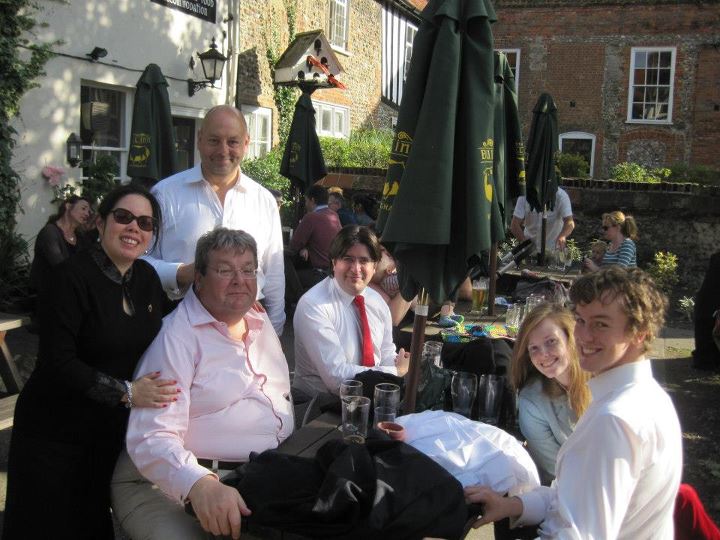
Then, as pilgrims thirsting after righteousness and mindful of our Anglican Patrimony we settled into The Bull to relive the events of the day over a pint. Some things never change.


Sunday, 25 September 2011

Two Reflections

In the first of the two reflections referred to in the title of this post, the Rector of St James's Spanish Place, Fr Christopher Colven, assesses the impact that the Holy Father's visit in September 2010 has had on Catholics in this country.  The text is taken from this week's Parish Notes.


The Rector writes :

On Saturday 1st October, beginning from Westminster Cathedral at 1.15pm, there is to be a Procession of the Blessed Sacrament through the streets to St George’s Cathedral Southwark. This act of witness to the Eucharistic Lord is part of celebrations to mark the first anniversary of Pope Benedict’s visit to this country. In itself, the procession is a sign of renewed confidence among the Catholic community: the months preceding last September’s Papal visit saw increasing nervousness as to how he would be received in what was thought to be among the most secularised parts of Europe – and there had been a well orchestrated campaign in elements of the media ridiculing belief in general and Catholicism in particular. In the event, from the moment the Holy Father touched down in Edinburgh, hundreds of thousands turned out to welcome him and, more importantly, listen attentively to what he had to say. This was evident when he addressed civil society in Westminster Hall and when he spoke to ecumenical leaders in Westminster Abbey, and spectacularly in the great vigil in Hyde Park and then Cardinal Newman’s beatification in Birmingham. The Pope commented that his visit had given him “fresh breath”, and that is certainly true for the Catholics of Scotland, Wales and England.

A year on, how can we assess the events of September 2010? Since St Gregory the Great sent Augustine on his mission in 597, England had always enjoyed a close relationship with the Successors of St Peter – which accounts for the pain of the discontinuity introduced in the 16th century and the searing experience of penal times which has written loyalty to Rome deep into the British Catholic consciousness. What was re-experienced last year was a sense of cohesion around Peter: through our communion with Rome, our place within the universality of the Church is secured. The Pope is there to ensure that St Peter’s act of faith in the living Christ as Son of Man and Son of God is proclaimed in every age: it is his responsibility to guarantee the parameters of right belief (to encourage dialogue and fresh thinking but to ensure it does not lose touch with “what was first received”). In so many unexpected ways the present Papacy has proved much more radical than could ever have been imagined ( a warning against stereotyping) and it is exciting and stimulating to be a Catholic Christian with Pope Benedict at the helm of Peter’s bark!

One of the lessons that the present Pope can teach us is not to be afraid to address contemporary culture on its own terms. In the address at Westminster Hall, Benedict XVI reminded those present of Europe’s rooting in Christian Faith and gave his analysis of contemporary societies not at ease with themselves having lost contact with God: he did not preach, but he did teach, and an audience which was uncertain at first acclaimed him enthusiastically at the end. This didactic approach, wanting to engage others in genuine discussion, putting forward thoughts and ideas which have intellectual integrity – going out into the market place (like St Paul) to meet people of different beliefs, and none, on their own ground – with a clarity underpinned by humility, which offers an invitation but does not demand attention, is surely the way to reach into the hearts and minds of our own generation.” I will endow him with my spirit: he will proclaim the true faith to the nations. He will not brawl or shout … he will not break the crushed reed, nor put out the smouldering wick” (Matthew 12:20).

Christopher Colven                                                              


Readers may also find a short reflection given by Fr Ed Tomlinson of the Tunbridge Wells Ordinariate Group of interest.  The theme is Our Lady of Walsingham and Christian Unity

To conclude, another Walsingham hymn :

Saturday, 24 September 2011

Our Lady of Walsingham, pray for us

Today is a very special day for the Personal Ordinariate of Our Lady of Walsingham, since we mark the Solemnity of Our Lady of Walsingham. 


Those who have come into the Catholic Church from the Church of England will usually have an existing devotion to Our Lady of Walsingham, and will have visited the Anglican Shrine and most probably the Catholic Shrine too, the Slipper Chapel, on a number of occasions.  Devotion to Our Lady of Walsingham is something that is most definitely not unfamiliar to former Anglo-Catholics. 

Indeed, when I was one of those running the Facebook site of St Mary's Bourne Street, I posted some albums that highlighted some of the strong connections that had existed between St Mary's and Walsingham.  The two albums in question are of Fr Humphrey Whitby and of Lord Halifax.

Here is a hymn called Mary of Walsingham, sung a few years ago by the choir of the Anglican Parish Church in Wantage, Oxfordshire.


This year, the annual Pilgrimage of Reparation and Consecration in Walsingham was joined by a large number of members of the Ordinariate, and was led by Monsignor Newton.

Here is a link to a very informative set of personal reflections on that day written by Angela Moffat, the organiser of the pilgrimage.  In particular, it shows that there is more to Anglican Patrimony than singing hymns, and that perhaps one of the things that former Anglicans can bring is a familiarity with certain devotional practices that have somehow retained greater popularity in Anglo-Catholic circles than they have managed to do in the wider Catholic Church that gave birth to them.  

Angela Moffatt's reflections also include an account of the moment when the Pilgrimage reached the Anglican Shrine.  The Anglican Shrine was of course very familiar to many of the Ordinariate members on the pilgrimage, and by all accounts it seems that many felt deeply moved by what was happening.  A joint prayer service was held with our Anglican friends, and the rite of sprinkling was carried out.  All prayed for the Unity of Christians.

Photos of the Ordinariate's Pilgrimage of Reconciliation to Walsingham

Pope Leo XIII, who authorised the re-opening of the Slipper Chapel as the Catholic Shrine in Walsingham in 1894, prophesied that "When England goes back to Walsingham, Our Lady will come back to England."  Let us pray for the Unity of all Christians, and that aided by the unending intercession of Our Most Blessed Mother, Our Lady of Walsingham, England may once again be known as Our Lady's Dowry.

It now seems appropriate to provide a link to this footage of Pope Leo XIII in 1896, accompanied by a recording of him chanting the Ave Maria.


Last but not least, if you are in or near Oxford, don't forget that the Oxford Ordinariate Group is marking today's Solemnity with a special programme of events. 
Oxford Ordinariate - Solemnity of Our Lady of Walsingham

O Sorrowful and Immaculate Heart of Mary, Our Lady of Walsingham, Mother of Reconciliation, pray for us.