Showing posts with label Our Lady of Walsingham. Show all posts

Monday, 17 September 2012

Walsingham Way

Members of the Marylebone Ordinariate Group forsook W1 for Norfolk on Saturday to join the Ordinariate Pilgrimage to Walsingham. We were each returning to England’s Nazareth for the first time as Catholics to join Mgr Keith Newton and several hundred fellow Ordinariate members for mass at the National Shrine.


For those of us accustomed to the rarified (and nowadays, dare one suggest, rather etiolated) character of Anglo Catholic parishes in London one of the most heartening features of the Ordinariate is the wonderful mix of people who make up its priesthood and laity. As we set off after mass to progress from the Slipper Chapel to the village it was striking that this group of pilgrims was very far from the stereotype of a self-selecting and insular group that one Anglican bishop of our acquaintance likes to refer to as “the Anglo-Catholic travelling circus”. This was quite simply a group of people, men and women, from all parts of the country and from all walks of life, gathered together in England's Nazareth to give thanks for many blessings received, and to celebrate that its petition for union with Holy Mother Church had been answered.


One unexpected consequence of the numbers joining the pilgrimage was that we were diverted from the road on to what had once been the Wells and Fakenham Railway, until it fell victim to Dr Beeching’s axe in 1964, a particular shock for those who had very properly and very bravely chosen to walk unshod and who now forsook the caressing tarmac for unforgiving stones and thistles. We followed the cross, lifted high and glinting in the bright sunlight, and a statue of Our Lady of Walsingham carried by four bearers, if not exactly o’er hill and dale then certainly through countryside a little more rugged than that of Regent’s Park.

Flushed as we were by the unaccustomed exercise, onlookers would not have noticed our blushes when, encountering first our Orthodox brethren outside the Chapel of Saint Seraphim, and then some minutes later the Administrator of the Anglican Shrine, we had on each occasion reached the second verse in the Lourdes Hymn:

We pray for God's glory, May his kingdom come!
We pray for His vicar, Our Father, and Rome.


Those blushes dissolved into beams of delight at the greater symbolism of arriving in the little village that is such an important part both of our Catholic history and our Anglican Patrimony, carrying Our Lady onwards into the grounds of the Anglican Shrine where we could offer up more petitions for the unity of Catholic Christendom.

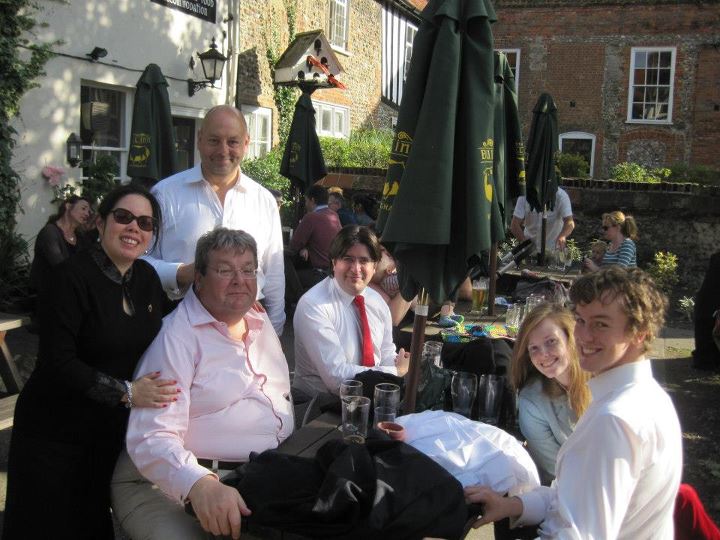
Then, as pilgrims thirsting after righteousness and mindful of our Anglican Patrimony we settled into The Bull to relive the events of the day over a pint. Some things never change.


Tuesday, 28 August 2012

Eternal Definitions, Reasonable Changes?

For most of our group, the first anniversary of being received into the full communion of the Catholic Church approaches.  Fr Colven included some very kind words on this subject in this week's parish notes at St James's, and went on to offer a little publicity for an event we hope you will all either attend or include in your prayers.
Sunday 2nd September will mark the first anniversary of the reception into full communion of the local group of the Ordinariate of Our Lady of Walsingham. We will pray for them especially during the 10.30am Mass and would want them to know how their presence within the parish community is valued. The secondary patron of the Ordinariate is Blessed John Henry Newman and to celebrate his feast day there will be Solemn Evensong & Benediction here in Saint James’s on Sunday 7th October at 5.30pm. The preacher will be Father Paul Chavasse of the Birmingham Oratory who has long been associated with the cause for Blessed John Henry’s canonisation.
The poster below should help inspire you to clear a space in your diary, and a Facebook Event has been set up in order to help spread the word.  If you are on Facebook, do please "share" the Event.


Longstanding readers of this blog will remember a fondness on our part for hymns sung by the late Frank Patterson (see here for Hail Redeemer, King Divine and here for Bring Flowers of the Rarest).  News of this upcoming Evensong gives us an excuse to share with you this powerful and rather moving performance of Blessed John Henry Newman's Lead, Kindly Light.


A couple of weeks before this special event, there is the no less significant milestone of the Ordinariate's pilgrimage to Walsingham, taking place on Saturday 15 September.   Another Facebook Event has been created for what promises to be an excellent day in England's Nazareth.


Apart from making kind mention of Ordinariate members in the parish notes last Sunday, Fr Colven took the opportunity of the Gospel readings appointed for the day to make an interesting comparison in his homily, one that can indeed be broadened out even further in order to apply to the context that gave rise to the Ordinariate. 

The Gospel reading had told of how some had found the teachings of Jesus too much, too difficult, too demanding. 
This is intolerable language. How could anyone accept it?
Many left Jesus, but the twelve disciples remained faithful.   Our Lord did not respond to this by altering His message to make it more popular: His message was, and still is, His message.   

Certainly it must be presented in ways that our times can understand, but at the heart of any such presentation must always be that same unchanging message of good news, love and redemption.  Where we water down the message in order to be more popular, then what we convey is no longer His message, but rather it is what we think His message ought to be in order to have more followers, as if we were doing no more than marketing a Facebook fanpage.
Jesus was aware that his followers were complaining about it and said, 'Does this disturb you? ............... After this, many of his disciples went away and accompanied him no more.  Then Jesus said to the Twelve, 'What about you, do you want to go away too?' Simon Peter answered, 'Lord, to whom shall we go? You have the message of eternal life, and we believe; we have come to know that you are the Holy One of God.'
Truth does not depend on popularity, nor indeed on the support of a majority in General Synod.  Fr Colven talked of Blessed John Paul II, who during his long papacy was much appreciated and loved far beyond the Catholic Church and even beyond the realm of Christians, but not everyone who admired this exceptional man wanted to hear the detail of what he had to say.

We might add that the Venerable Fulton Sheen, whose awe-inspiring addresses have featured before on this blog, expressed similar sentiments extremely succinctly and forcefully, as you will see if you scroll down the right-hand side bar of this blog.

Somewhat less succinctly and forcefully, we talked of the same issue in our post Missing the Point, when we explained that joining the Ordinariate is not tantamount to looking at the Catechism and saying "Wow, yes, I would have written exactly that myself," rather it is about accepting what the Catholic Church teaches and the basis of the authority it has to teach.
When you join the Ordinariate, you are not asked to say that if you had the chance to make up your own religion, according to what you felt would represent a popular view in your times of what was good, you would come up with something that was word for word identical to the Catechism. You are not asked to state that there are no hard teachings in the Catechism. You are asked to say that you accept the Catholic Faith as presented in the Catechism. You are asked to say that in Christian obedience you accept that the Church is, using the words of 1 Timothy 3.15, the "...pillar and bulwark of the truth...", and that therefore you accept the teachings of the Church. Specifically, you are asked to declare your faith through the Creed, and to say:
I believe and profess all that the holy Catholic Church believes, teaches, and proclaims to be revealed by God.
You are asked to say nothing more than you have probably sung a hundred times even in your Anglican days, now of course appreciating more completely the meaning of this verse from the hymn (Firmly I believe and truly) drawn from Newman's Dream of Gerontius :
And I hold in veneration
For the love of Him alone
Holy Church as His creation
And her teachings as His own
This has sometimes been criticised as meaning that you must switch your brain off upon becoming a Catholic. That just isn't so. Blessed John Henry Newman explained this point in the Apologia:
From the time that I became a Catholic, of course I have no further history of my religious opinions to narrate. In saying this, I do not mean to say that my mind has been idle, or that I have given up thinking on theological subjects; but that I have had no variations to record, and have had no anxiety of heart whatever. I have been in perfect peace and contentment; I never have had one doubt. I was not conscious to myself, on my conversion, of any change, intellectual or moral, wrought in my mind. I was not conscious of firmer faith in the fundamental truths of Revelation, or of more self-command; I had not more fervour; but it was like coming into port after a rough sea; and my happiness on that score remains to this day without interruption.
He had not changed, he was not a different person. What had happened is that he found himself in a place where what the Church taught was the Truth, however convenient or inconvenient the Truth might be.
That Gospel reading speaks powerfully of a clear message, being the Truth, that is not variable depending upon how popular it is in any generation.  The witness of Blessed John Paul II and of the Venerable Fulton Sheen show the same in two Catholics who lived in our time. 

Those who have left the Church of England to join the Catholic Church are somewhat familiar with the concept, even if on a much less imposing scale.  No-one can say that we have done what we have done in order to be popular.  What we have done is in response to the direct call for Unity expressed in the Gospel, and is, to build on Cardinal Cormac Murphy O'Connor's comments published recently in the Catholic Herald, a step away from the seeming reasonableness of adapting church teaching without reference to Scripture or Tradition towards an understanding of the divinely ordained nature of the Church, its teaching authority, and its guardianship of the deposit of faith.

In the Apostolic Constitution Fidei Depositum, issued in October 1992 upon the publication of the Catechism of the Catholic Church, Blessed John Paul II wrote:
Guarding the deposit of faith is the mission which the Lord has entrusted to his Church and which she fulfils in every age. The Second Vatican Ecumenical Council, which was opened 30 years ago by my predecessor Pope John XXIII, of happy memory, had as its intention and purpose to highlight the Church's apostolic and pastoral mission, and by making the truth of the Gospel shine forth, to lead all people to seek and receive Christ's love which surpasses all knowledge (cf. Eph 3:19).

The principal task entrusted to the Council by Pope John XXIII was to guard and present better the precious deposit of Christian doctrine in order to make it more accessible to the Christian faithful and to all people of good will. For this reason the Council was not first of all to condemn the errors of the time, but above all to strive calmly to show the strength and beauty of the doctrine of the faith. "Illumined by the light of this Council", the Pope said, "the Church... will become greater in spiritual riches and, gaining the strength of new energies therefrom, she will look to the future without fear... Our duty is... to dedicate ourselves with an earnest will and without fear to that work which our era demands of us, thus pursuing the path which the Church has followed for 20 centuries."
The message is the message.  We can and must adapt how we present it and explain it, but the message remains unchanged. 

Finally, a brief follow up on a comment received on our recent post A New Direction.  The comment invited us to look at the St Peter's London Docks blog to find out about the latest thinking among Anglo-Catholics still in the Church of England but who used to say that a Code of Practice will not do.

The Peterite blog used to be a very regular read for members of the Marylebone Group, and has been praised in these pages before.  We much admired the continuing efforts of Fr (now also Dr) Jones to teach the Catholic faith in a church whose parish and indeed whose parish clergy have played such an important part in the history of Anglo-Catholicism.  Given our Pusey House connections, we also liked the Ascot Priory link.  However, in the cold light of day, perhaps we might reasonably wonder if our enthusiasm for the Peterite blog was, with absolutely no criticism intended, a reflection of our own views of our then situation as Anglicans associated with a historically Anglo-Catholic parish in the Diocese of London, a parish that, utterly lovely as it is, bears little resemblance to the reality of the rest of the Church of England.  Did we like the blog because it allowed us to imagine that we were a little less congregationalist?

The person who left the comment on our recent post was perhaps referring in part to this, the penultimate paragraph of Fr Jones's recent post.  It encourages a new vision, rather than just pretending that more of the same is possible, and for throwing out this challenge, Fr Jones is much to be admired.  He goes along with Better Together, but he also knows that as a defining vision, it is somewhat limited and risks appearing hollow:
Well, one way or the other, much will be known and decided before Christmas this time, but nothing will be over or ended. There will however be a new paradigm for Anglo-Catholics to grasp. Whatever the House of Bishops offer, whatever Synod decides, Anglo-Catholics in 2013 will need a new way to see and understand their identity, mission and long term role within Anglicanism. A simple overwhelming 'I'm a Roman Catholic paid by the Church of England' will no longer do, not morally, not Spiritually, not Liturgically, not theologically and not practically.
While we might find the first part of the paragraph rather striking in its "We're staying, come what may" approach (and Dr Kirk certainly would), the second part is perhaps a helpful indication of where things are heading.  No longer the claim that Anglo-Catholics are separated from the wider Church solely by accident of Tudor history and misfortune, no, there is now an acknowledged need for frankness and clarity about what is different, and about why it is felt that difference should not only be allowed to persist but should be cherished. 

Those in Affirming Catholicism have for a long time been clear about why they don't agree with Rome, but perhaps Fr Jones is right that the time has come for Anglo-Catholics more broadly to define their position, now that there is no tangible sense of a move towards unity, of a positive trajectory towards reunion, indeed now that in some instances there is an apparent pride in the opposite. 

As Fr Jones says, the approach exemplified by Dr Eric Mascall's famous fictional Ultra-Catholic is no longer possible: there now needs to be an explanation other than procrastination, fence-sitting or anxiety over practicalities for not joining the Catholic Church.  That explanation might perhaps be extremely good (one hopes that it is about more than second order issues), but it has yet to be given. 
I am an Ultra-Catholic -No 'Anglo, I beseeech you!
You'll find no trace of heresy in anything I teach you.
The clergyman across the road has whiskers and a bowler,
But I wear buckles on my shoes and sport a feriola.

My alb is edged with deepest lace, spread over rich black satin;
The Psalms of David I recite in heaven's own native Latin,
And though I don't quite understand those awkward moods and tenses,
My ordo recitandi's strict Westmonasteriensis.

I read the children in my school the Penny Catechism,
Explaining how the C. of E.'s in heresy and schism.
The truths of Trent and Vatican I bate not one iota.
I have not met the Rural Dean. I do not pay my quota.

The Bishop's put me under his 'profoundest disapproval'
And, though he cannot bring about my actual removal,
He will not come and visit me or take my confirmations.
Colonial prelates I employ from far-off mission stations.

The music we perform at Mass is Verdi and Scarlatti.
Assorted females form the choir; I wish they weren't so catty.
Two flutes, a fiddle and a harp assist them in the gallery.
The organist left years ago, and so we save his salary.

We've started a 'Sodality of John of San Fagondez,'
Consisting of five young men who serve High Mass on Sundays;
And though they simply will not come to weekday Mass at seven,
They turn out looking wonderful on Sundays at eleven.

The Holy Father I extol in fervid perorations,
The Cardinals in curia, the Sacred Congregations;
And, though I've not submitted yet, as all my friends expected,
I should have gone last Tuesday week, had not my wife objected.

Monday, 26 September 2011

Pray unceasingly

In recent posts, we have commented on how devotion to Our Lady of Walsingham and to Blessed John Henry Newman are to be found in abundance amongst new Catholics arriving in the Ordinariate. For obvious reasons, those in the Ordinariate probably have a newly re-invigorated sense of such devotion.  It is rightly a source of joy that this is so.
.
Particular saints are venerated more in some places than in others, and more in some times than in others. This may be caused by a local connection, by a particular relevance to current events, or very simply because we find one saint more interesting or even likeable than another. Even although we are all united across time and space through our place in one Church, it is no surprise that we on earth, the Church Militant, should identify more readily with some of those of the Church Triumphant than with others.

The saints commemorated today throw up a little conundrum as far as the inhabitants of these isles are concerned. Saints Cosmas and Damian, the twin martyr physicians, are widely celebrated in both East and West, they are saints of extremely long standing, having been martyred before the year 300AD (not 300CE, as the BBC would have us say), and are well known for acts that remain very obviously good works even in these changed times (providing medical care without charging). They are even among the saints commemorated in the Communicantes prayer of the Roman Canon.

Yet, they are not especially known in this country. 

There are a few churches dedicated to them (internet sources suggest there might be five parish churches in England dedicated to them).  The Barbers’ Company in the City of London is dedicated to them, and the coat of arms of the Royal Society of Medicine includes them as supporters. The records of Canterbury Cathedral show that they once possessed some relics of the twin saints, as did Salisbury Cathedral, Bisham Abbey and other places. Salisbury Cathedral has some nineteenth century statuary of them.  Yet, apart from this, the twin saints are not especially recognised or venerated here.

Amongst the great Cloud of Witnesses, there are many with whom we are not familiar. We do not know all the Church Triumphant any more than we know all the Church Militant or indeed all the Church Penitent.  Yet, it doesn’t matter that we don't know them all.  Even if we should show interest in others, and draw inspiration from the lives of the saints, what counts is that, being members of one Church, we ask the prayers of the Communion of Saints, of our brothers and sisters in this life, and of the Holy Souls in Purgatory, and indeed also that we ourselves pray for others

As new members of the Catholic Church, members of the Ordinariate are very well aware that they have entered into a new and wider communion.  Therefore, we are as conscious as anyone of the wider perception of that fellowship and communion, which includes the living and the dead, the Saints in Heaven and the Holy Souls in Purgatory, the known and the unknown, those to whom we are devoted and those of whom we have never heard.

As we pray for all members of Christ’s Church, and ask their prayers for us, let us join that common intercession most especially today with the prayers of Our Lady of Walsingham, of Saints Cosmas and Damian, and of Blessed John Henry Newman. 

To finish, a much loved piece of Anglican Patrimony, the setting by Stanford of Iustorum Animae, the text used at the Offertory at Mass on the Solemnity of All Saints.


“Pray unceasingly, we must empty Purgatory”
Saint Pio of Pietrelcina “Padre Pio”

Sunday, 25 September 2011

Two Reflections

In the first of the two reflections referred to in the title of this post, the Rector of St James's Spanish Place, Fr Christopher Colven, assesses the impact that the Holy Father's visit in September 2010 has had on Catholics in this country.  The text is taken from this week's Parish Notes.


The Rector writes :

On Saturday 1st October, beginning from Westminster Cathedral at 1.15pm, there is to be a Procession of the Blessed Sacrament through the streets to St George’s Cathedral Southwark. This act of witness to the Eucharistic Lord is part of celebrations to mark the first anniversary of Pope Benedict’s visit to this country. In itself, the procession is a sign of renewed confidence among the Catholic community: the months preceding last September’s Papal visit saw increasing nervousness as to how he would be received in what was thought to be among the most secularised parts of Europe – and there had been a well orchestrated campaign in elements of the media ridiculing belief in general and Catholicism in particular. In the event, from the moment the Holy Father touched down in Edinburgh, hundreds of thousands turned out to welcome him and, more importantly, listen attentively to what he had to say. This was evident when he addressed civil society in Westminster Hall and when he spoke to ecumenical leaders in Westminster Abbey, and spectacularly in the great vigil in Hyde Park and then Cardinal Newman’s beatification in Birmingham. The Pope commented that his visit had given him “fresh breath”, and that is certainly true for the Catholics of Scotland, Wales and England.

A year on, how can we assess the events of September 2010? Since St Gregory the Great sent Augustine on his mission in 597, England had always enjoyed a close relationship with the Successors of St Peter – which accounts for the pain of the discontinuity introduced in the 16th century and the searing experience of penal times which has written loyalty to Rome deep into the British Catholic consciousness. What was re-experienced last year was a sense of cohesion around Peter: through our communion with Rome, our place within the universality of the Church is secured. The Pope is there to ensure that St Peter’s act of faith in the living Christ as Son of Man and Son of God is proclaimed in every age: it is his responsibility to guarantee the parameters of right belief (to encourage dialogue and fresh thinking but to ensure it does not lose touch with “what was first received”). In so many unexpected ways the present Papacy has proved much more radical than could ever have been imagined ( a warning against stereotyping) and it is exciting and stimulating to be a Catholic Christian with Pope Benedict at the helm of Peter’s bark!

One of the lessons that the present Pope can teach us is not to be afraid to address contemporary culture on its own terms. In the address at Westminster Hall, Benedict XVI reminded those present of Europe’s rooting in Christian Faith and gave his analysis of contemporary societies not at ease with themselves having lost contact with God: he did not preach, but he did teach, and an audience which was uncertain at first acclaimed him enthusiastically at the end. This didactic approach, wanting to engage others in genuine discussion, putting forward thoughts and ideas which have intellectual integrity – going out into the market place (like St Paul) to meet people of different beliefs, and none, on their own ground – with a clarity underpinned by humility, which offers an invitation but does not demand attention, is surely the way to reach into the hearts and minds of our own generation.” I will endow him with my spirit: he will proclaim the true faith to the nations. He will not brawl or shout … he will not break the crushed reed, nor put out the smouldering wick” (Matthew 12:20).

Christopher Colven                                                              


Readers may also find a short reflection given by Fr Ed Tomlinson of the Tunbridge Wells Ordinariate Group of interest.  The theme is Our Lady of Walsingham and Christian Unity

To conclude, another Walsingham hymn :

Saturday, 24 September 2011

Our Lady of Walsingham, pray for us

Today is a very special day for the Personal Ordinariate of Our Lady of Walsingham, since we mark the Solemnity of Our Lady of Walsingham. 


Those who have come into the Catholic Church from the Church of England will usually have an existing devotion to Our Lady of Walsingham, and will have visited the Anglican Shrine and most probably the Catholic Shrine too, the Slipper Chapel, on a number of occasions.  Devotion to Our Lady of Walsingham is something that is most definitely not unfamiliar to former Anglo-Catholics. 

Indeed, when I was one of those running the Facebook site of St Mary's Bourne Street, I posted some albums that highlighted some of the strong connections that had existed between St Mary's and Walsingham.  The two albums in question are of Fr Humphrey Whitby and of Lord Halifax.

Here is a hymn called Mary of Walsingham, sung a few years ago by the choir of the Anglican Parish Church in Wantage, Oxfordshire.


This year, the annual Pilgrimage of Reparation and Consecration in Walsingham was joined by a large number of members of the Ordinariate, and was led by Monsignor Newton.

Here is a link to a very informative set of personal reflections on that day written by Angela Moffat, the organiser of the pilgrimage.  In particular, it shows that there is more to Anglican Patrimony than singing hymns, and that perhaps one of the things that former Anglicans can bring is a familiarity with certain devotional practices that have somehow retained greater popularity in Anglo-Catholic circles than they have managed to do in the wider Catholic Church that gave birth to them.  

Angela Moffatt's reflections also include an account of the moment when the Pilgrimage reached the Anglican Shrine.  The Anglican Shrine was of course very familiar to many of the Ordinariate members on the pilgrimage, and by all accounts it seems that many felt deeply moved by what was happening.  A joint prayer service was held with our Anglican friends, and the rite of sprinkling was carried out.  All prayed for the Unity of Christians.

Photos of the Ordinariate's Pilgrimage of Reconciliation to Walsingham

Pope Leo XIII, who authorised the re-opening of the Slipper Chapel as the Catholic Shrine in Walsingham in 1894, prophesied that "When England goes back to Walsingham, Our Lady will come back to England."  Let us pray for the Unity of all Christians, and that aided by the unending intercession of Our Most Blessed Mother, Our Lady of Walsingham, England may once again be known as Our Lady's Dowry.

It now seems appropriate to provide a link to this footage of Pope Leo XIII in 1896, accompanied by a recording of him chanting the Ave Maria.


Last but not least, if you are in or near Oxford, don't forget that the Oxford Ordinariate Group is marking today's Solemnity with a special programme of events. 
Oxford Ordinariate - Solemnity of Our Lady of Walsingham

O Sorrowful and Immaculate Heart of Mary, Our Lady of Walsingham, Mother of Reconciliation, pray for us.

Friday, 23 September 2011

Padre Pio, pray for us

Time only allows for a short blogpost today, in which we touch briefly on the saint of the day, Padre Pio, Pio of Petrelcina, and in which we would like to draw your attention to two upcoming events

The video below shows a visit by Pope Benedict XVI to San Giovanni Rotondo, the home town of Padre Pio, where he prayed before the Saint's tomb and celebrated Mass.  In his homily that day, he reminded pilgrims not just of Padre Pio's spiritual strengths, but also of the obligation to provide for those in need, however difficult that might be. 


The first of the two events we would like to highlight is that the Oxford Ordinariate Group is marking the Solemnity of Our Lady of Walsingham (the day is marked as such in the Ordinariate) wih a special programme of events for tomorrow afternoon.  If you are in or near Oxford then, do support this with your presence and/or your prayers.

Oxford Ordinariate - Solemnity of Our Lady of Walsingham

The second event has been highlighted by Fr Ed Tomlinson of the Tunbridge Wells Ordinariate Group.  A Mass is being celebrated by the Archbishop of Westminster at Westminster Cathedral on October 6th for the St Barnabas Society, a charity that offers financial support to clergy converts and their families.  Again, please support this event with your presence and/or your prayers, and consider whether you might be able to offer some financial support as well, either throught the St Barnabas Society or through the Friends of the Ordinariate. 

Tunbridge Wells Ordinariate - St Barnabas Society

Friends of the Ordinariate