Monday, 5 December 2011

Deacon Bradley and the Gateway to the South

A blog like this needs to have several categories of posts if it is to stand a chance of keeping people interested.  One of our various categories describes our reactions, as new members of the Catholic Church, to our increasing awareness of being part of a very large "organisation", both in overall terms and in the specifics of parish and Ordinariate life.  In terms of the general, our October post entitled the Universal Church talked of a dawning consciousness of the global scale of the Catholic Church.  At a more local level, our blogpost on All Saints' Day talked about a most enjoyable visit to Holy Apostles, Pimlico.

Yesterday, I took the opportunity, following the kind invitation of James Bradley, to attend mass at the parish of the Holy Ghost in Balham, where James is parish Deacon.  James is a Deacon in the Ordinariate, and a friend of the Marylebone Ordinariate Group (having kindly deaconed our Reception Mass on September 3rd).  He is also a Deacon of some very spectacular international renown, having sung the Gospel in front of the Holy Father, countless Cardinals, Archishops, Bishops and Priests, and of a congregation far in excess of one million at the recent World Youth Day celebrations in Madrid.

Arriving in Nightingale Square, SW12, I was greeted by a sight that is now very familiar.  Catholic parishes usually have a series of masses each Sunday morning, often meaning that as the congregation from one mass files out, the congregation for the next mass is beginning to arrive.  This is something I had witnessed as an Anglican only during my days living in Hong Kong, where the Anglican Cathedral had the similar dual properties of a busy timetable and high attendance levels.  It was not something that I had previously encountered in the Church of England.

Since the often-maligned Victoria and Northern Lines had sped me down from Pimlico to Balham in unbelievably quick time (barely longer than it would have taken me to get to St James's), I was able to take the opportunity to wander around the square a little before mass, and to take the photo below, before finally approaching the church.  If you look very carefully in this photo by zooming and with your magnifying glass, you will see James in his purple dalmatic, right at the back, talking with a parishioner.


James greeted me at the door, helped me find the right selection of books and cards, and pointed me into the church itself.  Still not having the necessary brazen nature for papparazo duties, I managed only one photo of the interior of the church, the grainy result of which can be seen below.  Other photos are of course available by perusing the parish's own website.


I will confess that I had done a little preparation before my visit.  Years of Anglo-Catholic training had taught me to be very careful when stepping away from familar territory, you never know what you might find when away from home.  Yet, this caution was, as in the case of my visit to Holy Apostles Pimlico, shown to be utterly unnecessary.  In any event, the information I had read beforehand was extremely positive.  I had come across an article by Joanna Bogle entitled London's Balham parish, 'an icon of liturgical hope', which made me very much look forward to the Mass, despite my usual pathetic and despicable Central Londoner's attitude of wariness about crossing the river or going outside the Circle Line.

The Joanna Bogle article proved to describe a scene virtually identical to the one I found, as this extract explains :
Parish music director is Jeremy de Satge......  At Balham, there is a parish choir that sings Latin plainchant, and lovely settings of the Introit verse in Latin and English. The congregation has been taught some Mass settings and now large numbers of them join in, too.

The choir meets weekly to practise. It is made up of volunteers, many of whom do not read music. They are amateurs in the best sense of the word - people who love what they are doing.

Add to this a dignified sanctuary, a glittering new tabernacle in gold, marble floors that shine, a generous array of candles in tall silver candlesticks, and priests who celebrate the liturgy with love - and you have something that builds up the parish numbers, and attracts people from farther afield too.....

.....Is all this difficult? It seems not - although goodwill and energy are required. Jeremy de Satge is a convert- he joined the Church aged 18, back in the late 1970s, after a childhood spent singing in Anglican church and cathedral choirs. As a Catholic, he came to know and love the music and liturgy at London's Brompton Oratory and this was partly what inspired him to see what he could achieve at parish level.

Of course, commitment and encouragement from the parish priest are essential. Father Stephen Langridge, parish priest at Balham, makes no secret of wanting the best for God - a church that is a true place of prayer, a devout and enthusiastic congregation, a parish where the children are well instructed and the Faith is taught and honoured. Is it just a coincidence that confession is widely promoted? Confessions are heard regularly, including on Sundays, and the subject is mentioned frequently from the pulpit. 
I noticed that the church was busy, with a preponderance at the front of families with children, and elsewhere a remarkably healthy mix of men and women of all ages. Mass started with the sound of a bell, the choir beginning the plainchant introit in Latin, and a long procession entering from the sacristy.   The altar was censed (I noted the use of the so-called "Benedictine arrangement", with a cross standing in the middle of the altar), and we set to work using the new translation, which seemed already to have settled in very nicely with the congregation. 

After some more chant from the choir and some very well executed readings by a member of the congregation, I had the chance once again to hear Deacon Bradley singing the Gospel.  Then, we had the reason for his invitation, a homily that touched on the Ordinariate, what its place was, what its purpose was, and what its genesis had been.   This is part of the mission of the Ordinariate as mentioned in our blogpost yesterday, to introduce ourselves and to explain the purpose of the Ordinariate to the wider Catholic community. 

James's excellent homily may well be appearing elsewhere on the internet soon, and if it does, we will provide a link to it here.  Suffice it for now to say that I could very easily identify personally with much of what he said: life in Oxford and Sevenoaks, studying music at university, leaving behind Anglican years of a sound music tradition and catholic practice, and finally coming into the full communion of the Catholic Church this year.  The call to unity, as Our Lord had willed on the night that he was betrayed, was the driving force both behind the Holy Father's invitation in Anglicanorum coetibus, and behind the impetus that causes Anglicans to leave behind what they have known and loved and to accept that invitation.  The call to unity is a clear and explicit Gospel imperative.  The Catholic Church was not receiving us as naughty, errant schoolchildren, but as Christians who sought to follow that Gospel imperative.  Refusing Anglicanorum coetibus was not only resisting the call to unity, but actively blocking it. 

The homily talked of that great hymn, O Thou who at Thy Eucharist didst pray (which we sang later as a communion hymn) as a prayer very much connected with concepts behind the Ordinariate, especially the verse :
We pray Thee too for wanderers from thy fold;
O bring them back, good Shepherd of the sheep,
back to the faith which saints believed of old,
back to the Church which still that faith doth keep;
soon may we all one Bread, one Body be,
through this blest Sacrament of unity.
James explained that the Ordinariate had around 1000 lay members and around 60 clergy (with more in both categories planning to join in 2012), but as yet no churches and little money.  Members of the congregation were invited to discuss the Catholic Church and the Ordinariate with their Anglican friends, so that the human face of the Church can shine through.    As to financial support, another friend of the Marylebone Ordinariate Group, Peter Sefton-Williams, from the Friends of the Ordinariate, was present, and with James handed out leaflets about the work of the Ordinariate and the Friends of the Ordinariate after Mass.  We understand some donations were received, and a number of people have approached James about exploring the possibility of joining the Ordinariate.

After the homily and some sung intercessions, I was delighted to hear the Roman Canon, Eucharistic Prayer I, in use.  Although always dignified (not least the sonorous gong at the consecration), we moved quickly and efficiently through, and before long it was time to receive the sacrament, which a very sizeable proportion of people did on their knees, despite the lack of an altar rail.  A chance to sing Rorate Coeli in Latin followed (I had only sung it in English before, and so, despite having heard it in Latin previously, I was beaten to this achievement by a friend from Hong Kong.) 

We had various parish notices, including a reminder for parents to get references for applications to the Holy Ghost parish school, and a young chap called Peter then addressed the congregation in a very impressive and confident (and concise) fashion on youth group activities: it was all done efficiently though, and before long Deacon Bradley was inviting us to bow our heads for the blessing.

People might think they could accuse someone whose experience of the Catholic Church is mostly based around St James's Spanish Place, with some knowledge of the London Oratory, the Oxford Oratory and Westminster Cathedral of not having had the widest possible experience of the Catholic Church.  Perhaps so, but there is a clear answer to that superficial criticism: whenever I have found myself away from what critics might term my "comfort zone", I have always been very happy with what I have found, be that in France, Scotland, Kent, Pimlico or indeed Balham. 

The point is that, whatever the music, whatever the vintage of the vestments, whatever the particular Eucharistic Prayer employed, whatever the location, whether in Latin or the new English translation, the Catholic Church is the Catholic Church, and the Mass is the Mass, and all is in communion with the Holy Father.  That is one of the great joys of having becoming a Catholic, and does not depend in any way whatsoever on the Central London privilege of having access to some of the most well known Catholic places of worship in this country

Let us give thanks to God for the work of the parish of the Holy Ghost in Balham, and for the Ordinariate.  May their impressive achievements and ongoing efforts continue to bring great benefits to the people of that part of London.

Denial Ain't Just a River in Egypt

In our post discussing the introduction of Anglican liturgies in Anglican parishes where the Roman Rite had previously been used, we asked the following question.
So is it unkind, or is it actually rather merciful, for the Bishop of London to have written his letter in this way at this time?  Is he kicking people when they're down, or is he doing everyone a favour and asking them to make a decision about the future they truly want?
The more we think about it, the more we think that, whether this is what he intended or not, the Bishop of London is probably doing everyone a favour by forcing them to re-examine their positions.  Events are such that people need to give some thought to what is going around them.

John Betjeman, in his poem Summoned by Bells, cited the mocking questions often asked to him and fellow Anglo-Catholics as to why they seemed to "ape" some features of the Catholic Church:
Those were the days when that divine baroque
Transformed our English altars and our ways.
Fiddle-back chasuble in mid-Lent pink
Scandalized Rome and Protestants alike:
"Why do you try to ape the Holy See?"
"Why do you sojourn in a halfway house?"
And if these doubts had ever troubled me
(Praise God, they don't) I would have made the move.
What seemed to me a greater question then
Tugged, and still tugs: Is Christ the Son of God?
Betjeman was writing at a very different time from the one in which we live.  The Anglo-Catholic thesis, the branch theory, held then as much as it ever did.  Among other efforts to promote unity on the part of the Church of England, Saepius Officio and the "Dutch Touch" were very serious and sincere attempts (whether one considers them to have been succesful or not) to align the Church of England's orders with those of the Catholic Church.  Fr John Hunwicke talked of the Dutch Touch in the following terms :
Some sixteen years ago I coined the phrase 'the Dutch Touch' to describe the participation after 1933 of Dutch schismatics with indubitably valid orders in Anglican episcopal consecrations (the technical details are in my paper in the volume Reuniting Anglicans with Rome). The secret archives in Pusey House, Oxford, make absolutely clear that the intention of the very highest levels in the Church of England and the Dutch Old Catholic Church was to introduce the 'Dutch Succession' into the Church of England and so, after two or three generations, render Apostolicae curae obsolete. Remember that in 1662 the Cof E had made the formulae in presbyteral and episcopal ordination (which [Pope] Leo [XIII] had asserted were insufficiently clear), more explicit. Although the plotting of 1933 was done in private (so that nobody could say 'Ah, the Anglicans do realise they are not real priests'), it clearly represents a formal and ecclesial act.
Who in their right mind would argue that the approach of the Church of England would be the same today?  The Church of England has taken the approach that it has the right to vote on making whatever changes it likes, and if this leads to the creation of significant differences with the wider Church, whether in the East or the West, then that's just tough.  Not exactly Ut Unum Sint, is it?

Cardinal Walter Kasper, at the 2008 Lambeth Conference, said the following as part of his longer address :
We would see the Anglican Communion as moving a considerable distance closer to the side of the Protestant churches of the 16th century, and to a position they adopted only during the second half of the 20th century.
The 1966 Common Declaration signed by Pope Paul VI and Archbishop Michael Ramsey called for a dialogue that would “lead to that unity in truth, for which Christ prayed”, and spoke of “a restoration of complete communion of faith and sacramental life”. It now seems that full visible communion as the aim of our dialogue has receded further, and that our dialogue will have less ultimate goals and therefore will be altered in its character. While such a dialogue could still lead to good results, it would not be sustained by the dynamism which arises from the realistic possibility of the unity Christ asks of us, or the shared partaking of the one Lord’s table, for which we so earnestly long.
No-one, when trying to come up with examples of ultra-hardline, ultra-conservative or anti-ecumenical Catholics would ever come up with Pope Paul VI and Cardinal Kasper.  It's not just us pesky Catholics, of whatever hue, who are worried by the new approach of Anglicanism.  No, it's also the Orthodox, with whose spirituality a certain kind of Anglican cleric often likes to claim affinity.  At a 2010 address to the Nicaea Club at Lambeth Palace, Metropolitan Hilarion, of the Russian Orthodox Church, after recalling the warm history of co-operation between Anglicanism and the Orthodox, and having taken several none-too-subtle swipes at the über-liberal practices of certain parts of the Anglican Communion, went on to comment that the Church of England's approach on certain issues was not conducive to Christian Unity.
We have studied the preparatory documents for the decision on female episcopate and were struck by the conviction expressed in them that even if the female episcopate were introduced, ecumenical contacts with the Roman Catholic and the Orthodox Churches would not come to an end. What made the authors of these documents so certain?
Betjeman's concept of a "greater question" seems to have a completely different meaning now.  The "greater question" today is whatever happens to be on General Synod's agenda, and as long as the right legal and procedural niceties are respected, that can be just about anything.

There are, however, plenty in the Church of England who see what is happening as a very good thing, and of course they have every right to do so.  This is perhaps where the events of the past 20 years in the Church of England might be seen as having a positive outcome.  As suggested so compellingly in William Oddie's excellent and very prescient book The Roman Option, perhaps this is an opportunity for those who want to be clearly Catholic to become so, in full communion with Rome, and an opportunity for those who do not to be free of the shackles (as they might see it) of having to take into account the position of the Catholic Church on certain matters.

Even amongst those Anglicans who have felt themselves having difficulty with some of the Church of England's changes, there are different schools of thought.

There are people in the Church of England who, bravely and with great honesty, are deciding that in fact perhaps the label of Catholic or even Anglo-Catholic doesn't tell their whole story.  This must be difficult for some (but possibly joyful for others), and we must all hope and pray that for such people it represents a new and positive dawn.

Then there are those who are in a dilemma, who want to adhere to Catholic faith and practice within the Church of England.  These people, who see impaired communion as the only difference between them and their friends in the Catholic Church, need our prayers, support and sympathy.  There are difficult times ahead for them, and hard realities to be faced. 

There is a third category, one that includes many clergy: those who are in denial. 


Their view is that the Church of England will remain catholic (more so than the Pope indeed, who they feel has got many things wrong), no matter what General Synod decides on any issue.  Theirs is an Anglo-Catholicism steeped in an almost congregationalist approach, taking the John Keble line that as long as they run their parish, all is well.  Après moi le déluge.  They hark back to times long gone, to the era of the magnificent triumphs of the Anglo-Catholic conferences, when people, such as exemplified in the fictional Fr Hugh Chantry-Pigg, talked disparagingly of the Italian Mission and the Irish Mission.  The dramatic transformation in the ecclesial body around them is irrelevant, they believe.  They don't need to listen to the Bishop of Rome, they say, although they will pick and mix their way through the liturgies of his many predecessors, blending the concoction that best pleases them (one wonders how the Anglican Bishop of London, who disapproves of the use of the new translation of the Roman Missal by his clergy, feels about the use of never-authorised translations of pre-1955 Holy Week rites in his diocese).  

Those in denial are, to be fair, enjoying something that is truly appealing and truly great fun to a certain number of people.  Many a present and former Anglo-Catholic fully understands the temptation to take the "pull up the drawbridge approach".  What is unfair though, is when such people criticise the Ordinariate.

Other Catholics who have not had full information on what the Ordinariate is, quite rightly ask questions about the Ordinariate.  Many on the liberal wing of the Church of England do not like the Ordinariate, perhaps as a result of synodical battle scars incurred over many years, even if we would argue they should be happy to see us go.  Similarly, what Damian Thompson might rather bluntly call the "tabletista tendency" in the Catholic Church is not always thrilled by the existence of the Ordinariate.  All that, we can take, we can understand, and we will all come to a mutual understanding free of the fears of the unknown on all sides.  The Ordinariate engages actively in a programme of explaining its mission as widely as possible.

Sadly, those "in denial" usually like to make a big point of how the Ordinariate is irrelevant to them.  They don't need to join the "Roman Church" and even if they ever did so, they proclaim that they would not join the Ordinariate.

Why do the "deniers" act like this?  Perhaps, to some extent, fear of the unknown (and we can all understand that).  Perhaps a sadness at having to face up their dream of a Church of England as the Catholic Church in this Land slipping away (again, an entirely legitimate emotion).  There may be other reasons too.

One of the ultimate bêtes noires of the deniers is the question of ordination, and as a layman, I am going to steer well clear of that topic.  The only thing I will say is that people who are anxious about how their own ministry up to that point will be regarded (very favourably, is the answer, including in a prayer of thanksgiving in the Ordination Service), should understand that the Ordinariate is one way in which the Holy Father shows that he most definitely values the existing ecclesial, liturgical and religious life of Anglicans, and that he wants to bring them in to the Catholic Church without treating them as if they knew absolutely nothing.

The establishment of the Ordinariate was about many things, not least a response to groups of Anglicans across the world who had asked for a way to come into communion with Rome as groups.  However, it was also about recognising that Anglicans have something to bring with them.  There has been much discussion about what Anglican Patrimony means, but certainly, one of the thing that the existence of the Ordinariate recognises is that incoming Anglicans do not arrive with a year zero level of knowledge.  Often, a tailored programme of catechesis will be provided (in the same way that a tailored programme of priestly formation is provided for Ordinariate priests), acknowledging that these Anglicans are in a special position, they are not totally new to the Faith.  One of our most popular blogposts talked about the shared beliefs between Anglo-Catholics and those already in the Catholic Church.
 
The Ordinariate should be understood for what it is, a means to welcome Anglicans in, if they want to make that journey, on a basis that values all that they have done thus far, that will build on their existing experience, knowledge and gifts, and doesn't treat them as if they know nothing.

If readers will permit me this moment of vanity, I conclude with the last few paragraphs I wrote in an email announcing my departure from the Church of England :
This is not a decision taken lightly or in the heat of the moment. It is not a decision made out of hurt or disappointment. It is a tremendously difficult decision made out of a conviction that the right home for people with views such as mine is the Roman Church.
In May 1843, Blessed JHN wrote :

"At present I fear, as far as I can analyze my own convictions, I consider the Roman Catholic Communion to be the Church of the Apostles, and that what grace is among us (which, through God's mercy, is not little) is extraordinary, and from the overflowings of His dispensation. I am very far more sure that England is in schism, than that the Roman additions to the Primitive Creed may not be developments, arising out of a keen and vivid realizing of the Divine Depositum of Faith"

I think that about sums it up. I am infinitely less uncomfortable with the trickier parts of Roman "innovation" than I am with what the CofE is doing.

Making a separate point, how apt that this Newman extract was also cited by Fr Aidan Nichols OP in his homily at the "first mass" of Fr Andrew Burnham (the inverted commas were used by the Oxford Oratory too, they are not mine). Fr Nichols made a reference to Newman saying that there was "not little" grace among us in the CofE, and referred to Fr Burnham as Bishop Andrew - so like Fr Aidan and Fr Andrew, I do not regard what I am about to do as a rejection or a negation of anything I have done, rather, to paraphrase Fr Nichols again, this time from his sermon at the deaconing of the three former Anglican bishops, a "quiet rectification" of my position.
It seems that Dr Chartres's words will bring people closer to accepting the reality of their situation.  Some will be delighted with the new situation, others will feel called to think seriously about making a change.  The outcome for both is surely positive, even if there will surely be trials and challenges along the way.

Wednesday, 30 November 2011

St Andrew and St Andrews

Regular readers of this blog will have noticed a Scottish connection.  Two of the three members of the Marylebone Ordinariate Group were brought up in Scotland, and this has had some influence on a number of the posts put up on this site.

For example, for vintage footage of proceedings at the 1948 Restoration Mass at Pluscarden Abbey, you might want to read our blogpost Scottish Restorations.  Alternatively, our blogpost on St Margaret of Scotland includes a lightning tour of Dunfermline Abbey, some photos of that fine building as well of Cardinal Keith O'Brien, the Lord Lyon King of Arms and the tomb of St Margaret.  There is also film of a recent celebration by FSSP clergy of a Solemn High Mass in St Mary's Catholic Cathedral in Edinburgh.  Finally, one of our earliest posts, Saint Ninian, pray for us, included footage of the Holy Father's visit to Scotland in 2010, and talked of the life of St Ninian, that key figure in the history of the Church in Scotland.

With this background knowledge in mind, it can come as no surprise that we are posting on St Andrew, whose feast day falls today.  We include information on the saint himself, and on the town in Scotland that bears his name, and conclude with a very very fine hymn in his honour.
 

The first apostle (a former follower of St John the Baptist, he was the first to recognise Our Lord as the Messiah and to follow him), and the brother of St Peter (St Andrew brought St Peter to meet our Lord, whereupon they both received the call to become fishers of men), St Andrew is a prominent figure in Bible (as the disciple who brought the little boy with his loaves and fishes to Our Lord, for example), and also in the establishment of the Metropolitan See of Constantinople and in the founding of churches around the Black Sea.  The first bishop to serve in Byzantium, his influence in the region is enormous.

That he preached around the Black Sea is not in doubt, but it must be admitted that some of the specific connections he is traditionally said to have had are harder to prove.  It may be that in some cases, his undoubted travels around that area have led to the appropriation of his story to boost the credentials of certain of the Orthodox and Oriental Orthodox churches in the region, but that's a story for another day, when this blog returns to rambling around Eastern Europe, as it did in our previous post on The Pope of Christian Unity.

Picking up on the topic of the relics of St Athanasius as mentioned in The Pope of Christian Unity, relics of St Andrew that were housed for many centuries inside the Vatican (including some inside one of the main pillars of St Peter's Basilica) were given to the Greek Orthodox Church by Pope Paul VI in 1964.  They are now housed in Patras, the site of the martyrdom of St Andrew.

In 1969, Pope Paul VI gave a further relic of St Andrew to Cardinal Gordon Gray, then Archbishop of St Andrews and Edinburgh, greeting the Scottish bishop with the words "Peter greets his brother Andrew."  The relic is now housed in the St Andrew's altar in St Mary's Catholic Cathedral in Edinburgh, along with another relic of St Andrew, given by the Archbishop of Amalfi in the nineteenth century.

The way in which St Andrew is said to have met his death is by having been crucified on a cross in the shape of the X we now see in the Scottish flag, and from there in the Union Jack and multiple flags of Commonwealth countries and Crown Territories.  He is said to have been crucified in this way as he did not feel himself worthy to be crucified in the same way as Our Lord (echoing the upside-down crucifixion of St Peter for the same reasons).


So now indeed to Scotland, one of several countries to have St Andrew as its patron saint.  More specifically, to St Andrews, a beautiful town in the far east of the ancient kingdom of Fife.  St Andrews may very well now be famous for its association with the Duke of Cambridge and with golf, but for me it is associated with childhood visits, and later multiple visits with visiting friends and family (including now my wife and children) from England, to the ruins of the castle and of the cathedral. 

The castle is wonderful.  The best part, as far as I have been concerned as from the age of about five, is that you can still climb down into the mine and countermine that were built during the siege of St Andrew's Castle.  Once you have resurfaced and exited the castle, the game is to find, out in the street that runs outside the castle, the drain cover that sits over the end of the tunnel. 


As you might imagine, the history of the castle is very complicated.  The most famous episode followed the strong opposition of Cardinal David Beaton to the proposed marriage of Mary, Queen of Scots to the young Prince Edward (later King Edward VI) of England.  The fallout from this involved the burning at the stake of a protestant martyr (protestants were felt to have been in league with the English), the reprisal murder of Cardinal David Beaton and the hanging of his dead body from a castle window, and finally a siege of the protestants that then held the castle that lasted around a year. 

Until the Reformation, St Andrews had been the ecclesiastical capital of Scotland (even now, Cardinal Keith O'Brien is the Archbishop of St Andrews and Edinburgh), and the castle had been the home of the bishops and then archbishops of St Andrews.  After the Reformation, there were great and very lengthy struggles in Scotland between those favouring maintaining the episcopal office, and those of a more hardline presbyterian nature.  Upon the arrival in 1689 of the usurper, the office of bishop was abolished in Scotland, and the castle slowly fell into terrible disrepair.

The neighbouring ruins of St Andrew's Cathedral are no less spectacular.  The setting of the cathedral, at the edge of the land, looking out over the North Sea, merits the trip on its own, especially the view thereof if you approach St Andrews from the hillier south (ie from the direction of Anstruther). 


The site had been a centre of Christian worship for centuries when the work began on the new Cathedral in 1158.  It took well over another century for the 350-foot long building to be completed, with a dedication rite taking place in the presence of King Robert the Bruce in 1318.  The King placed a parchment expressing the nation's thanks to its Patron on the new High Altar.  Fire, repairs, expansion and enhancement marked its history, along with the appearance of several religious orders in this small town.  However, its altars were stripped in 1559, its images removed, the reliquary destroyed, and then over the next decades neglect and the collapse of one of its many towers began a long decline into ruin.

There are many places of worship under the patronage of St Andrew of course, particularly in places where there has been a large Scottish diaspora (though far fewer than you might expect in Scotland itself).  For example, the Catholic Cathedral in Glasgow, the Catholic Cathedral in Dundee, the Scottish Episcopalian Cathedral in Aberdeen, the Anglican Cathedral in Singapore, the Anglican (or rather Sydney Anglican) Cathedral in Sydney, and the Catholic Cathedral in Victoria, British Columbia. 

No-one seems to be entirely sure why Scotland developed such a strong cult of St Andrew, which it seems to have done long before the formal proclamation of St Andrew as the Patron Saint of Scotland, and even before the arrival of the relics of St Andrew in Scotland in the eighth or ninth century.  It is true that more prestigious patrons would be hard to find, the First Apostle, the brother of St Peter, certainly carrying some stature.

Prayers to St Andrew were famously made before the Battle of Bannockburn in 1314, when Scottish soldiers wore the Cross of St Andrew on their tunics. 

The famous Declaration of Arbroath, considered a formal Scottish declaration of independence and single nationhood, took the form of a letter to Pope John XXII, in which Scottish nobles rejected the claim of the English that Scotland came under the jurisdiction of the Archbishop of York.  The Declaration describes how Scots constituted a separate nation, with its own particular devotion to St Andrew, "Our Patron and Protector."

In any event, there was not the geographic connection that made St Andrew such an obvious choice for Patron Saint of the Ukraine, Russia, Greece and Romania (amongst other places).  It remains one of those unanswered questions.

Today's blogpost ends with the Hymn to St Andrew, by E M Barrett.  You can listen to the tune and find the sheet music here.   All the verses are very good, but the third and fourth particularly so, with echoes of Walsingham hymns and their twin themes of restoring the damage done at the Reformation and the conversion of the country. 


When Christ our Lord to Andrew cried:
"Come, thou, and follow me,"
the fisher left his net beside the Sea of Galilee.
To teach the truth the Master taught,
to tread the path he trod
was all his will and thus he brought
unnumbered souls to God.

When Andrew’s hour had come, and he
was doomed, like Christ to die,
he kissed his cross exultingly,
and this his noble cry:
“O noble cross! O precious wood!
I long have yearned for thee;
uplift me to my only good
who died on thee for me.”

The faith that Andrew taught once shone
o’er all this kingdom fair;
the cross that Jesus died upon
was honoured everywhere.
But times once changed and Andrew’s name
was for a while forgot;
the cross, though set in kingly crown,
became a sign of shame.

St Andrew now in bliss above,
thy fervent prayers renew
that Scotland yet again may love
the faith, entire and true;
that I the cross allotted me
may bear with patient love! ‘
Twill lift me, as it lifted thee,
to reign with Christ above.


Tuesday, 29 November 2011

Newman House London - Ordinariate Open Meeting Report

Another post from one of our roving reporters, this time from a member of the Marylebone Ordinariate Group, who attended an open meeting held last night at Newman House in Central London, where Monsignor Newton addressed a gathering on the subject of the origins of the Ordinariate, and its growth this year and in the future.


The meeting started on a positive note for me, being pleasantly surprised both by the venue and the numbers in attendance.  Members of various London Ordinariate Groups were present: North, South, Central and Marylebone included.  There were also some in attendance from the Westminster Archdiocese, representatives of the Friends of the Ordinariate, and a good number of practising Anglicans keen to find out more.

Proceedings began with Evensong, in the newly-approved (for the interim) Ordinariate form, led by Fr Peter Wilson.  One cradle catholic remarked that she knew that she was experiencing Anglican patrimony from the enthusiastic and lusty singing. 

Monsignor Newton then gave an introduction to the Ordinariate.  Anglicanorum Coetibus had been an extraordinary gesture of true charity by the Holy Father, in the spirit of unity.  It was, too, a fine example of "receptive ecumenism" where one asks not "What do the other traditions first need to learn from us?" but "What do we need to do to learn from them?"

The Catholic Church had raised no obstacles to unity since Vatican II, whereas the Church of England had erected many, not least the ordination of women, and it was clear now that there was no longer any place for Catholic Christians in the Church of England.  The Catholic Church had listened to those Anglicans who had sought unity with their Catholic brethren, Anglicans who had always recognised the Pope as the head of the Western Church and prayed for him by name, and the Ordinariate of Our Lady of Walsingham had been the first fruit of the Holy Father's response to their plea. 

Members of the Ordinariate recognised how blessed they had been by the opportunity given to them and had joined in response to the call for unity, and most certainly not because they saw the Ordinariate as an escape from the Church of England.

A great deal had happened in a very short time and there was still much to be done and much to learn, but already a mission was recognisable.  In a country that still viewed Catholicism with suspicion, if not downright hostility, yet where the established church had long ceased to hold the central role in the religious life of the land, members of the Ordinariate could do much to remove that suspicion and hostility, particularly as we brought with us, as part of our Anglican patrimony, the idea that a priest ministered to all in his parish and not just to those who came to his church.

Very encouraging to see that the Ordinariate continues to grow and develop, and is preparing itself for ongoing dialogue with potential new members. 

Monday, 28 November 2011

Lands of the East Awake, Soon Shall Your Sons Be Free

On a couple of occasions so far, this blog has featured information and photographs provided by "roving reporters", friends of the Marylebone Ordinariate Group who visit a particular place or attend a particular event that we think might be of interest to some of our readers.  For example, in our early October post Interactive Exchange, we included a picture of the new Porziuncola built at the National Shrine of St Francis in San Francisco, taken by a friend of our group who happened to be there on business, and who, having read our post Universal Church, felt inspired to see the place for himself.

(Followers of recent discussions about the Anglican Bishop of London will be interested to note on the subject of the Interactive Exchange post that it includes another snapshot of the Nero-esque canopy that sits over the episcopal throne at St Mary's Bourne Street whenever Dr Chartres comes to call, ostrich feathers and all.)

Today, we focus not on San Francisco, but on Hong Kong.  When I lived in Hong Kong (from 2003-2007) with my family, I visited the Anglican Cathedral ot St John there many times, that still being the regular place of worship of our roving reporter today.  However, this weekend, having followed the news of the arrival of a relic of Blessed John Paul II in Hong Kong, he decided to attend the 0930 Mass at the Catholic Cathedral of the Immaculate Conception, on Caine Road in Hong Kong. 


Dr Chartres might be interested to know that the new translation of the mass is not yet in use in Hong Kong.  The Catholic Bishop of Hong Kong has decided that it would be better to take a little more time to prepare the faithful for the new text in terms of catechesis, and so the people of Hong Kong will need to wait until December 2012 before being able to say "and with your spirit".

Our correspondent noted the presence of a large and varied congregation, which was communicated efficiently, and the preaching of a solid homily on watching and waiting. He was particularly pleased to hear the singing not only of O Come O Come Emmanuel, but also of the Rorate Coeli (in Latin), usually known to us in our Bourne Street days as the Advent Prose.   

Once Mass had ended, there was time for a short visit to the newly received relic of Blessed John Paul II.  The photo below comes from this visit (the other photos above were sourced from the internet).


Before leaving Hong Kong, we must include this fascinating youtube video, showing very a number of very powerful processions taking place at the Catholic Cathedral there in 1931.   I very much doubt that many readers will have seen bishops wearing solar topees before.


Back home at St James's, we had neither O Come O Come Emmanuel nor the Rorate Coeli.  We are not complaining though, what we did have was excellent.  This blog cannot claim that the choice of recessional hymn was influenced by our blogpost yesterday, with its link to a triumphant performance of Lo, He Comes with Clouds Descending, one of the most stirring of Advent hymns, and a piece of Anglican (indeed Wesleyan) Patrimony.  Rather, we can rejoice in having had the same musical reaction to the arrival of the first Sunday of Advent as Fr Colven.  The organ voluntary at the end was the very well known JS Bach chorale prelude on Wachet auf, ruft uns die Stimme (BWV 645).  The Mass sheet reported that all six of the Schubler chorale preludes were going to be played, but the Marylebone Ordinariate Group had left the building and headed off for a post-Mass drink before we could find out if that was really going to be the case.


Perhaps we shall sing the hymn on which that Chorale Prelude is based during Advent at St James's.  The words of this hymn, which is Lutheran in origin, are based on the Parable of the Wise and Foolish Virgins, contained in the Gospel of Matthew.

Wake, o wake! with tidings thrilling
the watchmen all the air are filling,
arise, Jerusalem, arise!
Midnight strikes! no more delaying,
"The hour has come!" we hear them saying.
Where are ye all, ye virgins wise?
The Bridegroom comes in sight,
raise high your torches bright!
Alleluia! The wedding song
swells long and strong:
go forth and join the festal throng.

Zion hears the watchmen shouting,
her heart leaps with joy undoubting,
she stands and waits with eager eyes;
adorned with truth and grace unending!
Her light burns clear, her star doth rise.
Now come, thou precious Crown,
Lord Jesus, God's own Son!
Hosanna! Let us prepare
to follow there,
where in thy supper we may share.

Every soul in thee rejoices;
from men and angelic voices
be glory given to thee alone!
Thy presence never more shall leave us,
we stand with angels round thy throne.
Earth cannot give below
the bliss thou dost bestow.
Alleluia! Grant us to raise
to length of days,
the triumph-chorus of thy praise.


I wouldn't want to leave a post that touched on the Schubler Chorales without including this one: very short, and touchingly simple.  It is BWV 648, Meine Seele erheb't den Herren, the German form of the Magnificat, another very appropriate text for this time of year.  Hearing it takes me straight back to listening to the piece being played by James Dalton in my student days, on the fantastic Frobenius organ at The Queen's College, Oxford.  By co-incidence, the current organist of St James's Spanish Place was an undergraduate at the same college a few years after me.


To conclude, a note of hope and optimism from Fr Colven's parish notes.  Much is said about 2011 having seen the largest number of new Catholics in England and Wales through the Rite of Election for many years, and indeed this is in no small part due to the creation of the Ordinariate.  However, Fr Colven in his notes cited as an example of the constantly evolving nature of our community that the 7pm Mass at St James's (one of six masses on a Sunday) is attended by a congregation of around 250, a large proportion of whom are young professionals, and also that St James's, in its plans to introduce a childrens' liturgy, has approximately 40 families signed up as being interested.  All this in a Central London parish, with the shifting demographics that that implies.

Let us give thanks for the growth in our parish and in the Church, both through the Ordinariate and otherwise.

Saturday, 26 November 2011

The End of the Year

Darkness has fallen over late November London, and the first Vigil Masses anticipating the beginning of a new liturgical year have been said.  Gold and green have given way to purple, and the last days of thanksgiving and great rejoicing have made way for a period of preparation. 


In our post last week entitled Christ the King, we reflected briefly on the sadness we feel at entering a new liturgical year without those beside whom we knelt at the communion rail for many years at St Mary's Bourne St.  That is not to say that we regret our decision to become Catholics: we most certainly do not, and we remain very grateful for the Holy Father's initiative of Anglicanorum Coetibus, but as with any Parting of Friends, unavoidably, there is a bittersweet edge to it. 

The post that has become by far the most read on our little blog is More than Words, which considers the implications for those who remain in the Church of England and who attempt to continue as faithful Anglo-Catholics, following the Anglican Bishop of London's latest pronouncements on the entitlement of Anglican clergy to use the new translation of the Roman Missal.  This sort of announcement, while it makes us more and more aware of the challenges faced by those of our brothers and sisters who have stayed behind, also makes us even more certain of the wisdom of our decision. 

An article in this week's Church Times (the main newspaper reporting on Church of England matters) reported Dr Chartres's comments, and mentioned how his edicts are to be interpreted at a parish that was historically a stronghold of Anglo-Catholicism.  The Vicar in that parish has announced that the Church of England's own liturgy, Common Worship, will be introduced from tomorrow, ending a 40-year tradition of using the Roman Rite, with all that that useage implied. 

For those in the Church of England who have no interest in the Ordinariate, then the Bishop of London's announcement and the issuing of the new translation of the Roman Rite, offer an opportunity to reflect, and to restate a more unambiguously Anglican position.  Perhaps that is what the good people of Holy Redeemer Clerkenwell have decided, and if so then it is of course their right to follow that path, and even if we might have wished that things were different, we must all wish each other all the best as we continue on our different paths.   For parishes in this position, wishing to move on and perhaps distance themselves from a more overtly pro-Catholic past, the latest developments might be welcome. 

However, there are still those in the Church of England who are in some turmoil over this. They may not feel ready to move to the Ordinariate or to elsewhere in the Catholic Church, but equally they have no wish to distance themselves even further from the Church founded on the Rock that is St Peter and his successors.  Our post More than Words concluded that the Bishop of London's logic seemed correct, but of course we would have found it a very unwelcome announcement during our own days as Anglicans.  As such, we understand very well how those in favour of using the Roman Rite in the Church of England must be feeling at the moment.

The easy, and in some ways over-simplistic, answer we could shout from the rooftops is of course to do as we have done.  Here in the Catholic Church, using a rite that expresses unity with the Pope and the Catholic Church is not something that has to be done secretly in corners, away from the disapproval of diocesan officials.  No, it is quite simply what happens every week and every day, without exception.

That over-simplistic answer understates many difficulties of course, and as former Anglicans we understand just how challenging it can be to make a decision to move.  We do not intend to be glib or smug about this, and we most certainly do not intend to be gleeful or triumphant : few are sadder than we are that the hopes of ecclesial unity that once seemed so real, even so very recently, are drifting further and further into the realms of fantasy.  Our blogpost on the first Feast of Blessed John Paul II compared the joyful hopes of unity that existed at the time of that great man's visit to the UK in 1982 with the situation today.  We too shared the dreams of Anglo-Catholicism that a form of corporate reunion would one day take place. 

Well, like the darkness falling over November London, we fear that the Bishop of London's letter is another step along the way towards the end of that dream.  As an Anglican bishop, he has every right to demand a more Anglican vision for, and practice in, his diocese, especially now that ever more accessible alternatives exist for those who wish to share, and to express, communion with the Successor of Peter.  Who can doubt that another step will come with next year's General Synod of the Church of England: the overwhelming support of Diocesan Synods across England (except that of London and that of one other diocese) for certain legislation that is unlikely to advance the cause of Catholic Unity must surely give some foretaste of what is ahead. 

The Church of England is, after many years of attempting to be many different things to many different people, moving towards a more confident and clear definition of itself.  That may not be the definition that we would have chosen for it, but it is the definition towards which its democratically elected system of governance is moving.  One may disagree with the idea that religious truth is something that depends on the assent of a majority, and one may say that something is either true or it isn't, regardless of whether people like it or not : but, as a matter of fact, the Church of England operates in that way, and has decided upon a certain path, and it has the right to follow that path.  The Church of England does not need our approval for any decision it makes.

So is it unkind, or is it actually rather merciful, for the Bishop of London to have written his letter in this way at this time?  Is he kicking people when they're down, or is he doing everyone a favour and asking them to make a decision about the future they truly want? 

Enough.  Let us not intrude further.

As we now enter Advent, a period of preparation, a period of readying ourselves for the marking of Christ's coming and of contemplation of his second coming, and a period when we focus on the Four Last Things and what might be our own futures, it is time now for a little Anglican Patrimony (in fact, almost Methodist....). 

One of the most powerful Advent hymns, as indeed already posted by our friends at the Facebook page of the Ordinariate of Our Lady of Walsingham is Lo, He Comes with Clouds Descending.  In the link in the previous sentence, you will find this majestic hymn in all its glory, with organ, timpani, trumpets and descant.


O, Come Quickly.  Alleluia, come Lord, come.

Wednesday, 23 November 2011

From the Bishop of London, through St Clement, to the Emperor Napoleon

Thanks to our previous blogpost More than Words having been shared on Facebook (if you are not a member of our Facebook group, please think about signing up, the link is in the right hand sidebar of this blog), then having been highlighted by the Ordinariate Portal blog and then finally having been referred to in a few other blogs, we have had very many more visitors than usual over the past couple of days.  A warm welcome to any new readers who have stuck with us and who are now reading their first post-big event blogpost here.

This blog started with the intention of documenting the arrival of our Ordinariate Group in the Catholic Church, and by reporting that we were quite happy with where we had ended up.  Early posts talked of the background to the decision making process, steps along the way in that thought process and then recounted some early experiences.  As time has gone on, posts have gone up based on streams of consciousness inspired by thoughts of the saint of the day, or from some news article or developments or blogposts elsewhere.  Occasionally, we have even strayed into the dangerous field of commenting on what is happening of relevance to our Anglo-Catholic friends still fighting the good fight in the CofE, as we did yesterday: but when commenting on Ordinariate-related matters, as seen from either side of the Tiber, we tend to focus on the happy landing we have had, rather than on the challenges facing those we have very sadly left behind on the other shore.

Today's post is not about the trials and tribulations of Anglo-Catholicism.  There are enough people writing about that already.  Instead, a few brief thoughts on St Clement (with absolutely no mention of Philadelphia).

St Clement, one of the very earliest popes, is one of the names from history that provides a connection with the time of Christ.  Pew fodder like me (sometimes referred to more politely as the laity) so often hear all these marvellous stories from the Gospels, but without the occasional dose of historical perspective, this can sometimes risk appearing to be rather remote.  St Clement, who became Pope at the end of the first century AD, is said to have been ordained by St Peter, and was in Rome at the time St Paul was (and was possibly one of the Romans to whom the Epistle to the Romans was addressed).  He may well be the Clement referred to in Philippians 4:3.
And I entreat thee also, my sincere companion, help those women who have laboured with me in the gospel, with Clement and the rest of my fellow labourers, whose names are in the book of life.
The one surviving document of his, a Letter to the Church in Corinth, is considered among the earliest, indeed possibly the earliest, Christian document after the component books of the New Testament.   The significance of this early letter for those with an interest in Roman primacy and in the threefold structure of Holy Order is that the letter includes authoritative admonitions from St Clement about events that have taken place in the Church in Corinth, and reminding his readers of the hierarchy of the offices of bishop, priest and deacon. 

It is one of those texts that sits very uneasily with the charming but not necessarily entirely accurate image conjured up when people talk cosily of something being "very early church", a term which for some reason now often appears to mean something closer to Quaker prayer meetings than to the highly ritualistic worship of the first century Jewish temple or indeed the very early Church (as Fr Hunwicke has discussed on his blog far more eruditely and eloquently than I ever could). 

St Clement, along with two of the other early popes (Linus and Cletus) are mentioned by name in the Roman Canon.  For those of us who follow the text week by week in the missal (covered by the singing of the Sanctus, the Celebrant's words are usually inaudible at St James's at this point), this provides yet another historical link to the first century.

St Clement's life, as one might expect for a Christian leader at that time, did not end pleasantly.  He is said to have been exiled to a colonial outpost near modern day Sebastopol in the Ukraine during the reign of the Emperor Trajan, and at some point thereafter, he was martyred by being thrown into the Black Sea tied to an anchor.  Given his importance as one of the very first popes, St Clement is almost always pictured in at least mitre, and often in tiara.  When it comes to images of his martyrdom, this leads to some rather interesting results, as this picture shows. 


The Basilica of San Clemente in Rome houses the tombs of St Clement (and of St Ignatius of Antioch).  This minor Basilica became one of the sites frequented by Blessed John Paul II during his years as Pope, on occasions when he wished to pray in particular for Poland, his native land, and for the countries of Eastern Europe.  The reason for the Pope John Paul's many vists was that the Basilica also contains the remains of St Cyril and Methodius, saints who evangelised much of Eastern Europe, and who in 868 brought the mortal remains of St Clement to Rome.


New readers of this blog may not be aware that many of our posts end with a rather tenuous link to a piece of music.  The Alleluia for a Mass of St Clement celebrated today is Tu es Petrus, of which the awe-inspiring setting by James MacMillan, as sung at Westminster Cathedral last year for the Holy Father's visit, is included in the right-hand sidebar of this blog.  The search is then for an alternative setting for inclusion today.  As St Clement was a Pope who struggled with (and was eventually killed by) secular powers, I find my mind somehow turning to Pope Pius VII, a Pope who spent his entire Papacy struggling against French Imperial interference. 

One of the most humiliating moments of his papacy must have been his participation in the extraganza and cavalcade that was what we in English usually call the Coronation of Napoleon, but in fact is properly called the Sacre de Napoleon, the Consecration of Napoleon (French royalty having been consecrated with chrism by the Archbishop of Rheims as the key moment of their formally becoming monarch, rather than the crowning being the crucial thing that people remember).  Huge pressure was placed on Pope Pius VII to attend, and despite recent assasinations of Church officials in France, and against the advice of the Roman Curia, Pius did end up attending (how voluntary this decision was is a matter of debate).  As every school boy and girl used to know, at the crucial moment, Napoleon took the crown himself and placed it on his own head, before himself crowning the Empress Josephine.  The humiliated Pope could do no more than stick to the script and announce "Vivat Imperator in Aeternum", before listening to the choir sing first the Te Deum and then, during the acclamations of the people as Napoleon processed out, "Domine salvum fac imperatorem nostrum Napoleonem".


The Papal Procession had earlier set off for Notre Dame from the Tuileries led by a bishop, carrying a processional cross and seated on a donkey (does that almost count as quasi-Anglican Patrimony, thinking of Aunt Dot and her camel, Fr Chantry-Pigg and the Towers of Trebizond?).  When the Pope arrived at Notre Dame and processed in (minus donkey I suppose, there is no donkey in the David painting of the event), the choir sang the Le Sueur setting of Tu es Petrus.  There you go, I warned you that I liked tenuous links.


St Clement, pray for us.

Monday, 21 November 2011

More Than Words

The new translation of the Mass is hitting the headlines.  As from next Sunday, it becomes compulsory for Catholic parishes in England and Wales to use this new, and in our view much-improved, translation.  The new translation was used for our Reception Mass on September 3rd, and seems to hit the right note between faithfulness to the Latin original, appropriate register and comprehensibility.  There might be one or two things that each of us might have altered, but overall this is a huge improvement. 


Yet the headlines are not about next Sunday's introduction.  Many if not most Catholic parishes have been using the new translation at least occasionally since September, and before long the previous translation will become firmly part of the past.  No, the headlines are about the Anglican Bishop of London and his approach to the use of the new translation in his diocese.

As former Anglo-Catholics who were based in the Diocese of London, it was often slightly difficult to know what to make of Richard Chartres, the Anglican Bishop of London.  On the one hand, he was more happy than one would have thought to go along with what some would see (although I certainly never did) as the "excesses" of Bourne St liturgy and ceremonial : in the first photo below, you see him giving his blessing in a Martin Travers chasuble and wearing a maniple; in the second the "Nero-esque" (not my name for it) Bourne St episcopal throne canopy, under which he has sat; indeed he even failed to flinch when a gremiale was thrust over his knees during a confirmation.  So for these smaller things, he would play ball.


For the bigger picture, it was often rather hard to tell to what extent there was sympathy with an Anglo-Catholic viewpoint.  One read some rather direct criticism of him and his alleged lack of tolerance for Catholicism (and indeed Anglo-Catholicism) on certain blogs and in certain newspapers.  One heard much gossip from what the Bishop of London was said to have called the "Anglo-Catholic Travelling Circus" about various things he might have said or done.  His views at the start of appointment processes as to who might be suitable candidates for the incumbency were often reported to be felt by those in the know to be, let us say, sometimes rather interesting.  All this, though, was nothing particularly unusual in the context of the history of relationships between Anglo-Catholic parishes and their diocesan bishops: in fact, it was really rather mild.  One might even say that the relationship was collaborative. 

Broadly, he let life at Bourne St continue pretty much untouched.  In no way did he give the appearance of following the example of his c19th century predecessor Charles Blomfield, pictured below, who insisted upon the departure of the then incumbent of St Barnabas Pimlico (the neighbouring parish to St Mary's Bourne St) following Protestant riots against ritualist practices in St Barnabas.  Nor did he in any way remind anyone of Blomfield's successor (second picture below) as Bishop of London, Archibald Campbell Tait, who went on to become Archbishop of Canterbury, and who once in that role was one of driving forces behind the passing of the Public Worship Regulation Act 1874, which led to the imprisonment of some of those in the Church of England who used what were seen as "Romish" or "Popish" practices.


Therefore, it is hard to know if he realised quite how much fuss his All Saints' Day Ad Clerum letter would cause.  In our time as Anglicans, he didn't make such public pronouncements on this sort of thing.  There was the odd comment here and there, made as an aside to a group, in a speech to Diocesan Synod or in a reported conversation, but in general these were not of massive significance.  This Ad Clerum letter is different.

Whether one agrees with its thesis or not, the letter does rather seem to be rather good for what it intends to be: it is a very clear statement of where Richard Chartres sees the Anglican Diocese of London being, and of where he sees it as going.  Ignoring some very good things he says that few could object to (in general terms) about the eucharist, the bishop and the local church, and also some remarks he makes on the importance of the sacraments; and ignoring some rather exciting glossing over of things (eg disagreement with Catholic teaching, eg transubstantiation being dismissed as a sort of temporarily useful attempt at explaining something), it strikes us that the letter is saying precisely the sort of thing that an Anglican bishop is perfectly entitled to be saying.  That the Anglican Bishop of London, in 2011, doesn't agree with the teachings of the Catholic Church shouldn't really shock anyone.  Nobody ever thought that Richard Chartres was an Anglo-Catholic in the way that his predecessor Monsignor Graham Leonard was, and to be fair, he has never marketed himself as such.
 

What is the specific issue at stake?  The little challenge that Richard Chartres has thrown out is that he has made it very plain that the new translation of the Mass should not be used in the Diocese of London.  Anglo-Catholics already knew that the mere existence of this new translation provided them with a real challenge.  Neither ignoring the new translation, nor adopting it, would prove easy.  Those who used the 1970 translation, having prided themselves on being in line with Rome, would find themselves using a liturgy authorised for use neither in the Church of England nor in the Catholic Church.  Those who wished to take up the new translation would have to be inventive in their justification for doing so.

The always interesting Fr Trevor Jones, Vicar of St Peter's London Docks (where the famous Fr Charles Lowder was once Vicar (having earlier been a curate at St Barnabas, Pimlico)), summed it up like this in a paragraph from his much-to-be recommended Peterite blog
My local SSC chapter both used and talked about the changes a few weeks ago, I know younger priests who plan to make the move in September and November but there has been little wider discussion ( of which I am aware). I am aware of priests who have chosen each of the three options, 1: Change to the new translation at once, 2: change to an amended CW in order to retain the old agreed texts. 3: Stick with the present ( and unauthorized from any source) translation. The first has the virtue of clarity, Western Rite (as we once called it) is Western Rite and thus an Anglo-Catholic default, the second has the virtue of indicating a loyalty to norms that derive from historic Anglican forms and re-engages a previous Anglo-Catholic default position ("use what you can from official Anglican sources, add what is missing"), the third position is one within which I can see no virtue, but I am sure that at some forthcoming meeting someone will offer a plausible argument to me; Anglo-Catholicism, the home of the plausible argument!  POSTED AUGUST 7th 2011
There seems much jumping of the gun in the use of the new Missal, in the pre-fab form which is authorised from this Sunday. One cleric told me that the Ordinariate were already allowed to use it and he thought of himself as the Church of England wing of the Ordinariate and thus permitted. It's hard to think what to say to that.  POSTED AUGUST 31st 2011
The difficulty is not so much that the Bishop of London is strongly critical of any of his clergy adopting the new translation.  Rather, it is his argument for taking this approach.  In short, he says that Anglicanorum Coetibus has called bluffs : those who wanted to use texts issued by Rome that express communion with the Pope have headed off to the Ordinariate, those who remain should not be following instructions issued by the Pope to those in that other communion.  His conclusion is that if people in the Diocese of London use the new translation, they are rejecting the instructions of both the Catholic Church and those of the Diocese of London.

Fr Alexander Lucie-Smith has written a very good post on this topic in his blog for The Catholic Herald. 

Fr Ed Tomlinson, in his typically forthright style, picks up on the fact that Anglicans using the Roman Rite used to argue for this approach on the basis of promoting moves towards unity, but wonders how those who are not attracted by the Ordinariate (or by otherwise joining the Catholic Church) can still say that their reason for choosing the Roman Rite would be connected with the promotion of unity with the Catholic Church.  His question is :
... how can any sane person turn to Rome for spiritual authority having just chosen to stand with Canterbury on matters of ecclesiological authority?
He might not have put it quite as bluntly as Fr Ed did (even if his message was pretty direct), but the Bishop of London's underlying point is exactly the same as Fr Ed's.

Finally, Fr Ray Blake in his blog says that the Bishop of London's words might be a little harsh on those affected in the CofE, and cites an amusing anecdote about the late, great Archbishop Amigo of Southwark.

We have to say that we struggle to disagree with the Bishop of London on this.  Now, of course you could very reasonably respond "You would say that, wouldn't you."  Given the decisions we have made and the path we have taken, it would be utterly bizarre if we didn't: but that, of itself, doesn't make the conclusion incorrect.

To calm everyone down after that, to mark today being the Feast of the Presentation of the Virgin, here is a very fine piece of Josquin, thanks due to Eoghain Murphy for his advocacy of this excellent setting (just wait for 1.52).


Our Lady, pray for us and for the Unity of Christians.

Saturday, 19 November 2011

Christ the King

We now approach the final days of the Church's year.   There is one more great feast day to come before we move into a new year, and into the penitential and preparational season of Advent.  In the modern calendar, the last Sunday of the liturgical year (ie tomorrow) is the Solemnity of Our Lord Jesus Christ King of the Universe.  Pope Paul VI moved the date of this feast in 1969, previously it had been celebrated on the last Sunday before All Saints' Day (and still is when the Extraordinary Form is used), which was the date set in the encyclical letter Quas Primas of Pope Pius XI, promulgated on 11 December 1925.


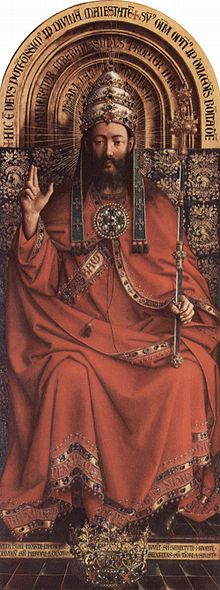
There are some rather good images of Christ the King, including the Van Eyck above, and indeed the rather more traditionally devotional image shown below (which I rather like).  However, we should not make the mistake of assuming that the feast is only about the time when the request expressed in the words of the Pater Noster "Thy kingdom come" have been fulfilled, even if Pope Paul VI's placing of the feast at the end of year points in that direction.


The feast is also about the ways in which Christ is already the Universal King.  In his Angelus address on the Feast of Christ the King in 2006, Pope Benedict XVI said that "The Cross is the 'throne' from which He demonstrated the sublime regality of God-love."  He went on to explain that Christ the King is not about human-style power, but about service and love, with the perfect example of acceptance of this being the life of the Virgin Mary. As a result of her fiat mihi, "God exalted her over all other creatures, and Christ crowned her Queen of heaven and earth."  

If you have trawled through the details of the right-hand sidebar of this blog, you might have spotted that the there is an embedded youtube video of Blessed John Henry Newman's Lead Kindly Light, sung by the late, great Irish tenor Frank Patterson.  Perhaps it is my Celtic blood, but I must confess a fondness for his performances of church music: so be warned, there will be more links in the future.  Frank Patterson was not only a talented tenor who sang for Popes and Presidents, but he was also a devout Catholic and indeed a Knight of Malta.  Having offered a brief prayer for the repose of his soul, we turn to his stirring performance of Hail Redeemer King Divine.


On a personal note, approaching the turn of the liturgical year gives pause for reflection.  This is not just in the way it always does, thinking of lost family and friends throughout the month of the Holy Souls, and of the Four Last Things in Advent, and indeed of the joy and hope to be brought by Christmas and a new year.  For members of all the Ordinariate groups, this is the end of the liturgical year in which we left our (yes we admit it) much loved Church of England in order to share, with much joy, the priority given by the Holy Father to Christ's fervent desire that all should be one.  Therefore, with sincere thanksgiving for our welcome in the Catholic Church through the Ordinariate, we also pause to pray for all those we have left behind in the Church of England, noting that we now for the first time enter a liturgical year without them. 

Coming from St Mary's Bourne St, the Feast of Christ the King is a particularly potent memory.  This was, and continues to be, marked in quite some style at St Mary's.  We send our friends there every good wish for tomorrow's event. 

For old time's sake, here is a photo taken from the organ gallery at St Mary's during the celebrations for Christ the King in 2009.  The author of this blogpost is acting as subdeacon, another member of Marylebone Ordinariate Group is on the far left at the altar rail, and it wouldn't surprise me if the third member of our group were also somewhere in the serving group. 

One Bourne St tradition at Christ the King that we can happily copy on this blog is the inclusion of the Hallelujah Chorus.  So, here it is.  A very happy Feast of the Christ the Universal King to you all, and please join your prayers with ours as we prepare to enter a new year.


Our Lady, pray for us, and may the souls of all the faithful departed rest in peace.