Showing posts with label Though the Streets of Heaven. Show all posts

Tuesday, 4 September 2012

The Marylebone Group's First Anniversary

We are now Catholics of one year's standing.  What a joy that is.  As mentioned in our previous post, One Year On, September 3rd, the Feast of St Gregory the Great, marks the first anniversary of the day when Monsignor Newton received the first three members of the Marylebone Ordinariate Group into the full communion of the Catholic Church.  We celebrated this happy anniversary in some style yesterday: due to work commitments, sadly one of our group couldn't be with us, but we did what we could to make the day as jolly as possible, notwithstanding his absence.

As well as having another favourable mention in the parish notes at St James's, and having Fr Christopher Pearson in attendance to concelebrate with Fr Colven, we were invited to prepare our own leaflet, to be distributed to all the congregation attending the 1030 Solemn Mass.  The production of the leaflet allowed us to share in the Ordinariate's ongoing task of explaining its purpose to our fellow Catholics.  Thanks are due to Fr Colven for offering us this opportunity. 


The leaflet also included the words and the melody of a hymn we have mentioned before, Though The Streets of Heaven, written for St Mary's Bourne St, our former home in our Anglican days.  To mark our first anniversary in full visible communion, the post-Mass hymn at St James's yesterday was that very Bourne St hymn, so typical of the heyday of Anglo-Catholicism, and so much a part of the patrimony we bring with us.  The same hymn had been sung at our reception one year earlier.   We have previously posted footage of Though The Streets of Heaven being sung at Bourne Street, here it is being sung at St James's yesterday.


My only regret is that, by inadvertently touching the wrong button at the wrong time, I stopped recording not only just as the congregation were getting to know and indeed to enjoy the hymn, but also before the organist dazzled us with his reharmonisation of the last verse.

Perhaps those readers who run parishes or ordinariate groups, or who are responsible for the music there, might consider introducing this great example of Anglican Patrimony into their regular repertoire.  Here are the words and music of Wilfred Knox's 1921 hymn: do download this and try to find an occasion to sing it.


The setting of the ordinary of the Mass was the Mozart Missa Brevis in C K257.  Having had the privilege of Viennese settings so often at Bourne Street (not that, in any way, we can easily call that an example of Anglican Patrimony), it was particularly pleasing that yesterday was a day when we were similarly blessed. 

We are happy below to include a few photos taken during yesterday's liturgy (better quality versions can be found on our Flickr photostream).  The photo of Fr Colven giving the homily shows not only a Crucifix and the image of the Sacred Heart, but also a large statue of St Peter.  In this context, Fr Colven's homily might perhaps have reminded us of one of the many Newman quotations that we have recently included on this blog.  The readings at Mass talked of the importance of looking beyond the externals of religiosity and ensuring that there is true faith, love and right belief underlying religious practice.  This is not to say that religious practice, religion, the Church are unimportant, far from it, but it is to say that they are part of a bigger picture.  Blessed John Henry Newman :
Look into the matter more steadily; it is very pleasant to decorate your chapels, oratories, and studies now, but you cannot be doing this for ever. It is pleasant to adopt a habit or a vestment; to use your office-book or your beads; but it is like feeding on flowers, unless you have that objective vision in your faith, and that satisfaction in your reason, of which devotional exercises and ecclesiastical appointment are the suitable expression. They will not last in the long run, unless commanded and rewarded on Divine authority; they cannot be made to rest on the influence of individuals. It is well to have rich architecture, curious works of art, and splendid vestments, when you have a present God; but, oh! what a mockery if you have not.
This and the other photos tell their own story, of faithful and respectful liturgy executed properly, in the full communion of the Catholic Church, in communion with the Successor of St Peter. 

After Mass, we continued our festivities with another example of Anglican Patrimony, a long lunch in honour of a special occasion.  Deo gratias, and, Deo volente, may there be many more anniversaries to be marked. 

 
Fr Colven gives the homily, under the splendid tester with its dove symbolising the Holy Spirit.  To the left of the photo, you see the statue of St Peter to which we referred above.

 
Offertory 1.

 
Offertory 2.

 
Offertory 3.

 
Offertory 4.


Consecration.


Hoc est enim corpus meum.
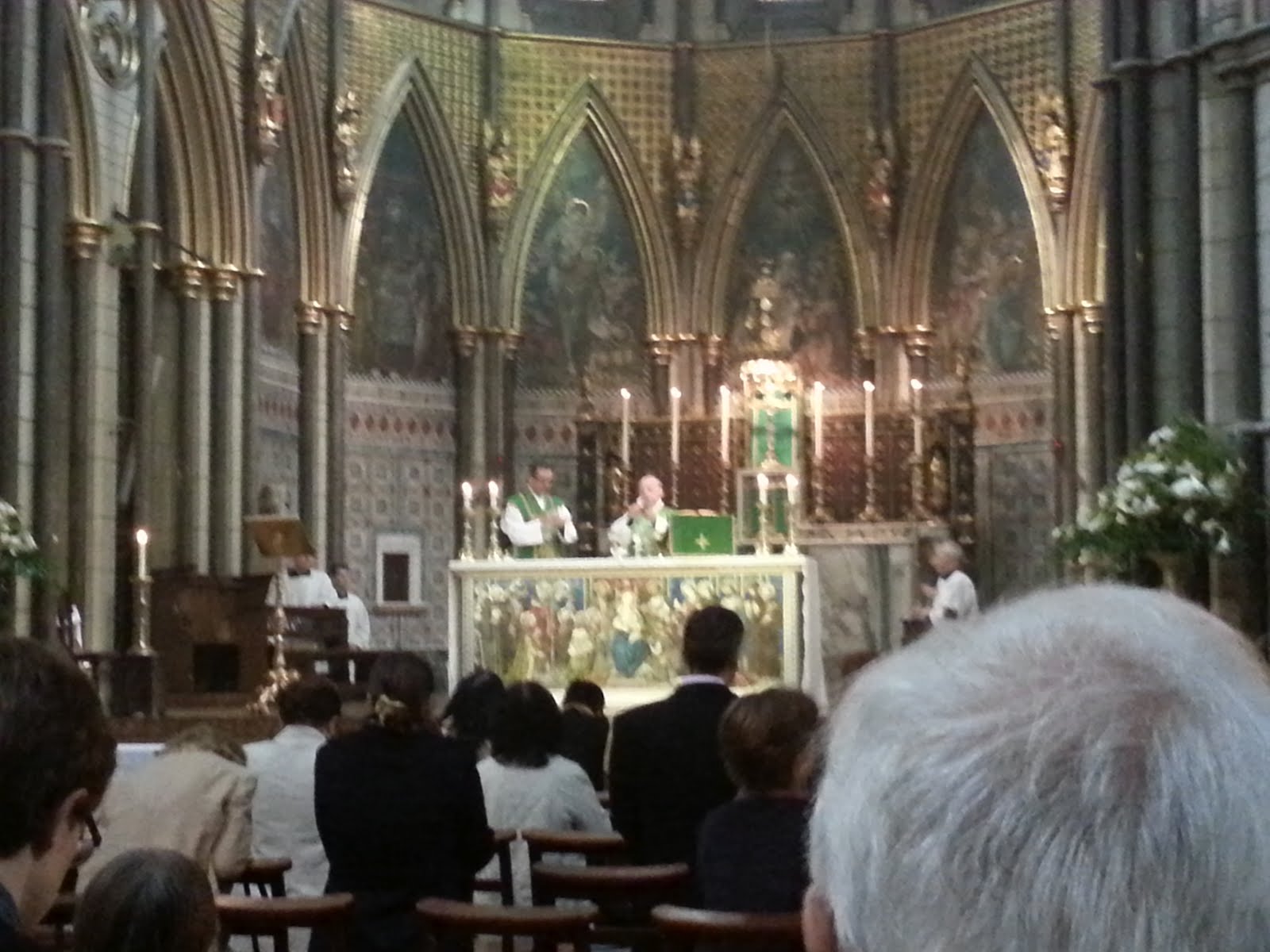

Ecce Agnus Dei.


The group sits down to a celebratory anniversary lunch with Fr Pearson and Fr Colven.


The group by the 1973 Gavin Stamp poster for St Mary's Bourne St,which includes the Martin Travers image of Our Lady holding St Mary's.

 
In the post A New Direction, we referred to prints of Pusey and Newman hanging side by side.  Here's the proof. 


Wednesday, 22 August 2012

Two-way Patrimony

Today's Marian feasts falling under the Ordinary Form and Extraordinary Form kalendars give an opportunity for reflection on a couple of hymns that have become Anglican Patrimony, as well as indirectly on an element of Anglican Patrimony that seems to have become more popular in the Church of England than it was.

Before all of that, a pair of images in honour of today's Ordinary Form feast, showing that even when we were Anglicans, the Coronation of Our Lady was very much part of our group's patrimony. First, the famous Velazquez painting of the Coronation of Our Lady by the Trinity, the second the image of the Coronation of Our Lady in Heaven that sits atop the glorious Martin Travers High Altar at St Mary's Bourne Street.


When, Deo volente, we reach September 3rd, the Feast of St Gregory the Great in the modern calendar and of St Pius X in the Extraordinary Form, we shall attain the joy of having been Catholics for a full year.

On Sunday September 2nd at St James's, we hope to mark this by singing as the post-Mass hymn at the 1030 Solemn Latin Mass Though The Streets of Heaven, a hymn written for St Mary's Bourne St (and very rarely sung anywhere else, as far as we know), the Anglican parish from which most of our Ordinariate group came.  The words are by Wilfred Knox (who was mentioned towards the end of our previous post), the music by Louis Parker. 

In the video below, you can hear the last verse and a half of this rare but beautiful hymn being sung upon the occasion of the Annual Dedication Festival of St Mary's Bourne St (we described the background to that service here).  Typical of the 1920s Anglo-Catholicism in which context it was written, it is a hymn to the Virgin in a mixture of English and Latin.  You will note from the video that this very much matches the Bourne St service, where a rite of Benediction is given in Latin, interspersed with English. 


Though the streets of Heaven,
Mary, thou dost tread,
Roses in thy bosom,
Stars about thy head;
Though before thy presence
Angels bow the knee,
Hear the supplication
Sinners make to thee.

Mater creatoris,
Domus aurea,
Mater salvatoris,
Caeli janua:
Meet it is thy praises
Every tongue should sound
Mary over all things
To all ages crowned.

In the heart of heaven
Perfect is thy rest;
Yet thou once didst wander,
Jesus on thy breast;
Poor, and scorned and helpless
Thou thy Son didst tend,
All who toil and suffer,
Mary Maid, befriend.

Mater creatoris...

Though with Christ thou dwellest
Evermore at one,
Yet thou once did seek him,
Sorrowing, thy Son;
Anxious hearts that tremble,
Heavy eyes that wake,
Into thy protection,
Mary, Mother, take.

Mater creatoris...

Midst the heavenly treasures
Happy though thou be,
Call to mind thy vigil
By the bitter Tree;
Mothers sorrow laden,
Widowed brides that weep,
By thy intercession,
Mary, Mother, keep.

Mater creatoris...

When upon our death-beds
Earthly comforts fade,
Mary, let thy presence
Keep us unafraid;
When the books are opened,
And the judgement set,
Mary, be our succour,
Pleading for us yet.

Mater creatoris...


The video contains what might even be an example of reverse Anglican patrimony (let's face it, apart from the use of great Anglican hymn tunes for O Salutaris and Tantum Ergo, there isn't much outwardly Anglican about the shape of the ritual seen in the video), in that the prayer before Tantum Ergo is the Book of Common Prayer's General Thanksgiving.  This is not something I ever recall happening in my Bourne St days, although it was certainly the usual practice in my time at Pusey House in the early 1990s.

Using this prayer during Benediction is something that has become a hallmark of practice in the Ordinariate, including at the Ordinariate's own Anniversary Evensong and Benediction at the beginning of this year.  Since some of our Bourne St friends attended that event, and indeed some of them perhaps read regularly of what is going in the Ordinariate, it is intriguing but definitely very pleasing to see this influence, adding to the Catholic influence that gave rise to the form of service in the first place.  After all, not only are we borrowing a Bourne St hymn and bringing it into the Catholic Church, we as former Anglicans have brought the classic Anglo-Catholic service of Solemn Evensong and Benediction into the Ordinariate, and as you can read in Fr Mark Woodruff's excellent description, what we have brought with us bears no little resemblance to what we had before, as we have already shown in photographic form in this post.

Another hymn that Anglo-Catholics have brought with them into the Ordinariate is the wonderful "Joy to thee, Queen, within thine ancient dowry".  It is a hymn that I have not had a chance to sing since long ago in my Anglican history, but I wonder if perhaps the occasion might arise during the Ordinariate's upcoming pilgrimage to Walsingham on the 15th September.


Here is its stirring tune from youtube, followed by its powerful words "Ladye of Walsingham, be as thou hast been - England’s Protectress, our Mother and our Queen!"


Joy to thee, Queen, within thine ancient dowry -
joy to thee, Queen, for once again thy fame
is noised abroad and spoken of in England
and thy lost children call upon thy name.
Ladye of Walsingham, be as thou hast been -
England’s Protectress, our Mother and our Queen!

In ages past, thy palmer-children sought thee
from near and far, a faith-enlightened throng,
bringing their gems, and gold and silver love-gifts
where tapers gleamed, where all was prayer and song.
Ladye of Walsingham, be as thou hast been -
England’s Protectress, our Mother and our Queen!

Countless the signs and wonders that men told there,
for not in vain did any pilgrim kneel
before thy throne to seek thy intercession
but thou didst bend to listen and to heal.
Ladye of Walsingham, be as thou hast been -
England’s Protectress, our Mother and our Queen!

The Martyrs’ blood, like heavenly seed, is scattered;
the harvest now is ripe for us to reap;
the Faith dishonoured now is held in honour;
O help thine own this precious gift to keep!
Ladye of Walsingham, be as thou hast been -
England’s Protectress, our Mother and our Queen!

Unto thy Son – unto our sweet Redeemer,
Source of our Hope, our Life, our Joy, once more
we bring the love and loyalty of England
and in his Sacrament we him adore.
Ladye of Walsingham, be as thou hast been -
England’s Protectress, our Mother and our Queen!

How wonderful, on this day when we celebrate the Coronation of Our Lady in Heaven, Our Lady as Queen of Heaven (or in the EF calendar, the Immaculate Heart of Mary), that we can talk of two examples of Anglican Patrimony that are hymns to the Virgin. The Bourne St hymn ties in nicely with the theme of the Immaculate Heart, while the Walsingham hymn is perfect for the modern feast, so associated with Pope Pius XII, whom we included on this blog in video format only a few days ago.