Wednesday, 20 February 2013

A humble labourer in the vineyard of the Lord

The reactions around the world to the imminent abdication of our Holy Father Pope Benedict have made interesting reading during the past week. Whilst there have been a variety of slants taken on why he has made this decision to retire into seclusion, there has been an overwhelming sense of shock and sadness, but also joy at what will inevitably be a great turning point defining the course of the Church for the next decade or more. We are grateful for the submission of the guest post below from the author of Beauty and the New Evangelisation, now in full communion with the Holy Father, who shares his thoughts on Pope Benedict's papacy and resignation.


I was just shy of fifteen when the Holy Father was elected in 2005, and growing up in a strongly Anglo-Catholic environment, the events around the funeral of Blessed John Paul II and the election of Joseph Cardinal Ratzinger fell conveniently within a family holiday to Rome. I was there on the night that Blessed John Paul II died, and flew back shortly before the funeral. At the time, my interest in the Papacy was limited to niche historical oddities, I was more focused on the characters than the office itself. Pope Benedict XVI has been the Supreme Pontiff of the Universal Church during my entire formative years, so it is natural that he’s had such an affect on me: if I’d turned fifteen in the late 1990s, Blessed John Paul II’s pontificate, particularly his heroic witness to the value and integrity of human life from birth to natural death, would have no doubt had the same affect.


The most profound part of my Christian journey has been worked out during the reign of Benedict XVI, and to say that his personal holiness and theology was a key part of my eventual conversion would not be over stating the matter.  But the key, for me, to his pontificate was not necessarily any of the large gestures, such as the Ordinariate, or the major theological works, like Jesus of Nazareth, it was the theological underpinnings of his focus on, and attachment to, Christ that made all of this possible.  Without the Holy Father’s focus on the identity of Christ, and his belief that human beings set apart from Christ cannot be understood as complete, his pontificate would not have been marked by so many extraordinary events.


To produce any kind of complete account of the Holy Father’s academic output is simply beyond this short article, but the two of most importance for me, personally, are his understandings of ecclesiology and the liturgy, and more broadly within the areas of politics and philosophy, his attacks on relativism and immoral political and economic systems.  In terms of his reform of the liturgy, his primary focus has been very simply on the beautiful: the beauty of the Church’s teachings are mirrored throughout every aspect of her life, including the liturgy.  Whilst some of his reforms have received a bad reception in some parts of the Church, these reactions seem not to gain a full sense of what these reforms have sought to bring about.  In a Church which is still trying to receive and understand the teachings of the Second Vatican Council, an attempt to enrich both forms of the Roman Rite can only be a good thing, and to more closely define the Council as a continuation with the past, not a break away from the old.


Clearly, as a former Anglican, our Holy Father's understandings of ecclesiology have been immensely important.  A clear line runs through his thought, particularly from Dominus Iesus, which defined more exactly the relationship between the Church and ecclesial communities, to Anglicanorum Coetibus, which created a specific structure to allow members of the Anglican Communion to become Catholics.  In this part of his work, the Holy Father has tried, and succeeded, in creating something tangible which goes beyond the long series of discussions which have run and run since the Second Vatican Council.  In many ways, as one person put it, he called everyone’s bluff by offering the most generous provision which was within the Church’s gift.


But underpinning all of this is the Holy Father’s focus on Christ which creates within his theology a humanism which is not simply founded on Christian principles, but which has Christ at the very centre.  He took on the concept that humanity could ever be understood as complete without being focused and centred on Christ.  He challenged the tendency of secularism and liberalism to paint humanity as beyond salvation; something which these two ideologies achieve by either portraying humanity as not needing, or as being beyond the hope of salvation.  The tendency of liberal Christianity to create a view of the human which everyone can agree on, with Christian doctrines simply being added on the end, is not acceptable to Benedict XVI. Indeed, in his analysis of Gaudium et Spes, the then Ratzinger asked, “why exactly the reasonable and perfectly free human being” described by the document “should suddenly be burdened with the story of Christ.” Without Christ, for the Holy Father, there is no proper humanity, because our whole nature and being have been so much changed by Christ.


And it is this that undergirds all of the Holy Father’s time as Supreme Pontiff.  All of humanity is called to centre their life on Christ, a call which he has lived out through his resignation.  And it was the reign of this Christ centred man who ultimately taught me the importance of the Catholic Faith and of being in communion with the Holy See.  This focus on Christ leads to the Holy Father’s teaching of the beauty of Christian unity, of the Church as the Universal Sacrament of Salvation, of the beauty of a prayerful celebration of the Liturgy of the Church, and that all hope is futile, unless it is hope in our Saviour’s Resurrection.

Wednesday, 13 February 2013

Let us change our garments for ashes and sackcloth

Today the Marylebone Ordinariate Group marked the beginning of Lent in the usual way by attending the Holy Sacrifice at St. James's, Spanish Place at which we received the ashes of repentance to begin the Christian war of defence with holy fasts, protected with the help of self-denial.


As ever, the choir assisted in our devotions as we enter into this great season of preparation for the coming passion, death, and resurrection of the Lord over the Triduum Sacrum. An appropriately sombre yet powerful choice of singing both propers and ordinary of the Mass to the historic chant of the Church, recalling the penance of our brethren from former generations, with whom as Catholics we now share communion.


There is something most comforting that as we approach these great forty days we are surrounded by that great crowd of witnesses who for centuries marked this most solemn day with the same notes of humility, assonant with ages of lament for our shortcomings.


Yet as our minds turn from the Lord's nativity to His revelation as servant and sacrifice, we cannot but continue to ponder our Holy Father's momentous decision just days ago to abdicate the throne of Peter and instead enter his own wilderness of constant supplications for the Church for the remainder of his days. This example of prayer, modelled on Christ's own example, is a timely reminder that our hope is founded not on one man, but the Man, God from God, Light from Light, the Eternal High Priest.


Fr Irwin called us to a deeper devotion to prayer, fasting, and almsgiving in his homily, charging us to grow closer to the Lord in spirit, and to put first things first, that is our eternal salvation in Christ, and last things last, the cares of the world and the Devil. Our prayer then, at this time of piety and fasting, recalls those great words of our Anglican Patrimony, beloved by our Holy Father and now reconciled to the Church of the Apostles.

Here might I stay and sing,
No story so divine;
Never was love, dear King!
Never was grief like Thine.
This is my Friend, in Whose sweet praise
I all my days could gladly spend.


Tuesday, 12 February 2013

Et portæ inferi non prævalebunt adversus eam

Pope Benedict XVI has truly been our Pope.


We looked in from outside for years, but then his were the arms outstretched to welcome us into the embrace of our Holy Mother Church. His was the brilliant iniative that cut through the plethora of mealy-mouthed verbiage and foggy thinking that has characterized so much ecumenical activity in recent decades. His was the vision that found a way to make us see what was right and to allow us to bring so much of what has been good about Anglicanism with us. His was the reign in which we were at last united, by the Power of the Divine Will, into One Fold and under One Shepherd.

How better to remember him than with the footage of his arrival and departure from Mass at Westminster Cathedral. That day, as recounted before on these pages, was crucial in the process of our becoming Catholics.

Amidst the splendour of Westminster Cathedral, behind a procession of cardinals, archbishops, bishops, priests, deacons, and seminarians, and to the accompaniment of James Macmillan’s splendid Tu es Petrus, there arrived the humble figure of a shy, smiling old man: full of love for the Almighty, and full of love for all of God’s creation, even this very Kingdom.

After the Mass, and after he had met with crowds of youngsters at the West Door, Pope Benedict processed out to Bruckner’s Ecce Sacerdos Magnus. Again, amidst the brilliance of the eight-part polyphonic singing and the sounding brass, there was that same gentle figure : who can fail to be moved by the smiles at the word Deo, as the soaring tenors sound out amidst the fortissimo chord, just as the procession reached the Shrine of St David.


Even if we feel sorrow at his departure from the Chair of St Peter, we give thanks to Almighty God for all that this Servant of the Servants of God has achieved, not only for us, among the least deserving of God’s children, but for all the Church and for all mankind.

We ask God’s blessing upon Pope Benedict, and in gratitude, faith and trust, call to mind these words of Our Lord.

Thou art Peter, and upon this rock I will build my church; and the gates of hell will not prevail against it.


A letter that we have come across from an FSSP priest in France sums up well the feelings of the Marylebone Ordinariate Group, and provides sound words for this extraordinary time.

Dear faithful, it falls upon us to live the upcoming days with hope. What if we trusted the Holy Spirit? True, it will be necessary that we wait, for some weeks, to view it in all its tones: as in 2005, we will hear the assembly of "experts" explain to us one more time that the Church must change, that the faith must change, that morals must change. Some will expect the election of a "modern" pope, "living according to his time", wearing a white suit and dark glasses and proposing the marriage of priests, opening the priesthood to women, favoring the remarriage of divorcees, and blessing the sacrosanct condom. We will hear, as usual, on television sets, before excited and obliging journalists, the priest who is outside the system, the defrocked one who wants to go back into service, the parishioner who is allergic to all things that recall the Church of the past, and, why not, some trendy exegetes or theologians who explain to us that everyone has been mistaken for two thousand years.


What matters, my dear friends, is to think that, after some inevitable disturbances, the Church will have a new leader, and that he will have the graces that are needed to accomplish his mission, just as his predecessor did.

He will know, as those who were before him on the chair of Peter, that nobody cares about an adulterated truth, and that the "evolutions" desired by some will fill neither our churches, nor our seminaries.

May the Lent that will begin this week move us to offer our prayers and our sacrifices for our Church, so that her future head will impart to us the love of truth and will guide us to heaven!


Tuesday, 5 February 2013

Till we have built Jerusalem in England's green and pleasant land

On this day it is time, more so than ever before, to get down on our knees, make reparation, and urgently plead for the intercession of Our Lady, Help of Christians, to restore her Dowry to its former grace and glory.


Be not angry, O Lord,
and remember our iniquity no more.
Behold, we are all your people.

Your holy city has become a wilderness.
Zion has become a wilderness,
Jerusalem has been made desolate.

Ora pro nobis peccatoribus, nunc, et in hora mortis nostrae

Sunday, 3 February 2013

Fulfilling all righteousness


The Feast of Candlemas gave even greater cause for celebration this year than simply marking the conclusion of the Christmas cycle. Mr Harry Smith recovered the communion first enjoyed at his baptism when he was received by Fr James Bradley into Holy Mother Church. Harry has regularly worshipped with the Marylebone Ordinariate Group since first expressing his desire to return to the one true fold and pleasingly strengthens the contingent of those formerly connected to Pusey House now united in communion with Peter. We give thanks for his journey into the Church and pray that he may continue to deepen his love for Christ and His Church.

Below we include the homily from Candlemas along with a number of photographs taken of the liturgy.


"Our Saviour was born without sin. His mother, the Blessed Virgin Mary, need have made no offering, as requiring no purification. On the contrary, it was that very birth of the Son of God which sanctifies the whole race of woman, and turned her curse into a blessing. Nevertheless, as Christ himself was minded to ‘fulfil all righteousness’ (Mt 3:13), to obey all ordinances of the covenant under which he was born, so in like manner his Mother Mary submitted to the Law, in order to do it reverence."

These words of our patron, Blessed John Henry Newman, remind us of two points which we might usefully consider as we come to this feast today. First, we are here because of the obedience of Our Blessed Lady, both in her acceptance of the will of God in her fiat, her ‘yes’ to the Lord’s will at the annunciation, and in her obedience to the Law, laid down in the Book of Exodus and Leviticus: ‘Consecrate to me all the first-born’ (Ex. 13: 1).


Secondly, we are here because the Lord himself - although, as Newman says, he was ‘requiring no purification’ - nonetheless submits himself to the Law with humility, out of love for his heavenly Father and for those - for us! - he came to redeem. God became Man, but as if that is not enough, he submits himself to the Law prescribed for those who are in need of the very thing which he embodies.

These two traits, which are in actual fact personified in Our Lady and Our Lord - that is obedience and humility - are central not only to our understanding of this great and glorious feast of the Church’s year, but the entire Christian life, which summons us to grow in likeness of Christ through the example he gives us in himself and in the saints.


Harry: in some profound way you are embodying these traits today as you come in humble obedience to Holy Mother Church and ask for the grace to persevere in a deepening relation with the Lord. In full communion with the Church, you are placing no obstacles between yourself and God’s favour, allowing him to do what he desires above all things, to prepare you for eternal life in the glory of the heavenly Jerusalem.

When we come to the Lord in this way - by reception into the Church, and in our ongoing and continual reconciliation with the Church through the Sacrament of Confession - we open ourselves unconditionally to God’s love, in order that he might convert our hearts and our lives in an ever-more profound way, and draw us more closely to him. We should expect this to be a great joy, but also a great challenge to our human inclination to err, and so it is only with the grace which we receive in the sacraments - and particularly in the Holy Eucharist - that we can ever hope to succeed.


And if all this seems a daunting task, we should remember that the humility shown us in Christ is not an aspect of Our Lord’s divine nature, but his human nature. As St Thomas Aquinas reminds us, ‘Humility cannot befit God, who has no superior’. Christ accepted humility, and obeyed the Law as we must, and through his humanity: he shows us the way to perfect our lives. In him we are presented not only with the fullness of life in God - what we hope one day to attain in heaven - but also the fullness of human existence, which is humble before the Lord in all things, even to the point of death, death on a cross (cf. Phill. 2).


Harry: let the humility and obedience of Christ and his blessed Mother be yours today. And recognise, too, the example you are offering, to us who rejoice with you in the Church, and to those who long to do so. Let your whole life take on a new ardour and purpose - letting the bright light of Christ radiate through you, so that he may draw all men together in one, that the world may believe. 

The liturgical theologian, Romano Guardini, once said, “As one candle is lit from the flame of another, so is faith kindled by faith”. Use the grace which the Lord offers to you in abundance in your new life fully united to him, not only to grow in grace and virtue, perfecting each day the very essence of your person, but in order to bring others to the gladdening light of his pure glory. 


As the light of the Candlemas flame has been passed to you, and as the guaranteed fullness of God’s grace is passed to you in communion with the apostles, allow that flame of faith to consume your life entirely - as a holocaust, a wholly consumed offering to the Lord - that he may (through you) bring others into the life we share with him, and bring you into a closer and more profound union with him, that one day we may see face-to-face the salvation prepared for all people, the glory of Israel, even Christ the Lord. Amen.


Tuesday, 29 January 2013

By the Grace of God brought to the knowledge of the Truth


Those of us who have had the privilege of being received into the Catholic Church understand full well that it was only through the enlightenment of divine grace that we were brought to embrace, and to be embraced by, holy Mother Church. No matter how long we spent praying and debating with ourselves and with others about taking, what seemed to us at the time, such a momentous step we could do nothing of ourselves without that grace.


There were those who thought that the disarray in the Church of England and the generosity shown by the Holy Father in Anglicanorum Coetibus would result in a stampede of disaffected Anglo Catholics clamouring to be received into the Catholic Church. That was never to be, for it is not in the noise and the fury of a stampede that one opens one’s heart in peaceful submission to the work of the Spirit. Rather there is a quiet and gentle flow of those experiencing (and open to) the operation of divine grace. So let us not be impatient with those we have left behind but be steadfast in praying that our separated brethren may be united with us to the Chief Shepherd in the One True Fold.


We have written before about the immense joy experienced at our restoration to communion and union with the faithful and to the holy sacraments of the Church and it is a joy we relive whenever we attend the reception of a new convert. On Candlemas a new member of the Marylebone Ordinariate Group, Harry Smith, will be received into holy Mother Church and on Saturday, the Feast of St Polycarp, members of our Group witnessed the reception of Alex Robertson, like Harry another former resident of Pusey House, by Fr Nicholas Edmonds-Smith Cong. Orat. in the stark beauty of the Priory Church at Blackfriars, Oxford. The Rite, and the Missa Cantata that followed, was in the Extraordinary Form with its ringing Statement of Faith by the convert.


I, born outside the Catholic Church, have held and believed errors contrary to her teaching. Now, enlightened by divine grace, I kneel before you, Reverend Father having before my eyes and touching with my hand the holy Gospels. And with firm faith I believe and profess each and all the articles contained in the Apostles' Creed, that is: I believe in God, the Father almighty, Creator of heaven and earth; and in Jesus Christ, His only Son, our Lord, who was conceived by the Holy Spirit, born of the Virgin Mary, suffered under Pontius Pilate, was crucified, died, and was buried; He descended into hell, the third day He arose again from the dead; He ascended into heaven, and sits at the right hand of God, the Father almighty, from there He shall come to judge the living and the dead. I believe in the Holy Spirit; the holy Catholic Church; the communion of saints; the forgiveness of sins; the resurrection of the body, and life everlasting. Amen.


I firmly admit and embrace the apostolic and ecclesiastical traditions and all the other constitutions and ordinances of the Church.


I admit the Sacred Scriptures in the sense which has been held and is still held by holy Mother Church, whose duty it is to judge the true sense and interpretation of Sacred Scripture, and I shall never accept or interpret them in a sense contrary to the unanimous consent of the fathers.


I profess that the sacraments of the New Law are truly and precisely seven in number, instituted for the salvation of mankind, though all are not necessary for each individual: baptism, confirmation, holy Eucharist, penance, anointing of the sick, holy orders, and matrimony. I profess that all confer grace, and that baptism, confirmation, and holy orders cannot be repeated without sacrilege. I also accept and admit the ritual of the Catholic Church in the solemn administration of all the aforementioned sacraments.


I accept and hold in each and every part all that has been defined and declared by the Sacred Council of Trent concerning original sin and justification. I profess that in the Mass there is offered to God a true, real, and propitiatory sacrifice for the living and the dead; that in the holy sacrament of the Eucharist the body and blood together with the soul and divinity of our Lord Jesus Christ is really, truly, and substantially present, and that there takes place in the Mass what the Church calls transubstantiation, which is the change of all the substance of bread into the body of Christ and of all substance of wine into His blood. I confess also that in receiving under either of these species one receives Jesus Christ whole and entire.

I firmly hold that Purgatory exists and that the souls detained there can be helped by the prayers of the faithful.

Likewise I hold that the saints, who reign with Jesus Christ, should be venerated and invoked, that they offer prayers to God for us, and that their relics are to be venerated.


I firmly profess that the images of Jesus Christ and of the Mother of God, ever a Virgin, as well as of all the saints should be given due honour and veneration. I also affirm that Jesus Christ left to the Church the faculty to grant indulgences, and that their use is most salutary to the Christian people. I recognize the holy, Roman, Catholic, and apostolic Church as the mother and teacher of all the churches, and I promise and swear true obedience to the Roman Pontiff, successor of St. Peter, the prince of the apostles and vicar of Jesus Christ.


Moreover, without hesitation I accept and profess all that has been handed down, defined, and declared by the sacred canons and by the general councils, especially by the Sacred Council of Trent and by the Vatican General Council, and in special manner all that concerns the primacy and infallibility of the Roman Pontiff. At the same time I condemn and reprove all that the Church has condemned and reproved. This same Catholic faith, outside of which none can be saved, I now freely profess and I truly adhere to it. With the help of God, I promise and swear to maintain and profess this faith entirely, inviolately, and with firm constancy until the last breath of life. And I shall strive, as far as possible, that this same faith shall be held, taught, and publicly professed by all who depend on me and over whom I shall have charge.


Deo gratias.


Monday, 28 January 2013

Spot the difference (ie. original title)


At this address, there was previously a post the focus of which was misinterpreted by some and therefore, in its misinterpretation, caused some concern to some others. Our intention was not to open a discussion on orders, as any longstanding readers of this 'blog would have known.  That’s not something we have ever done, it is not our place to do so being mere subjects of Christ's Church, holding in veneration her teachings as His own.  Rather, our intention was to make a cheeky remark upon noticing the increasing prevalence of clerical scarlet in Anglican quarters: in substance, we were stealing a line often spoken by Anglo Catholics themselves when they tease Anglicans who would describe themselves as Affirming Catholics, being that a focus on vesture is “salvation by haberdashery alone”.

It was an in joke, but it was misunderstood and it has thus upset one or two friends as a result. We stand by what the post really said, but not by how it could be misinterpreted.

Sunday, 13 January 2013

Prophet, Priest, and King supreme


From today's pewsheet at St. James's:


The Rector writes...

The effect of the sacrament of Baptism is twofold - cleansing from original sin, that bias towards self which has tainted human nature since its original Fall, and the opening up to the life of grace, through which the Holy Spirit indwells the soul, and speaks to the heart in a language deeper than words. All this is achieved through the agency of water, that most basic of all the elements which make up the created order. We cannot reflect on the BAPTISM of JESUS without drawing parallels with our own initiation at the font - but there is a fundamental difference between what Jesus accepted at the hands of John, and the baptism which is crucial to the salvation of the rest of the human race.

The Baptist’s ministry was a call to repentance: “get ready, change your lifestyle, the Messiah is very close”. As a sign of that necessary conversion, John baptised with water, the washing away of past sin. But Jesus did not need this baptism - he had no sin to be washed away - he was the Message itself, not the medium. So why does Jesus come to the River Jordan? St Matthew has John say: “It is I who need baptism from you, and yet you come to me”, and Jesus responding somewhat ambiguously: "Leave it like this for the time being. It is fitting that we should, in this way, do all that righteousness demands”.

Over and over again we need to remind ourselves that the Incarnation is God’s act of total self-abasement. “It is fitting”. He lays his glory aside and, in a Trinitarian action, the Son - through the activity of the Spirit - assumes a humanity which is then offered to the Father in an obedience of love which re-connects the creation to its Creator. That this is the acceptable offering is evidenced by the Father’s intervention as Jesus prays after his Baptism - the heavens open, the Spirit is seen to descend, and the moment is interpreted by the Father’s voice: “You are my Son, the Beloved, my favour rests on you”.

So why is Jesus baptised? St Cyril of Alexandria writing in the 5th century takes up a theme which is common to many of the early Christian writers in seeing that Christ goes into the water not for his own needs but for ours. “The Only-begotten receives the Holy Spirit not for himself (for the Spirit is his, and is given in him, and through him) but because he was made man he had the whole nature in himself, that he might renew and restore its integrity”. Christ, the Second Adam, comes to reverse all that had led to alienation between God and those he has made in his own image and likeness. In his Baptism, Jesus begins that work of re-constitution which means that you and I are capable of communion with the living Father. Made by God, made for God, our individual calling is to holiness of life, to that righteousness which is described by St Paul in his Letter to Titus: "He did this so that we should be justified by his grace, to become heirs looking forward to inheriting eternal life”.

The challenge, of course, is whether we do really want to lead a Christian life and to allow the Spirit to sanctify us. I suspect that for you, as for me, when we come face to face with God our many sins and failures will not so much be those of commission, but of omission. In the final judgement, we are called to be saints: that is our shared vocation. But is that what we really want? Is that the goal of our lives, “the pearl without price”? In our heart of hearts is that what we are truly striving towards? And if not, why not?

Christopher Colven


Saturday, 5 January 2013

Press Release from the Friends of the Ordinariate

PRESS RELEASE
 
For Immediate Release : 3 January 2013
 
A Special Ephipany Celebration in Chelsea

Friends, supporters and members of the Personal Ordinariate of Our Lady of Walsingham are gathering next Thursday (10 January) at St Mary’s Church in Cadogan Street, London, for an Epiphany Service intended as a true expression of the Holy Father’s vision of allowing the traditions and heritage of Anglicanism a place in the Catholic Church.

The Ordinary, Monsignor Keith Newton, will preside and music will be provided by the well-known Schola Cantorum of the Cardinal Vaughan Memorial School. Readers will include His Grace the Duke of Norfolk, the Catholic journalist Peter Stanford and the novelist Piers Paul Read. The service – part of a wider campaign by the Friends of the Ordinariate charity to raise awareness and funds for the Ordinariate – follows yesterday (Wednesday)’s announcement from the Most Reverend the Archbishop of Westminster Vincent Nichols that the historic church of Our Lady of the Assumption and Saint Gregory in Warwick Street, Soho, is to be handed over to the Ordinariate next month.

The chairman of the Friends, Peter Sefton-Williams, said: “The New Year has got off to a wonderful start for the Ordinariate and all those who want to see it grow and flourish as the Holy Father intended. First we had the announcement that the Precious Blood Church near London Bridge in Borough is to be made available to the Ordinariate. Now Archbishop Nichols has also generously designated Warwick Street as an Ordinariate church. These churches will give real focus and direction for the great spiritual energy within the Ordinariate.

Next Thursday’s service at St. Mary’s Cadogan Street, which begins at 7pm, will include Epiphany carols as well as readings taken from scripture and from Anglican authors. It will conclude with Pontifical Solemn Benediction. Admission is free but there will be a collection for the Friends of the Ordinariate. “We hope that as many people as possible, both Catholics and Anglicans, will come to celebrate with us and see this showcase of the Ordinariate”, said Peter Sefton-Williams.

Later in January, at the invitation of the Apostolic Nuncio, His Excellency the Most Reverend Antonio Mennini, the Friends will hold a fund-raising reception at the Apostolic Nunciature in Wimbledon. They are also organising a programme of visits from Ordinariate clergy to Catholic parishes to inform congregations about the Ordinariate and to appeal for funds. The Ordinariate of Our Lady of Walsingham has to provide financial support for its clergy, many of whom are married with families. It also needs funds for the training of priests and the upkeep and beautifying of the church buildings which are now entrusted to it.

Friends of the Ordinariate of Our Lady of Walsingham.


Tuesday, 1 January 2013

Corde natus ex parentis

The Marylebone Ordinariate Group began this new year of grace by attending Solemn Mass celebrated this lunchtime at St. James' Spanish Place in the Extraordinary Form of the Roman Rite.  Needless to say the liturgy was executed with precision and elegance, supplemented sublimely by wonderful music from the choir. We find it difficult to imagine a better way of welcoming in the new secular year than Mozart's Coronation Mass, Palestrina's O Magnum Mysterium, and a rousing offering of Widor's Toccata from his Fifth Organ Symphony.

Introibo ad altare Dei

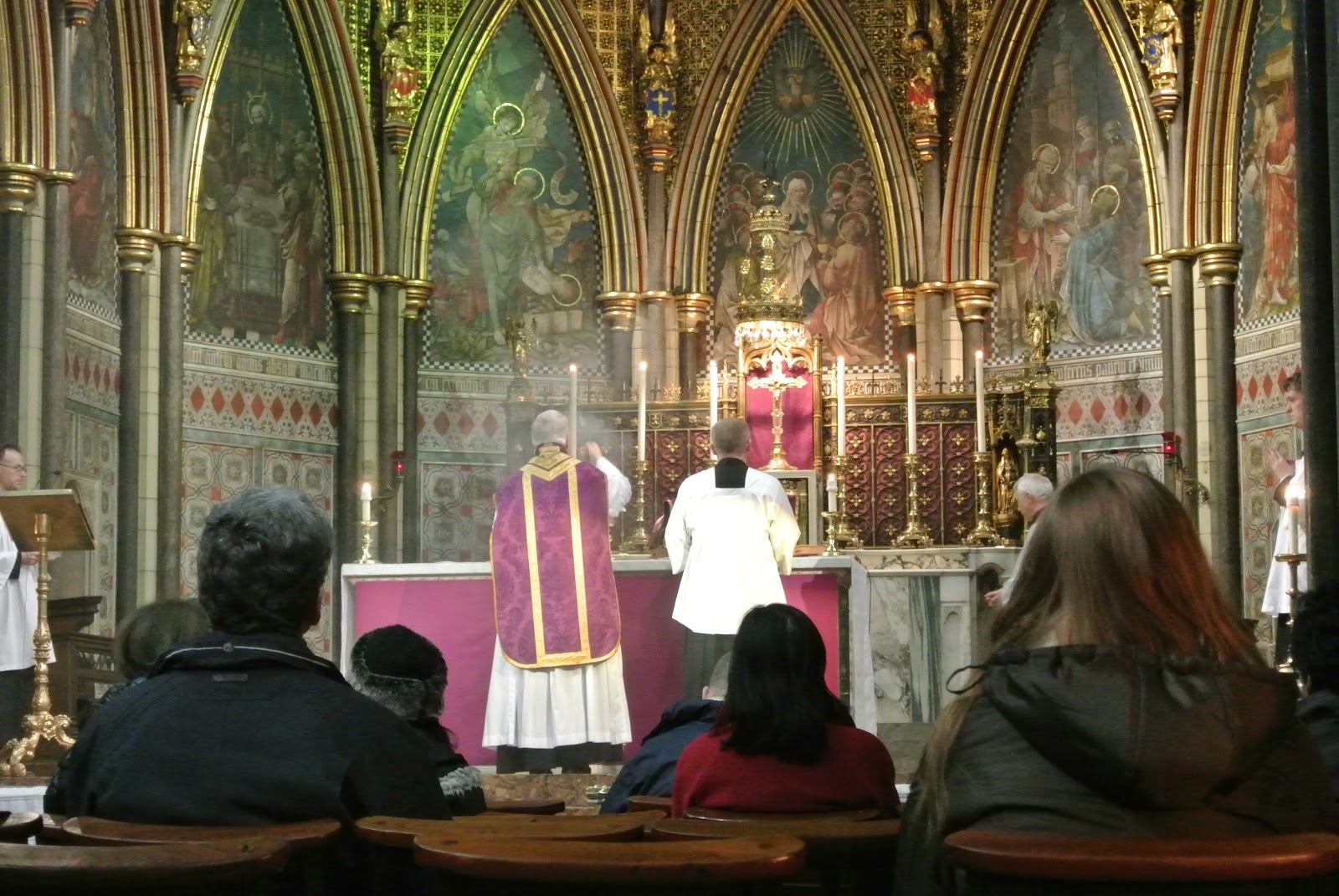
Fr Irwin (like us, and like the other clergy at St James's, a former Anglican) celebrated the Mass with the usual stately dignity, and can be seen below incensing the altar during the offertory.


We are privileged as Catholics to have a great treasure trove of grace stored up in the Church dispensed by the Pope as wielder of the Keys of the Kingdom. One example of such an indulgence may be attained today by participating in the public recitation of the Veni Creator Spiritus. Naturally, this devotion began today's liturgy.

Anoint and cheer our soiled face...

The Recessional Hymn at the conclusion of Mass, Of the Father's Heart Begotten, is a favourite of ours, and indeed sings of a great outpouring of joy and praise at the birth of the Lord so appropriate this Octave Day of His Nativity. We include below the translation found in the English Hymnal so worthy of meditation in their own right.

Of the Father’s heart begotten
Ere the world from chaos rose,
He is Alpha: from that Fountain,
All that is and hath been flows;
He is Omega, of all things
Yet to come the mystic Close,
Evermore and evermore.

By his word was all created;
He commanded and ’twas done;
Earth and sky and boundless ocean,
Universe of three in one,
All that sees the moon’s soft radiance,
All that breathes beneath the sun,
Evermore and evermore.

He assumed this mortal body,
Frail and feeble, doomed to die,
That the race from dust created
Might not perish utterly,
Which the dreadful Law had sentenced
In the depths of hell to lie,
Evermore and evermore.

O how blest that wondrous birthday,
When the Maid the curse retrieved,
Brought to birth mankind’s salvation,
By the Holy Ghost conceived,
And the Babe, the world’s Redeemer,
In her loving arms received,
Evermore and evermore.

This is he, whom seer and sybil
Sang in ages long gone by;
This is he of old revealed
In the page of prophecy;
Lo! he comes, the promised Saviour;
Let the world his praises cry!
Evermore and evermore.

Sing, ye heights of heaven, his praises;
Angels and Archangels, sing!
Wheresoe’er ye be, ye faithful,
Let your joyous anthems ring,
Every tongue his name confessing,
Countless voices answering,
Evermore and evermore.

Hail! thou Judge of souls departed;
Hail! of all the living King!
On the Father's right hand throned,
Through his courts thy praises ring,
Till at lest for all offences
Righteous judgement thou shalt bring,
Evermore and evermore.

Now let old and young uniting
Chant to thee harmonious lays
Maid and matron hymn thy glory,
Infant lips their anthem raise,
Boys and girls together singing
With pure heart their song of praise,
Evermore and evermore.

Let the storm and summer sunshine,
Gliding stream and sounding shore,
Sea and forest, frost and zephyr,
Day and night their Lord alone;
Let creation join to laud thee
Through the ages evermore,
Evermore and evermore. Amen.


Ite, missa est